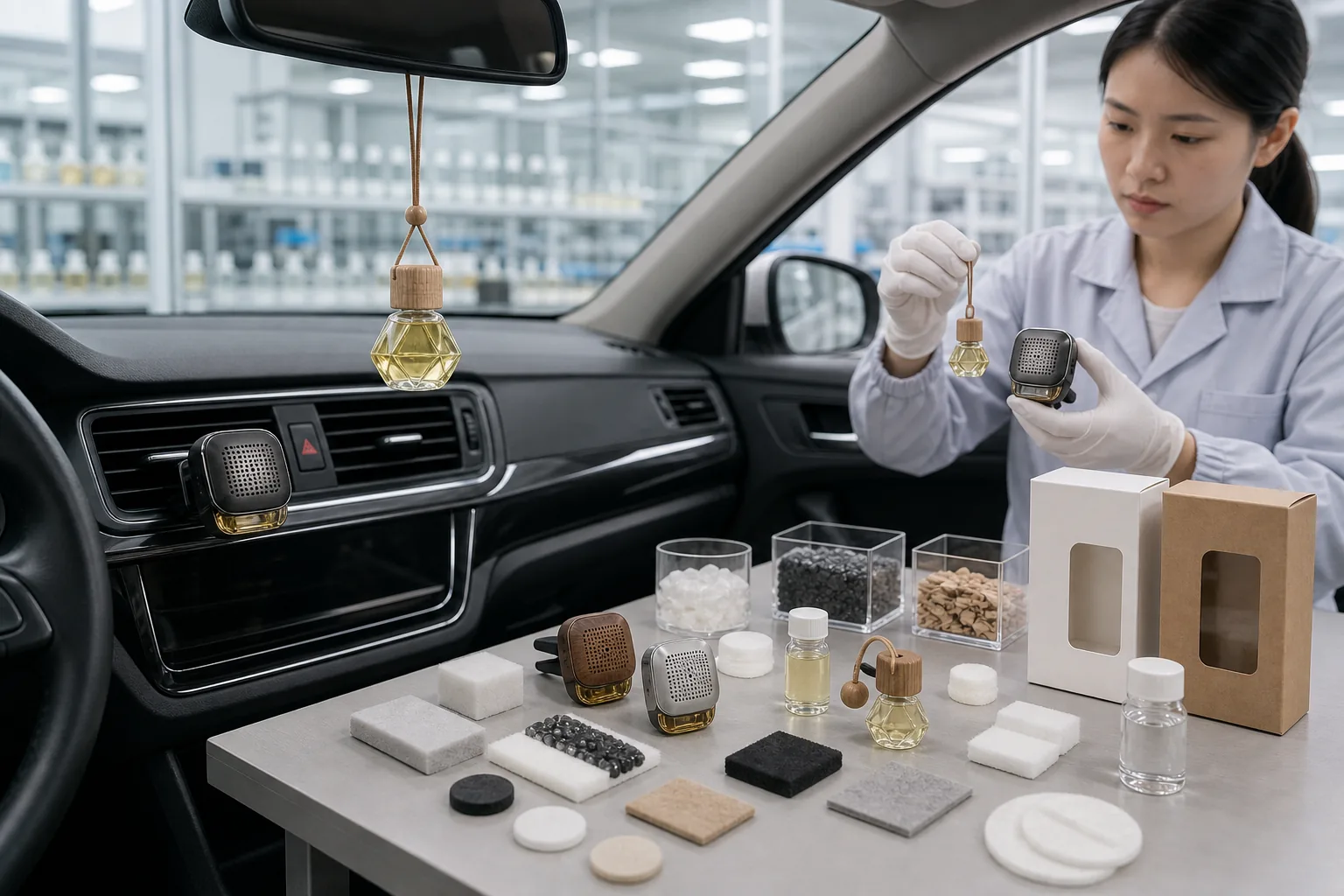
Car vent diffusers and hanging car air fresheners can both support private label car-fragrance programs, but they create different product-development questions. The decision affects where the fragrance product sits inside the vehicle, how airflow interacts with it, which materials need to be tested, how the consumer handles it, and how the finished item should be packaged.
Quick answer: In a car vent diffuser vs hanging car air freshener comparison, choose the vent format when the product concept depends on mounting at the air vent and interaction with vent airflow. Choose a hanging format when the concept prioritizes a visible suspended product and fragrance release that is less directly controlled by the ventilation outlet. Neither format should be selected on appearance alone: define the use scene, test the finished system, and approve the fragrance carrier, structure, packaging, and hot-environment behavior together.
Car vent diffuser vs hanging car air freshener is primarily a use-scene decision. A vent diffuser is positioned at an HVAC vent and can be influenced directly by airflow, while a hanging format is suspended elsewhere in the cabin and depends more on its material, exposed area, location, cabin conditions, and product construction.
Format Selection Snapshot
For private label buyers, the main differences are:
- Vent interaction: A vent diffuser sits directly in the airflow path; a hanging format normally does not.
- Product structure: Vent products require a mounting system as part of the finished product, while hanging formats require a suitable suspension method.
- Temperature exposure: Both formats can experience elevated vehicle temperatures, so fragrance carrier and material stability should be tested for the intended use.
- Consumer interaction: Vent diffusers involve installation onto a vent; hanging products involve choosing a suitable hanging position.
- Packaging: The clip or mounting part of a vent product and the cord, string, or hanging structure of a hanging product both need protection during packing and transport.
- Approval: Do not approve only the fragrance. Approve the assembled product, carrier, functional components, decoration, individual packaging, and instructions where applicable.
What Is the Main Difference Between a Car Vent Diffuser and a Hanging Car Air Freshener?
The main difference is where the fragrance product is positioned and how the surrounding air reaches it.
A car vent diffuser is designed to attach to an air-conditioning or ventilation outlet. Its fragrance experience can therefore change depending on vent airflow, vent temperature, ventilation settings, fragrance carrier, exposed fragrance area, and product construction.
A hanging car air freshener is suspended from an appropriate location inside the cabin. Depending on the product design, it may use paper, EVA or another fragrance-bearing structure, but its scent release is not directly driven by an HVAC vent in the same way.
This creates a useful sourcing rule:
Choose the format before optimizing fragrance intensity, because the use position is part of the fragrance-delivery system.
A fragrance system that performs as expected in one format should not automatically be assumed to perform identically in the other.
When Is a Car Vent Diffuser the More Suitable Private Label Format?
A car vent diffuser is a logical candidate when the brand concept specifically calls for a compact product installed at the vehicle's ventilation outlet.
For private label development, the buyer should evaluate both the fragrance portion and the mechanical mounting system.
Define the vent-diffuser use scene
Before sampling, specify:
- Which type of vehicle vent the product is intended to fit.
- How the consumer is expected to install and remove it.
- Whether the fragrance carrier is replaceable or integrated into the product.
- Which surfaces or components contain fragrance material.
- How the product is expected to behave with ventilation operating and not operating.
- Whether warm or cool airflow should be included in the product evaluation.
The clip should not be treated as an accessory added after fragrance approval. It is part of the finished system.
A technically useful sample therefore includes the actual mounting structure, fragrance carrier, housing where applicable, decoration, and intended packaging.
Buyers developing this type of product can review the available custom car air freshener manufacturing formats before preparing a private label specification.
When Does a Hanging Car Air Freshener Make More Sense?
A hanging format is suitable when the product concept depends on a suspended fragrance item rather than attachment to an air vent.
This can give the buyer more freedom in visible shape, printed presentation, color, material concept, or decorative positioning, depending on the selected construction. However, greater visual flexibility does not remove the need for technical testing.
The buyer still needs to define:
- hanging material or carrier;
- product dimensions;
- fragrance system;
- hanging cord or attachment structure;
- printed or decorated surface;
- individual packaging;
- retail packaging;
- intended hanging position;
- environmental conditions used for evaluation.
A hanging product should also be evaluated as an assembled product. A fragrance carrier tested flat on a laboratory table does not automatically represent how the finished product behaves when hanging inside a vehicle.
Car Vent Diffuser vs Hanging Car Air Freshener: Which Specifications Differ?
The comparison becomes clearer when buyers convert the format decision into a specification sheet.
| Buyer decision | Car vent diffuser | Hanging car air freshener |
|---|---|---|
| Installation | Mounted to a vehicle vent | Suspended from an appropriate cabin position |
| Airflow relationship | Directly influenced by vent airflow | More dependent on general cabin air movement and product exposure |
| Functional component | Vent clip or mounting structure | Cord, string, loop, or other hanging structure |
| Fragrance carrier | Depends on selected product construction | Depends on selected product construction |
| Key mechanical check | Mounting fit and assembled stability | Hanging connection and assembled stability |
| Important environmental variable | Vent airflow plus cabin temperature | Cabin temperature, product position, and surrounding airflow |
| Shape flexibility | May be influenced by housing and vent mounting | Often less constrained by a vent-mounted housing, depending on construction |
| Packaging focus | Protect mounting components and fragrance system | Protect product surface, fragrance system, and hanging component |
| Approval reference | Finished assembled vent product | Finished assembled hanging product |
The table describes development differences rather than universal performance rankings.
A vent diffuser is not automatically stronger, and a hanging format is not automatically longer-lasting. Both outcomes depend on the actual fragrance system, materials, exposed area, airflow, temperature, packaging, and use conditions.
How Does Airflow Affect the Format Decision?
Airflow should be treated as a controlled product-development variable rather than a marketing assumption.
A vent-mounted fragrance product is positioned where ventilation settings can directly change the air moving around the fragrance carrier. A hanging product normally experiences more indirect cabin airflow, although its exact position still matters.
When comparing samples, avoid testing one product with strong ventilation and another in a stationary cabin and then treating the result as a pure format comparison.
Instead, define the evaluation conditions.
For example:
- ventilation off;
- agreed low or moderate airflow condition;
- agreed warm-air condition where relevant;
- agreed cool-air condition where relevant;
- parked-cabin comparison;
- consistent evaluation intervals.
The exact protocol depends on the product. What matters is recording enough information to understand what the comparison actually demonstrates.
Why Is High-Temperature Testing Important for Car Fragrance Products?
Vehicle-use fragrance projects need additional attention to temperature because elevated temperatures can affect fragrance release and material stability.
This is especially important when the fragrance is incorporated into a polymer, carrier, adhesive, printed surface, housing, or another material whose behavior may change under heat. High fragrance loading and high-temperature use can also create different material and scent-release behavior, so the selected formulation and finished construction should be tested rather than assumed to be suitable.
Before approving, inspect the finished sample for relevant changes such as:
- visible deformation;
- softening or dimensional change;
- surface tackiness;
- fragrance or oil migration;
- discoloration;
- decoration changes;
- adhesive changes;
- cracking;
- component loosening;
- changes in the fragrance experience.
Do not convert one elevated-temperature result into a universal performance claim. Record the temperature, duration, sample construction, packaging status, and observed result.
How Should Buyers Compare Fragrance Performance Between the Two Formats?
Use the same fragrance reference where technically appropriate, then compare the complete product under defined conditions.
The purpose is not necessarily to determine which format produces "more fragrance." The more useful question is whether each format delivers an acceptable fragrance experience for its intended position and construction.
A practical comparison route
- Define the fragrance reference.
Use an identifiable fragrance version or physical reference.
- Define the carrier and loading specification.
Record the variables relevant to each construction.
- Define the use position.
Test the vent product at the vent and the hanging product in its intended hanging scene.
- Define airflow and temperature conditions.
Avoid uncontrolled comparisons.
- Evaluate at agreed intervals.
Record fragrance character and perceived intensity separately from physical-product observations.
- Retain the samples.
Keep the approved reference for later production comparison.
A physical fragrance reference and product-compatibility testing are generally more useful during development than relying on a written scent description alone.
Should the Two Formats Use the Same Packaging?
Not necessarily. Packaging should be selected for the actual finished construction.
A car vent diffuser may contain a housing, clip, fragrance insert, or multiple assembled components that need to remain positioned correctly. A hanging product may require protection of printed surfaces, fragrance-bearing material, and the hanging element.
The buyer should define the complete packaging sequence, which may include:
- Finished fragrance product.
- Protective or fragrance-retaining individual package.
- Insert or holder where required.
- Usage information where applicable.
- Retail carton, card, pouch, or other sales packaging.
- Inner packing.
- Transport carton.
Test the finished system rather than approving an attractive retail box before checking how the actual fragranced product behaves inside it.
Packaging is part of fragrance performance control because the unopened product and the opened product operate under different exposure conditions.
How Should Unopened Stability and After-Opening Scent Experience Be Tested?
They should be evaluated as two separate stages.
Unopened package stability
This asks whether the packaged product remains acceptable under the agreed storage and evaluation conditions before consumer opening.
Depending on the project, buyers may inspect:
- package integrity;
- fragrance migration;
- oil marks;
- component condition;
- print and decoration;
- fragrance character after opening;
- physical changes to the carrier or housing.
After-opening scent experience
This asks what happens after the package is opened and the product is placed in its intended use position.
For a vent diffuser, ventilation settings can become an important variable. For a hanging product, placement, exposed area, cabin airflow, and temperature may matter.
Do not combine these into one universal "scent lasts X days" specification without project-specific evidence.
What Should Buyers Approve Before Mass Production?
Approve the version that will actually define production.
A final approval record should identify, where applicable:
- product format;
- fragrance reference;
- fragrance carrier;
- carrier dimensions;
- fragrance-loading specification;
- housing or outer structure;
- vent clip or hanging component;
- material and finish;
- product color;
- logo and decoration;
- artwork revision;
- individual packaging;
- retail packaging;
- agreed environmental test version;
- approved physical sample.
Retain the approved reference.
If the manufacturer later proposes another carrier material, fragrance level, clip design, hanging cord, housing material, packaging film, adhesive, artwork, or other critical specification, the existing approval does not automatically validate the later variation.
Review the changed version again where appropriate.
What Claims and Documents Should Private Label Buyers Review?
Document requirements depend on the fragrance mixture, product construction, target market, packaging, and the buyer's role in the supply chain.
LoyalCrafts can support product-level information such as International Fragrance Association (IFRA) documentation, Safety Data Sheet or SDS/MSDS information, allergen information, specifications, formula or safety data, and export documentation where applicable. Final market requirements still need to be confirmed for the specific product and destination.
For products containing mixtures placed on the European Union market, buyers should determine whether requirements under the Classification, Labelling and Packaging Regulation (CLP Regulation) apply to the actual mixture. The European Chemicals Agency explains that hazardous substances and mixtures subject to CLP must carry the required hazard communication before being placed on the EU market. European Chemicals Agency: CLP labelling and packaging.
Where a hazardous mixture is within the scope of Annex VIII to CLP, the European Chemicals Agency also explains that a Unique Formula Identifier (UFI) connects the product with the mixture composition submitted for poison-centre purposes. A composition change can therefore require regulatory review rather than being treated simply as a fragrance-production adjustment. European Chemicals Agency: UFI requirements.
Final EU labelling, UFI/Poison Centre Notification requirements, importer responsibilities, and other market obligations should be reviewed separately for the actual product.
What Is the Recommended Approval Route?
Use the format decision as the beginning of development, not the final decision.
Step 1: Define the consumer use scene
State where the fragrance will be positioned inside the vehicle and how the consumer is expected to install or hang it.
Step 2: Select the product format
Choose vent-mounted or hanging based on the intended user experience, product structure, and branding direction.
Step 3: Develop the fragrance and carrier together
Do not approve fragrance without considering the material or carrier through which it will be presented.
Step 4: Build the finished sample
Include the actual mounting or hanging components, decoration, and packaging where possible.
Step 5: Test the finished system
Evaluate use position, airflow where relevant, elevated temperature, physical stability, packaging, and fragrance experience under the agreed conditions.
Step 6: Review market documents
Confirm which information and regulatory review are required for the destination market and actual formula.
Step 7: Retain the approved reference
Keep the final sample, fragrance revision, specification, packaging reference, and artwork version.
Step 8: Review later changes again
A material, fragrance, component, or packaging change should trigger another review when it can affect the approved product.
Private Label Car Air Freshener Buyer Checklist
Before approving either format, confirm:
- The intended vehicle use scene is defined.
- Vent-mounted versus hanging format has been selected for a technical reason, not appearance alone.
- The fragrance reference is identifiable.
- The fragrance carrier and relevant specification are defined.
- The vent clip or hanging component is included in the approval sample.
- The finished product has been evaluated in its intended position.
- Airflow conditions are defined where relevant.
- Elevated-temperature behavior has been reviewed under agreed conditions.
- Materials have been checked for visible changes and fragrance interaction.
- Individual packaging has been tested with the fragranced product inside.
- Unopened stability and after-opening scent experience are treated separately.
- Decoration and artwork versions are recorded.
- Destination-market documentation requirements have been reviewed.
- The final approved reference will be retained.
- Changed materials or specifications will be reviewed again where necessary.
Preparing a Private Label Car Fragrance Project
LoyalCrafts focuses on finished fragrance products and OEM/private-label development, including car-fragrance products. A customized project can involve fragrance selection, material and carrier matching, packaging development, sampling, and mass production.
For a useful technical discussion, prepare the intended format, vehicle use scene, fragrance direction, approximate dimensions, carrier preference, branding concept, packaging requirements, target market, and the questions the sample must answer. Buyers with a defined project can submit a technical inquiry for a custom car fragrance project.
Sources
- European Chemicals Agency — CLP Labelling and Packaging — official guidance on hazard communication and packaging requirements under the European Union Classification, Labelling and Packaging Regulation.
- European Chemicals Agency — Generate and Apply the UFI — official guidance explaining the relationship between Unique Formula Identifiers, mixture compositions, labels, and poison-centre notifications.
FAQs
Is a car vent diffuser stronger than a hanging car air freshener?
Not automatically. A vent product is directly influenced by ventilation airflow, while a hanging product depends more on its carrier, exposed area, position, cabin airflow, temperature, and construction. Fragrance intensity should therefore be compared under defined conditions rather than assumed from the product format alone.
Which format is better for a premium private label car fragrance?
Either can support premium positioning if the product construction, materials, fragrance, decoration, and packaging match the brand concept. A vent diffuser may suit a compact functional product, while a hanging format may provide more visible design space. Buyers should choose according to use scene and test results rather than perceived format hierarchy.
Do car vent diffusers need high-temperature testing?
Car-use fragrance products should be evaluated for the intended thermal environment because temperature can affect fragrance release and material stability. The relevant sample should include the actual fragrance carrier, housing or structure, functional components, and materials. Test conditions and acceptance criteria should be agreed before approving the production version.
Can the same fragrance formula be used in both formats?
Possibly, but it should not be assumed without testing. The carrier, exposed area, airflow, material compatibility, and product construction differ between formats and can change the fragrance experience. If the same fragrance reference is proposed for both products, evaluate each finished system separately before approving it.
Should car air freshener packaging be tested with the fragrance already inside?
Yes. The useful approval sample is the finished fragranced system because fragrance-containing materials can interact differently with packaging than empty components. Review the product, individual package, printed decoration, inserts, and retail packaging together where relevant, and retain the approved version as the production reference.
How should buyers choose between a vent diffuser and hanging format for a new project?
Start by defining where the consumer should place the product, how airflow should interact with it, what visual role it has in the cabin, and what construction the brand wants to develop. Then sample both formats if necessary and compare the finished systems under agreed temperature, airflow, packaging, and fragrance-evaluation conditions.
Summary
The car vent diffuser vs hanging car air freshener decision should be based on the intended use scene, not simply appearance or an assumed fragrance advantage.
A vent diffuser interacts directly with the vehicle's ventilation system and requires the mounting structure to be part of product approval. A hanging air freshener uses a different placement and suspension system, so its carrier, exposed area, hanging component, and cabin conditions become important variables.
For either format, define the fragrance and carrier together, test the finished system, evaluate elevated-temperature conditions, separate unopened stability from after-opening scent experience, retain the approved reference, and review the changed version again whenever an important material, fragrance, component, or packaging specification changes.