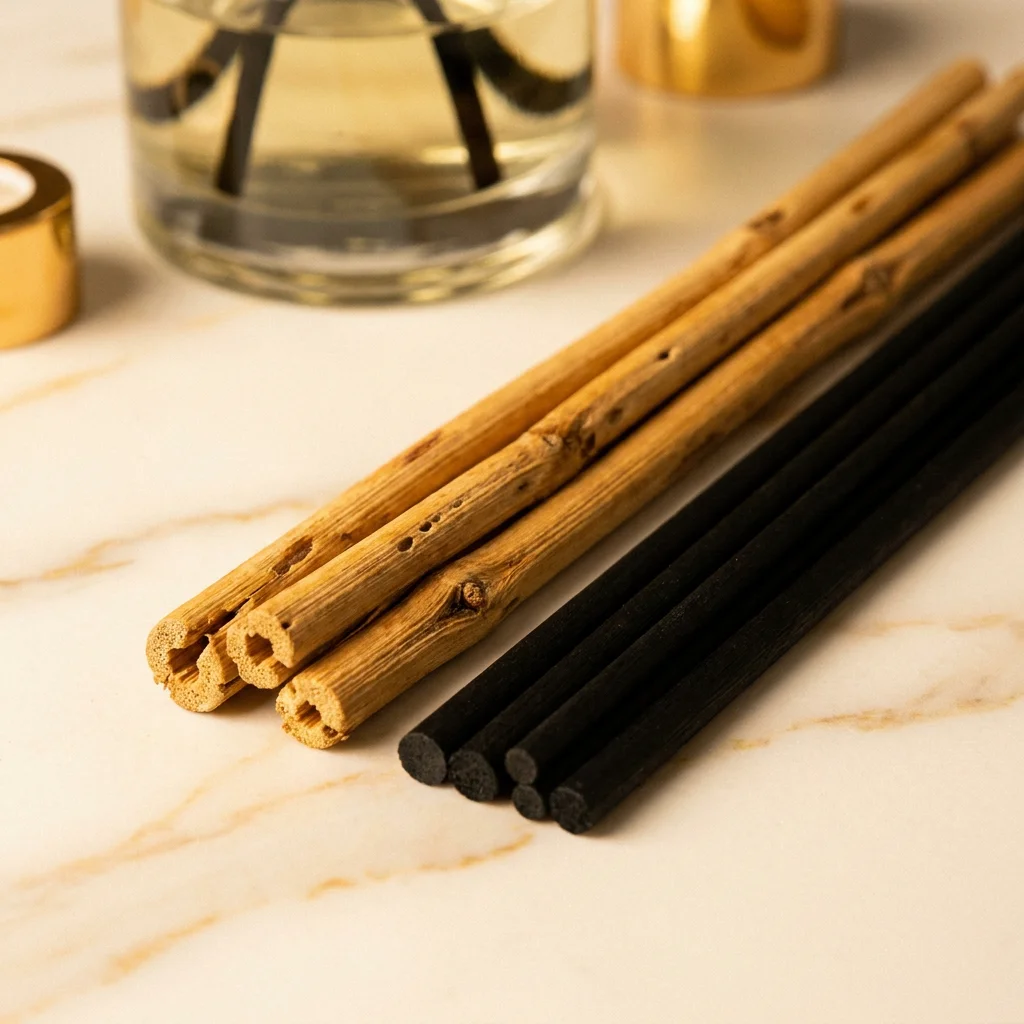
Compare fiber vs. rattan diffuser sticks for your home fragrance brand. Learn about scent throw, pore density, and why engineered fiber is the superior wholesale choice for longevity.
1. Introduction: The Invisible Engine of Reed Diffuser Performance
In the luxury home fragrance market, the "juice"—the fragrance oil—often receives the most attention. Brands spend months perfecting top notes and ensuring IFRA compliance. However, for a B2B buyer or a product development manager, the most critical component for consumer satisfaction isn't just the scent itself, but the delivery mechanism.
The choice between fiber vs. rattan diffuser sticks is the difference between a product that lasts three months with a consistent throw and one that fails after three weeks due to "clogging." As a leading reed diffuser manufacturer in China, LoyalCrafts understands that the performance of your brand depends on the technical synergy between the oil's viscosity and the stick's capillary action.
In this comprehensive guide, we analyze the engineering behind both natural rattan and synthetic fiber sticks to help wholesale buyers make data-driven decisions for their product lines.
2. Rattan Sticks: The Traditional Natural Choice
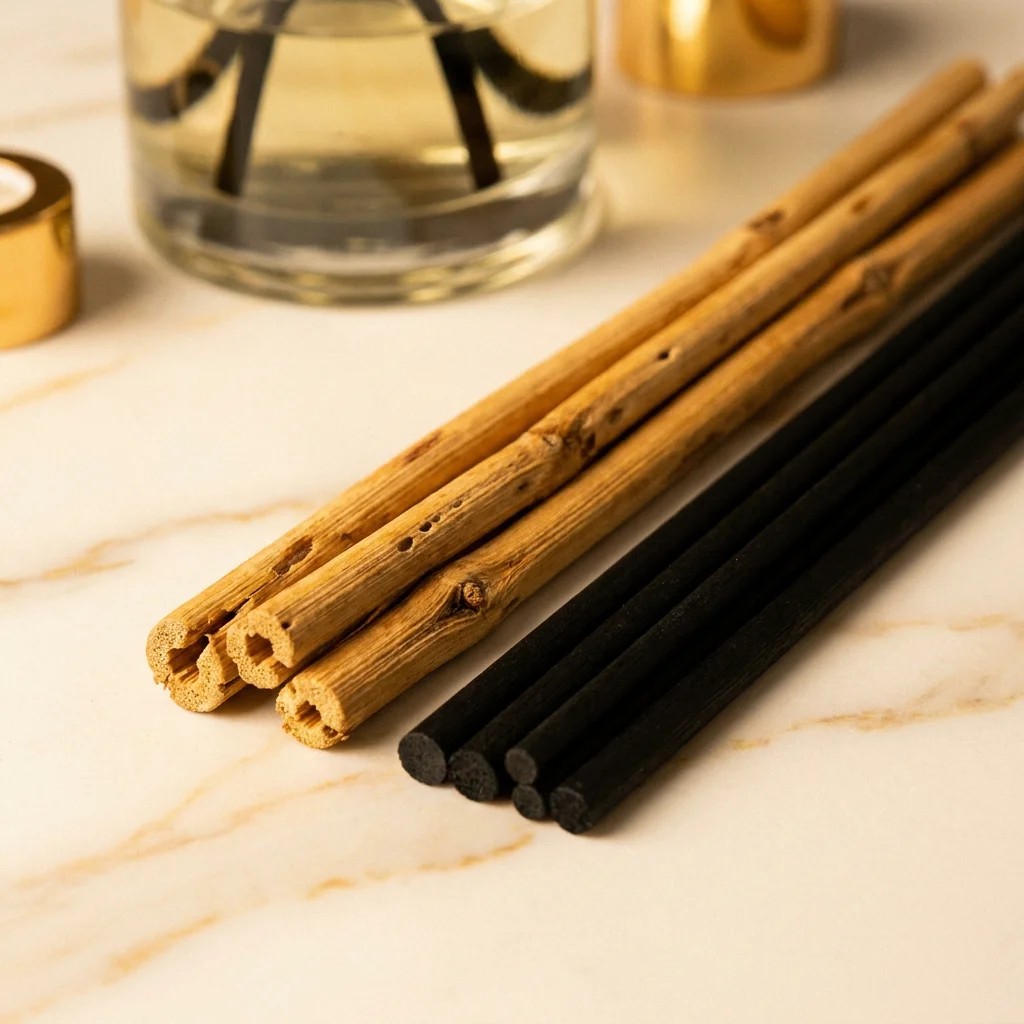
For decades, rattan (a climbing palm native to tropical regions) has been the industry standard. Its internal structure consists of dozens of tiny vertical "tubes" or vessels that draw liquid upward via capillary action.
The Pros of Rattan
- Natural Aesthetic: For brands positioning themselves as "eco-friendly," "all-natural," or "boho-chic," rattan’s organic, slightly irregular appearance is a key selling point.
- Cost-Effective for Entry-Level: In high-volume wholesale reed diffuser supplies, rattan is often the most accessible price point for budget-conscious lines.
The Cons and Technical Challenges
- The "Clogging" Issue: Because rattan is a natural plant material, its vessels can vary in size. Furthermore, natural oils and heavier fragrance molecules can eventually clog these vessels, stopping the scent throw entirely.
- Inconsistent Performance: No two rattan sticks are identical. This variance can lead to "dead sticks" in a consumer's diffuser, damaging brand trust.
- Maintenance Intensity: Rattan sticks usually require "flipping" once a week to refresh the scent, which many modern consumers find inconvenient.
3. Fiber Sticks: The Engineered Solution for Modern Fragrance
As the fragrance industry moves toward more complex, alcohol-free, or high-viscosity formulations, the demand for fiber diffuser sticks wholesale has skyrocketed. These are not just "synthetic sticks"; they are precision-engineered polyester or cotton-based filaments designed specifically for diffusion.
The Pros of Engineered Fiber
- Uniform Pore Density: Unlike rattan, fiber sticks are manufactured with a fixed number of micro-pores. This ensures a 100% consistent wicking rate across every single stick in a batch.
- Superior Scent Throw: Fiber sticks tend to "fill the room" faster. Because the material is highly porous, the evaporation surface area is maximized.
- No Clogging: High-quality fiber is resistant to the "gumming" effect caused by heavier base oils.
- Aesthetic Versatility: Fiber can be dyed in vibrant blacks, grays, or even custom brand colors without bleeding into the fragrance oil.
The Cons
- Higher Initial Cost: On a per-unit basis, high-density fiber sticks carry a premium compared to low-grade rattan.
- Synthetic Perception: While highly effective, brands focused strictly on "100% plant-based" claims may find the polyester composition a hurdle in their marketing narrative.
4. Head-to-Head Comparison: Performance Metrics
When selecting the best diffuser sticks for reed diffusers, B2B buyers must weigh four primary metrics:
| Metric | Rattan Sticks | Fiber Sticks |
|---|---|---|
| Initial Scent Throw | Slower (requires 24-48 hours) | Rapid (often within 1-2 hours) |
| Longevity | Medium (risk of vessel clogging) | High (consistent until oil is gone) |
| Maintenance | High (must flip weekly) | Low (no flipping required) |
| Color Stability | Natural only (dyes may bleed) | Excellent (colorfast engineering) |
| Best Used With | Alcohol-based, thin liquids | Oil-based, high-viscosity liquids |
Scent Throw: Instant vs. Steady
Fiber sticks provide an "instant gratification" experience for the consumer. Rattan, while steady, often requires the user to flip the sticks immediately upon first use to jumpstart the capillary action. For luxury brands, the "instant" scent of fiber is often preferred for a premium "unboxing" experience.
5. Technical Deep Dive: Why Pore Size Matters in B2B
From a manufacturing perspective at Jinhua Loyal Crafts, we view a diffuser stick as a micro-fluidic device. The physics of diffusion is governed by Poiseuille's Law, which relates flow rate to the radius of the pores.
In natural rattan, the "pores" are actually vascular bundles of varying diameters. If the diameter is too wide, the oil evaporates too quickly; if too narrow, the oil never reaches the top.
Engineered fiber allows us to control the "tortuosity" of the path. By manipulating the density of the polyester filaments, we create a network of interconnected channels that prevent air bubbles from stripping the capillary tension. This is why Loyal Crafts utilizes high-density (HD) fiber—to ensure that even the heaviest "Oudh" or "Sandalwood" molecules can travel vertically without resistance.
6. How to Choose for Your Brand: Matching Stick to Viscosity
A common mistake in the wholesale reed diffuser supplies market is pairing the wrong stick with a specific oil base.
- Alcohol-Based Formulations (Traditional): If your fragrance uses a high percentage of ethanol, rattan performs well. The alcohol reduces the surface tension, allowing the oil to move easily through natural vessels.
- DPM/TPM or Glycol-Based (Modern): These eco-friendly bases are much thicker. For these, fiber sticks are non-negotiable. Rattan will likely clog within 14 days, leading to customer complaints that "the diffuser isn't working."
- High Fragrance Load (20%+): If you are marketing a "Luxury Intense" diffuser, the high oil concentration requires the high-performance wicking of fiber to maintain the scent profile.

7. Manufacturing Quality: The Loyal Crafts Edge
At Jinhua Loyal Crafts, we don't just source sticks; we engineer them. As a reed diffuser manufacturer in China with a background in "medical-grade" filling and precision industrial production, our approach to diffuser components is rooted in science.
Why Choose Our Fiber Sticks?
- High-Density Filaments: We use a proprietary heat-setting process that ensures our fiber sticks do not "soften" or bend over time, even in high-humidity environments.
- Color-Lock Technology: Our black and charcoal fiber sticks are guaranteed not to discolor your fragrance oil—a common issue with inferior wholesale supplies.
- Customization: We offer diameters from 2mm to 10mm and custom lengths to fit any vessel geometry, ensuring optimal "headspace" for scent evaporation.
Our facility is certified under ISO 9001 and BRCGS, reflecting our commitment to the same standards used in high-end perfumery and pharmaceutical production. We bridge the gap between "craft" and "industrial scale."
8. Conclusion: The Strategic Path Forward
Choosing between rattan vs fiber diffuser sticks isn't just a matter of price—it's a matter of brand strategy.
- If your brand is built on Natural/Organic pillars, high-grade, sorted rattan is your best path.
- If your brand is built on Performance, Luxury, and Consistency, engineered fiber is the superior choice.
Don't let a $0.10 component ruin a $50.00 retail product. As your strategic partner, Loyal Crafts provides the technical documentation (MSDS, COA) and the manufacturing precision needed to scale your fragrance brand globally.
Ready to elevate your product line?
Request a Sample Kit & Wholesale Pricing Today
Learn more about our medical-grade manufacturing standards or explore our full reed diffuser portfolio.
Get in Touch with Jinhua Loyal Crafts Co., Ltd.
Submit a sourcing inquiry and our export team will respond within 24 hours.
Request a Quote →