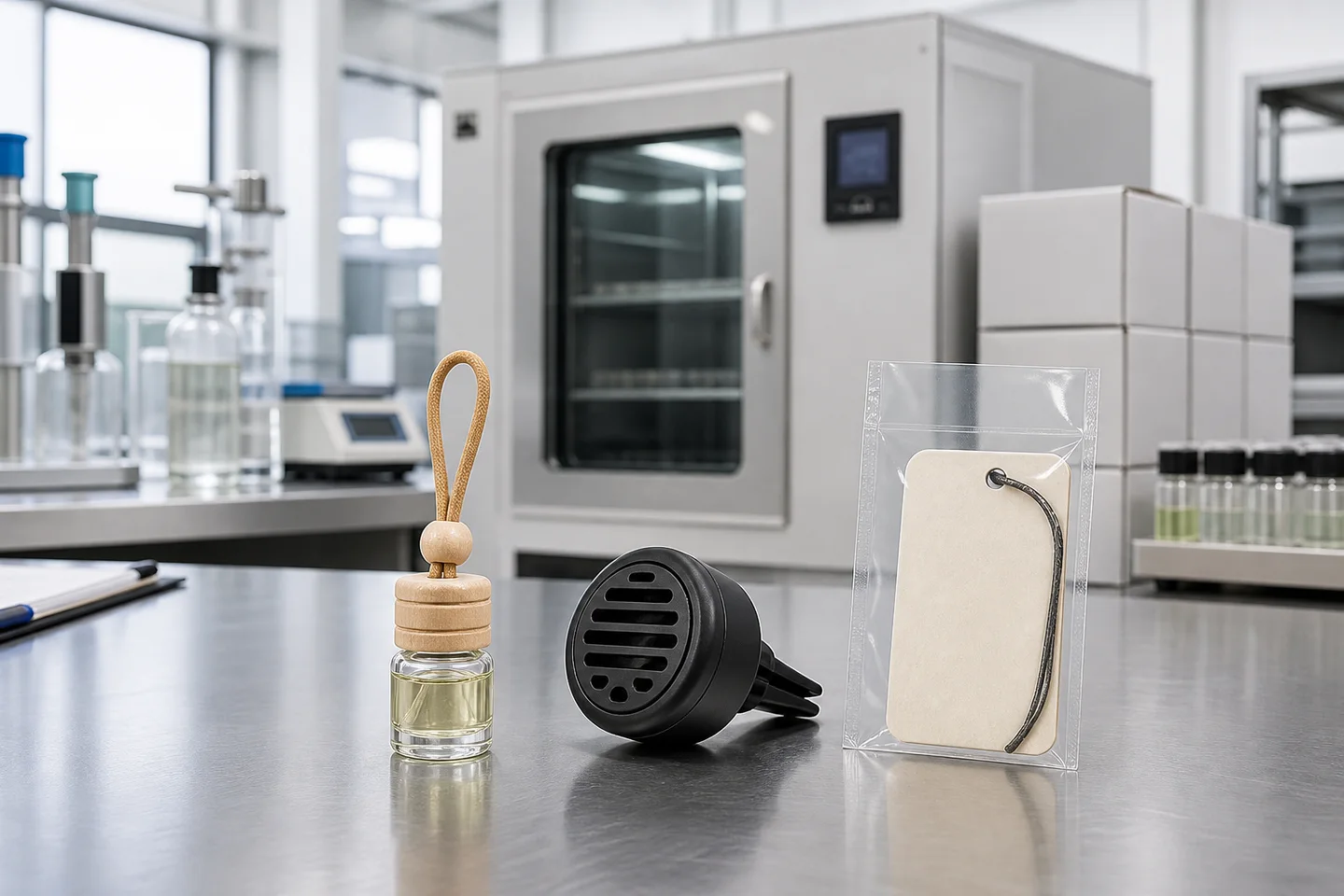
Quick answer: A dependable car air freshener OEM order is approved as a finished system: fragrance, carrier or liquid, housing, closure, retail pouch and shipping carton. Before production, buyers should review how the exact sample looks and smells after storage, whether a liquid format stays sealed, whether a vent clip fits its intended use, whether a paper card remains clean inside its pouch, and whether the final carton protects the product. A short, recorded quality checklist is more useful than a vague request for a "high-quality" air freshener.
Buyer planning snapshot
- Approve the full system: test the final fragrance, format, closure, pouch and carton together.
- Stock samples: normally prepared in 1-3 days; freight is paid by the buyer.
- Custom samples: normally take 7-14 days after the brief, sample fee and freight are confirmed. The sampling fee can be refunded after a final order.
- Bulk timing: normally 30-40 days after final sample approval and payment.
- First action: agree the intended car format, target market and packaging route before asking for a final quote.
What a Car Air Freshener OEM Quality Check Should Cover
Car fragrance products travel through several different environments: the factory, sealed storage, international transit, a retail shelf and a warm vehicle interior. Each stage can reveal a different weakness. A product can look excellent when freshly assembled but show a loose cap, a stained pouch, a distorted housing or an inadequate carton only after storage and handling. That is why the sample review should examine the exact proposed product, not an unrelated component or open fragrance oil.
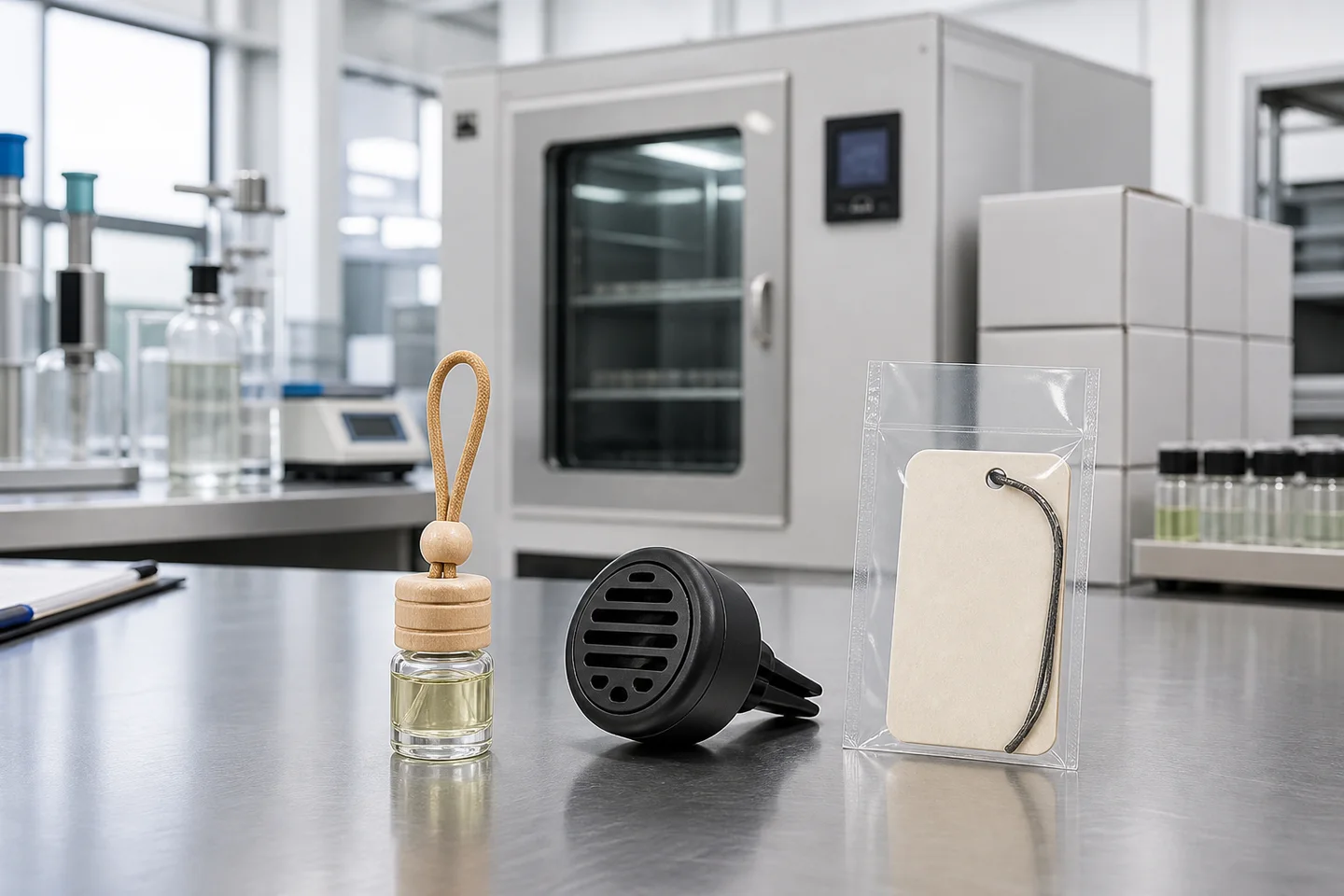
This checklist applies to the three common routes buyers often compare: a scented paper card, a car vent diffuser, and a hanging liquid product from our car diffuser portfolio. The checks are not identical. Paper products need pouch and print protection. Vent products need a secure clip and a correctly fitted scent core. Liquid products need particular attention to the bottle, stopper, cap, cord and leakage controls. All three need a clear approved reference before production begins.
1. Start With the Intended Format and Use Scene
Quality begins with a precise product brief. Confirm whether the product will hang from a rear-view mirror, attach to an air vent, sit in a cup holder or console, or be supplied as a flat promotional card. State the target market, sales channel, preferred scent direction, artwork status, retail packaging and expected launch date. This gives the supplier a practical basis for recommending a sample route and appropriate checks.
Do not assume that one scent formula, pack or claim transfers unchanged between formats. A fragrance on absorbent paper behaves differently from a liquid diffuser, and a vent clip may use a separate carrier or refill element. The aim is to approve the product the customer will open and use, including its instructions and protective pouch. When a project includes multiple formats under one scent family, keep a separate sample record for each SKU.
| Format | Core pre-production checks | What to approve |
|---|---|---|
| Scented paper card | Print rub, die-cut edge, string strength, oil marks, sealed-pouch integrity. | Card artwork, scent direction, pouch construction and retail presentation. |
| Vent clip diffuser | Clip fit, housing finish, scent-core fit, assembly and pack protection. | Clip style, carrier or refill configuration, use instruction and display pack. |
| Hanging liquid diffuser | Bottle, stopper, cap, cord, fill level, leakage and carton protection. | Final bottle assembly, fragrance, closure parts and shipping configuration. |
2. Review Heat Stability as a Finished Product
A parked vehicle can become much warmer than a normal room, especially near glass or direct sunlight. The correct question is not whether a product can be described as universally "heat-proof." Instead, ask the supplier to review the finished sample under agreed storage conditions that are relevant to the product and intended market. After storage, compare it with the approved reference for visible changes, scent balance, closure condition, pouch appearance and assembly fit.
For a liquid diffuser, check the bottle, cap, plug or stopper, cord and label together. For a paper card, check for surface marks, curl, color transfer or a pouch that has weakened. For a vent clip, check that the housing has not visibly distorted and that the clip and scent element remain properly seated. The exact condition, time and acceptance criteria should be agreed during sample review rather than copied from an unrelated product.
Our fragrance expert says: "Heat review is most useful when the buyer sees a before-and-after sample in the same pack that will be sold. It turns a general concern into a documented decision about appearance, seal condition and consumer presentation."
3. Run a Leakage Review for Hanging Liquid Diffusers
Leakage control is a product-system question. The bottle alone may be sound, but the assembled item can still have an issue if the stopper is not seated consistently, the cap fit changes, the cord interferes with the closure, the fill level is unsuitable, or the individual pack permits too much movement. Evaluate the final bottle, liquid, closure and retail package together.
A practical buyer review can include visual checks after upright and side-oriented storage, a careful examination around the neck and cap, and a review after normal carton handling or movement. The purpose is to identify signs of seepage, a loose part, label damage or a compromised pouch before mass production. The supplier should record the bottle reference, cap and stopper versions, liquid code, fill level and package version used for the checked sample.
Do not promote a hanging liquid diffuser as leak-proof without validated project-specific evidence. Instead, make the production approval dependent on the agreed sample and approved packing route. If the brand changes the bottle, closure, cord, fill volume or carton later, repeat the relevant review because the approved system has changed.
4. Check Vent Clip Fit, Housing and Scent Component
A vent clip has a different failure pattern from a hanging bottle. Buyers should look closely at the clip structure, the way the housing sits on a typical vent blade, the fit of any fragrance core or refill piece, and the consumer-facing assembly instruction. A good sample should feel deliberate and stable in its intended placement; it should not depend on a product photograph alone.
During approval, check for sharp molding flash, color inconsistency, loose decorative pieces, uneven assembly, and any part that is difficult to fit or remove. If the clip is designed for a particular vent shape, state that in the product instructions rather than implying it fits every vehicle. The retail pack should protect the clip from scuffing and keep its fragrance component separated as required by the approved design.
For buyers developing a range, a paper card can make a useful promotional companion while the vent clip serves as a more durable accessory. Compare the formats separately, then align the artwork, scent naming and packaging level so the collection feels connected without forcing identical construction.
5. Protect Paper Cards and Sachets Inside the Retail Pouch
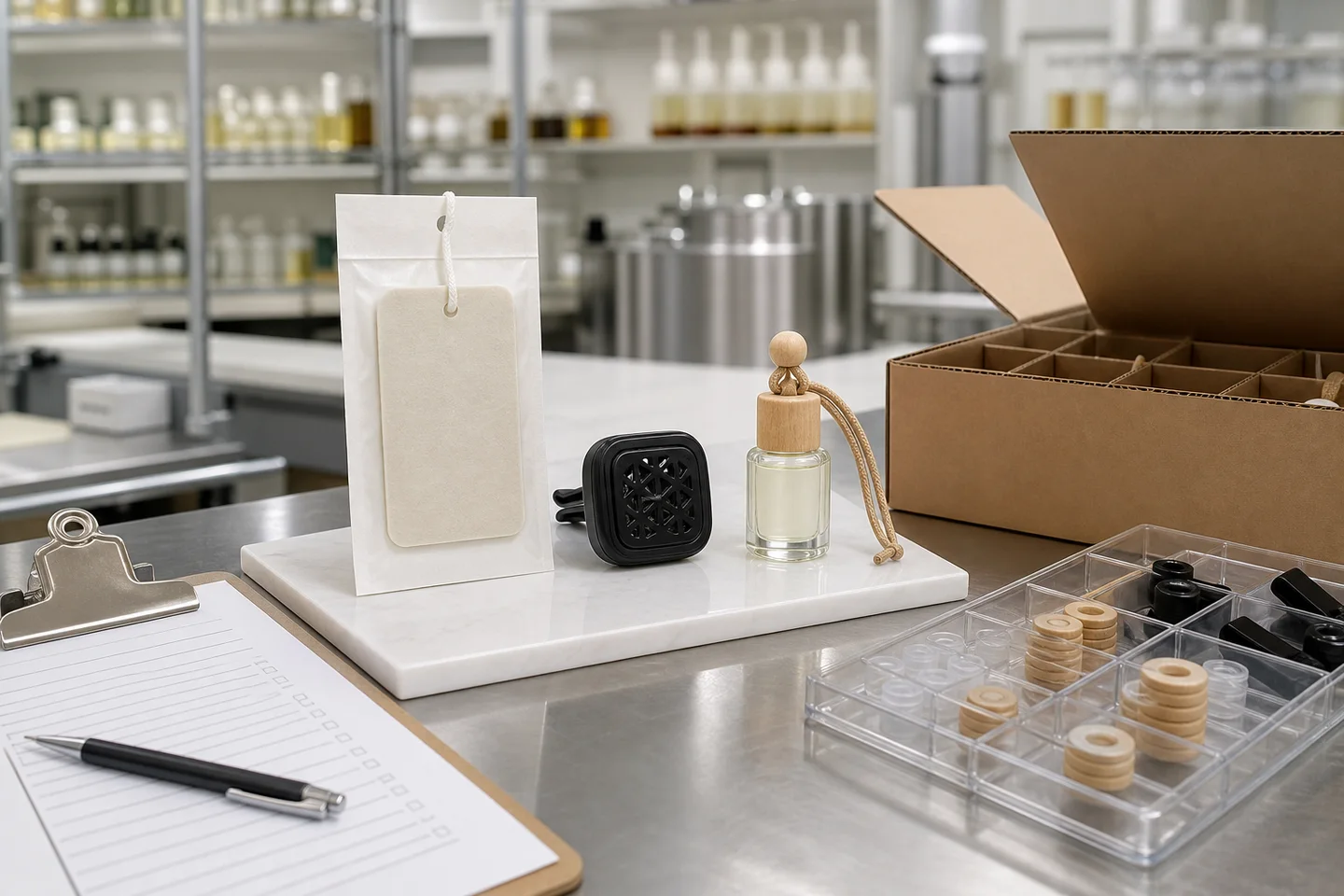
Paper cards, paper sachets and related flat formats can be efficient to ship and easy to print, but their fragrance protection depends heavily on the pouch. Review whether the seal remains clean and consistent, whether the card stays flat, whether the string or hang hole is strong enough for normal handling, and whether the printed surface remains presentable after contact with the approved fragrance system.
A buyer should inspect the finished card after sealed storage, not only immediately after scent loading. Look for print rub, visible marks, edge damage, unexpected fragrance transfer, pouch cloudiness or a poor opening experience. Confirm where the batch code, warning copy, barcode and country-specific information will sit before artwork is released. Clear pack planning avoids last-minute changes that can disrupt the final sample approval.
6. Approve Shipping Packaging Before Mass Production
International shipping packaging should protect the approved retail product, not merely fill an outer carton. Work from the inside out: the individual pouch or retail box, any insert or divider, the inner quantity, the master carton and the handling marks or records needed for the project. A hanging liquid diffuser may need a divider or protective insert to limit movement. A vent clip needs protection against rubbing and loose components. Paper cards need protection from crushing, moisture exposure and pouch damage.
Ask to see the assembled shipping sample whenever the project is new, premium, fragile or uses several different components. Check carton fit, headspace, inner count, direction of packing and the way products are separated. The exact route must also reflect the destination and the freight provider's applicable requirements. Do not rely on a generic carton photo if the final bottle, retail box or product count differs.
For teams sourcing several automotive fragrance lines, our custom car air freshener manufacturing page provides the product routes that can be discussed in one project brief. The most useful first message includes the intended format, market, packaging reference, fragrance direction and target timing. We reply within 24 hours.
7. Create a Golden Sample and Production Checklist
The golden sample is the agreed physical and visual reference for production. It should be identified with the product name or code, fragrance direction, artwork revision, pack revision and approval date. Keep photos of the front, back, closure, pack and carton arrangement with the record. This makes it easier for both sides to spot an unintended substitution or presentation change before goods are packed.
- Product identity: confirm format, scent direction, color, artwork revision, pack count and intended market.
- Appearance: compare printing, labels, bottle or housing finish, cords, clip parts and visible surface marks with the approved sample.
- Function and fit: check closure seating for liquid products, vent-clip assembly for hardware products, and string or pouch integrity for paper formats.
- Storage review: compare the final product after agreed storage for appearance, scent impression, pack condition and any sign of leakage or migration.
- Carton review: confirm individual protection, dividers, inner count, master-carton fit and the approved packing direction.
- Record changes: if any component changes after sample approval, review that change before treating the order as ready for production.
Documentation and Claims: Keep the Brief Specific
Document requirements depend on the fragrance, product format, claims and destination market. State the intended use and market early so the project can identify which product specifications, safety information and fragrance documents may be relevant. The IFRA Standards are a globally recognized risk-management system for the safe use of fragrance ingredients. They do not replace a brand's responsibility to review finished-product and applicable local requirements for its specific market and claims.
Keep marketing wording proportionate to what the product and evidence support. A statement that a product adds fragrance to a vehicle interior is different from an antimicrobial, mold-control, allergy or health claim. Reviewing claims alongside the golden sample helps avoid a situation where packaging is printed before the intended use, document needs and final product wording are aligned.
Need a car air freshener sample and quality plan?
Send your chosen format, target market, scent direction, packaging reference and launch timing. LoyalCrafts can outline a practical sample route, the approval points to record and the relevant product options within 24 hours.
FAQ
What should be tested before car air freshener OEM production?
Test the final format, fragrance, closure or carrier, retail pouch and shipping carton together. Core checks include appearance after agreed storage, leakage controls for liquid products, clip fit for vent products, pouch and print condition for paper products, and carton protection.
How do you check a hanging car diffuser for leakage?
Review the finished bottle, stopper, cap, cord, fill level and retail pack together. Check the neck area and packaging after agreed storage and normal handling conditions, and record the exact approved component versions. Any later component change should be reviewed again.
Does every car air freshener need a heat review?
Warm vehicle conditions can affect different formats in different ways, so a finished-product storage review is sensible before production. The agreed conditions and acceptance criteria should match the format, intended use and target market rather than rely on a generic claim.
What shipping packaging should a buyer approve?
Approve the individual pouch or retail box, any insert or divider, inner count, master carton, packing direction and protection for the exact product. Fragile or liquid items often need a more specific packing review than flat paper formats.
What should I send for a car air freshener sample request?
Send the preferred format, scent direction, target market, artwork or packaging reference, quantity per SKU, intended sales channel, document needs and launch timing. This helps the supplier suggest a suitable sample and approval route.
You May Also Like
- Car Air Freshener OEM Cost Comparison: Paper, Vent and Liquid Formats
- Custom Car Air Freshener Manufacturer
- Car Vent Diffuser Portfolio
- Scented Paper Card Portfolio
Summary
A good car air freshener OEM quality checklist helps a buyer approve the exact product, not a collection of loose components. Confirm the format and intended use, review the product after agreed storage, check leakage or hardware fit where relevant, approve the retail pouch and shipping carton, then keep a clear golden-sample record. This gives the project a stronger handover from sampling to production and makes future reorders easier to control.