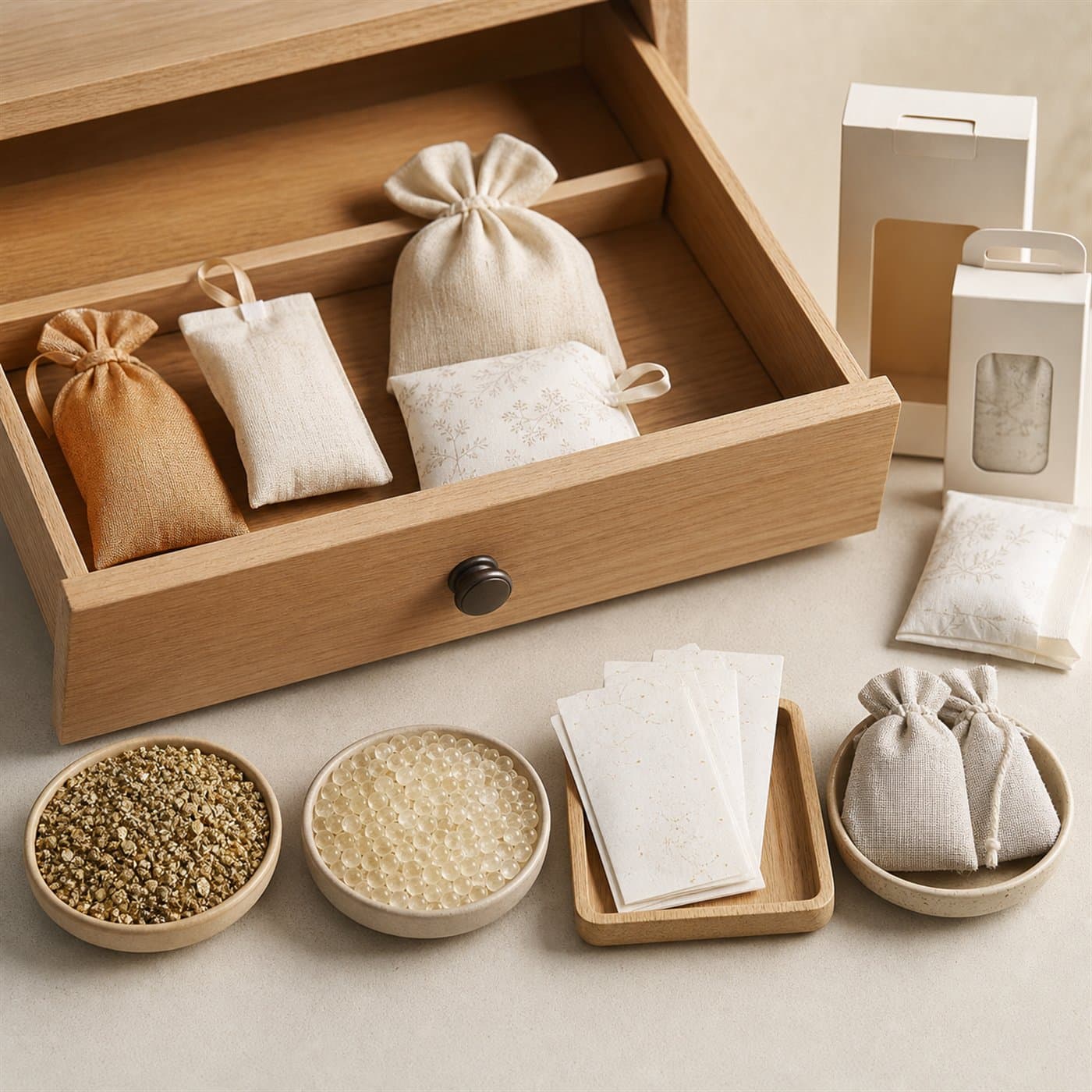
Quick answer: Drawer sachet filling materials should be chosen by scent release, dust control, pouch compatibility, packaging protection, and the retail use case. Vermiculite and mineral-style granules are useful when the buyer wants a porous fragrance carrier inside paper or fabric packs. Scented beads give a cleaner visual feel and can work well in fabric pouches. Scented paper is flat and cost-efficient for drawer multipacks. Fabric sachets feel softer and more giftable, but they need stronger checks for seam strength, oil migration, and filling leakage.
Buyer Planning Snapshot
- Main keyword: drawer sachet filling materials.
- Best low-profile format: scented paper sachets for drawer multipacks, mailers, refill packs, and value retail.
- Best soft-goods format: scented linen or fabric sachets for wardrobes, home textile programs, gift sets, and hotel amenities.
- Best material test: approve fragrance in the final carrier, final pouch, and final retail pack, not only as fragrance oil.
- Sample timing: stock samples 1-3 days; custom samples usually 7-14 days after brief, fee, and freight are confirmed.
- Bulk timing: normally 30-40 days after sample approval and payment.
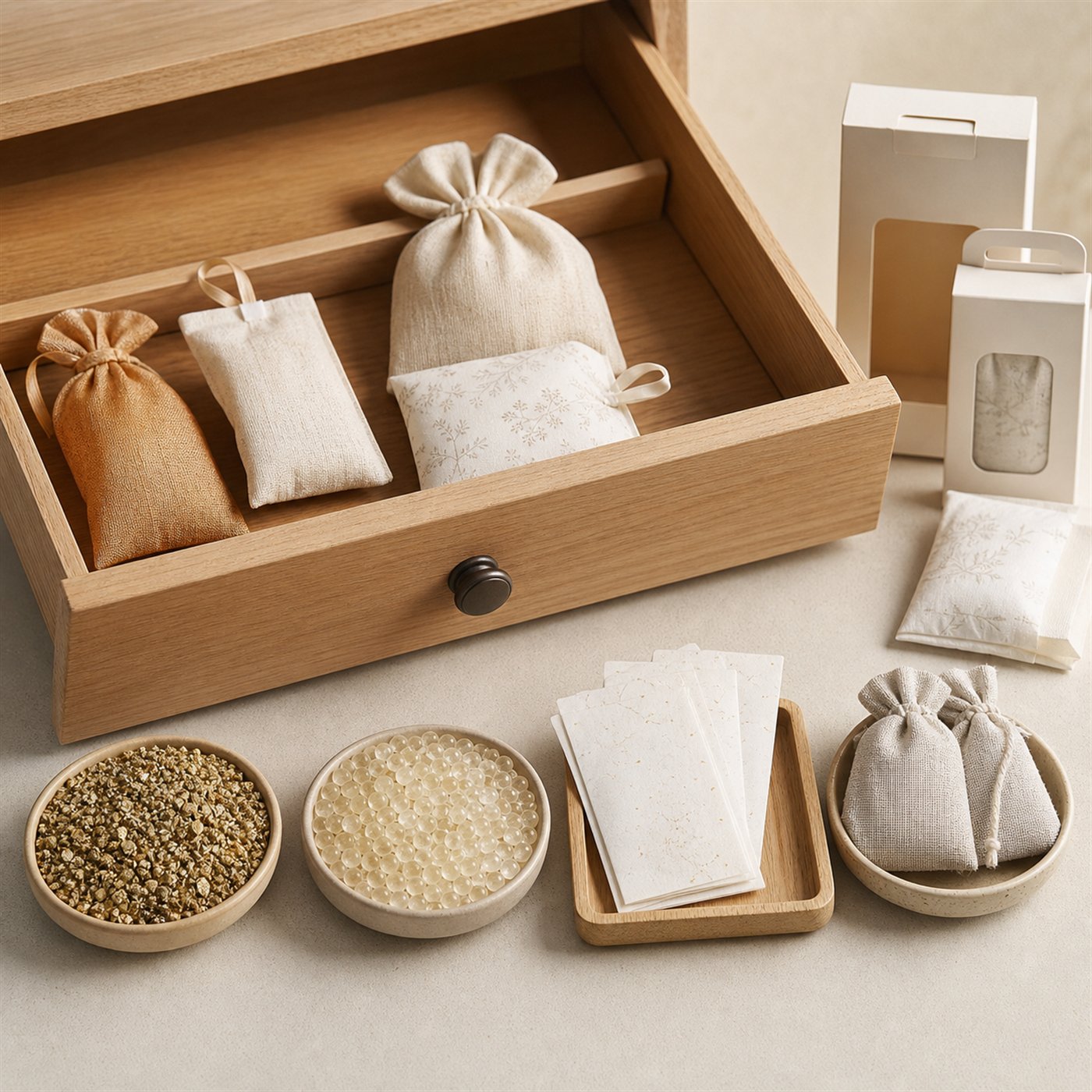
What Counts as a Drawer Sachet Filling Material?
A drawer sachet is a small fragrance product designed for dresser drawers, wardrobes, closets, luggage, storage boxes, hotel room closets, and gift sets. The outside can be paper, nonwoven material, linen, cotton, organza, polyester, or a custom pouch. The inside can be vermiculite granules, scented beads, cellulose-based paper, aroma powder, fragranced pads, fiber filling, or a blended carrier.
For private label sourcing, the word "filling" should not be treated as a minor detail. It affects scent life, product weight, dust, oil migration, packaging odor transfer, shipping behavior, and the final consumer experience. A buyer may like the fragrance in a sample bottle, but the same scent can feel weaker, sharper, sweeter, or dustier after it is loaded into a carrier and sealed in packaging.
This guide focuses on four common decision groups: vermiculite, beads, paper, and fabric sachet systems. It is designed to sit between our paper vs fabric scented sachets comparison and the product pages for scented paper sachets and scented linen sachets.
Comparison Table: Vermiculite, Beads, Paper and Fabric
| Material Route | Best Fit | Advantages | Risks to Test |
|---|---|---|---|
| Vermiculite or mineral-style granules | Paper sachets, fabric sachets, closet packs, refill pouches | Porous carrier feel, flexible filling weight, practical scent loading | Dust, particle leakage, oil staining, grade consistency |
| Scented beads | Fabric pouches, transparent windows, premium drawer kits | Clean appearance, controlled dosing, easy consumer understanding | Bead hardness, fragrance load, heat response, cost |
| Scented paper | Flat drawer sachets, multipacks, mailers, promotional inserts | Low profile, printable, light shipping weight, efficient packing | Scent retention, oil marks, pouch barrier, print durability |
| Fabric sachet system | Gift sets, home textile lines, hotel amenities, wardrobes | Soft premium feel, easy hanging, strong lifestyle presentation | Seam strength, fiber dust, filling leakage, scent transfer |
Vermiculite: Useful Porous Carrier, But Grade Control Matters
Vermiculite is often discussed because it can work as a porous carrier for fragrance in dry sachet products. For drawer sachets, buyers usually care less about the mineral name itself and more about how the selected grade behaves after fragrance loading: particle size, dust level, oil hold, color, smell neutrality, and compatibility with the pouch.
The U.S. Geological Survey tracks vermiculite as a mineral commodity, which is a useful reminder that source, grade, and consistency matter. A private label buyer should ask the supplier to keep the carrier specification stable between sample and mass production. If the carrier changes, scent release, dust, and appearance can change too.
Vermiculite-style carriers can be practical in both paper and fabric sachets. The main checks are dust leakage through seams, oil staining on paper, scent stability after storage, and whether the consumer can feel loose grit through a soft pouch. For premium drawer programs, the filling should not make the product feel cheap or messy.
Scented Beads: Cleaner Visual Story for Fabric Pouches
Scented beads can be attractive when the buyer wants a clean, modern material story. They are easy to explain to retail buyers, can look tidy in a fabric pouch or window pack, and can be dosed consistently during filling. Beads may be a good option for gift sachets, wardrobe pouches, car drawer-style packs, and product lines where the filling is partly visible.
The weakness is that beads are not automatically better than granules. Cost can be higher. Fragrance loading may need adjustment. Hard beads can affect hand feel if the pouch is thin. Heat and long storage should be tested, especially for products shipped in summer or sold through online channels. If the pack is sealed too tightly, a buyer should confirm that the scent is still strong enough when the consumer opens it.
Our fragrance expert says: "For drawer sachets, beads are useful when the buyer wants a cleaner look, but the approval sample should be checked after being sealed in the final bag or box. A beautiful bead can still underperform if the packaging blocks too much fragrance release."
Scented Paper: Flat, Efficient and Strong for Multipacks
Scented paper works well when the buyer wants a flat product that can be packed efficiently and sold as a multipack. It is often suitable for drawers, shoe boxes, luggage, mailers, subscription boxes, wardrobe refill packs, and promotional inserts. The format can carry printed artwork and instructions more easily than loose-fill sachets.
The tradeoff is that paper has less physical volume and less gift feel than a fabric pouch. The buyer should test fragrance load, oil marks, paper curl, print rub, pouch seal, scent retention, and storage odor. If the pack needs to sit in a warehouse for months before sale, the barrier pouch and carton structure matter.
For LoyalCrafts custom scented paper sachets, order planning is usually separate from fabric sachets because printing, cutting, sealing, and filling logic are different. Custom paper sachet projects usually start from 3,000 units, with final confirmation based on size, scent, print, packaging, and SKU split. See the scented paper sachet portfolio for product direction.
Fabric Sachets: Premium Feel, More Assembly Checks
Fabric sachets are the natural choice when the drawer product should feel soft, decorative, and giftable. They work well for home textile brands, hotel amenities, wardrobe-care programs, seasonal gift sets, and closet bundles. The pouch can use linen-look fabric, cotton, nonwoven, satin, organza, canvas, felt, or custom textiles. A ribbon, hang loop, hang tag, woven label, or small box can make the item more retail-ready.
Fabric gives more design freedom, but it also adds more checks. Buyers should review seam strength, stitch density, fabric color, fiber dust, filling leakage, ribbon pull strength, oil migration, scent transfer, and whether the pouch stains white textiles under realistic storage conditions. The best pouch is not only pretty; it must hold the filling cleanly.
For LoyalCrafts custom scented linen sachets, private label projects usually start from 1,000 units, depending on pouch size, fabric, filling, scent, artwork, retail pack, and SKU split. If the buyer wants both paper and fabric versions, quote them as two related but separate products. The scented linen sachet portfolio shows common fabric-sachet directions.
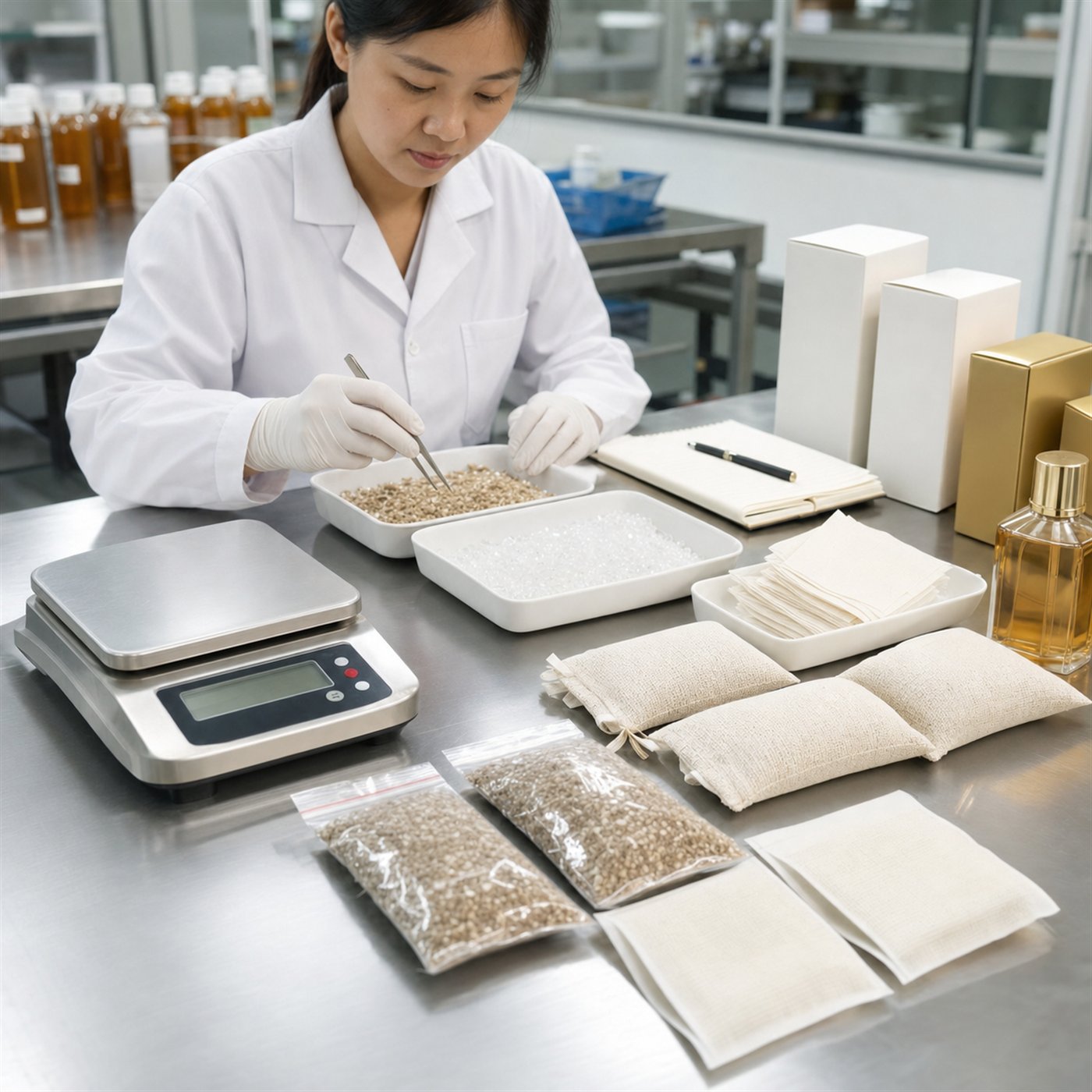
Packaging Fit: The Carrier Must Match the Pack
A drawer sachet can fail because the filling is wrong, but it can also fail because the packaging is wrong. Porous granules may need a tighter inner bag. Scented paper may need a stronger barrier pouch to protect fragrance before opening. Beads may need a fabric that feels smooth and does not show hard edges. A fabric sachet may need a box or bag that prevents scent loss during shipping.
Private label buyers should approve the full packaging system, not only the pouch. This includes inner bag, hang tag, header card, carton, display box, barcode panel, warning language, batch code, and retailer-required marks. For a complete closet-care line, drawer sachets can also be bundled with scented drawer liners and scented moisture absorbers.
Compliance and Document Checks
Fragrance documentation should be considered before artwork is finalized. The IFRA Standards are widely used as a fragrance safety risk-management system, and the IFRA Standards Library provides ingredient standard information. Buyers should request fragrance documentation aligned with the intended product type and target market.
For US-oriented projects, the CPSC explains that the Federal Hazardous Substances Act requires precautionary labeling for hazardous substances. This does not mean every drawer sachet uses the same label, but it does mean buyers should check foreseeable use, warnings, and claims before printing packaging.
For B2B handling, OSHA's Hazard Communication overview notes that chemical manufacturers and importers evaluate hazards and communicate hazard information through labels and safety data sheets for downstream customers. If a buyer needs SDS support, the request should be included in the RFQ so the supplier can plan documentation early.
Claim Control: Freshness Is Safer Than Overpromising
Drawer sachets are usually safest as fragrance and freshness products. Claims such as keeps drawers smelling fresh, adds a clean linen scent, or suitable for drawers and closets are easier to support than kills bacteria, prevents mold, eliminates allergens, or repels moths. The latter claims can change the regulatory path and should be reviewed before use.
Natural, non-toxic, eco-friendly, biodegradable, and plant-based claims also need care. The material may be natural-looking, but that does not automatically support broad environmental or safety claims. For B2B private label orders, strong claim control reduces retailer questions, relabeling cost, and import risk.
Sample Approval Checklist for Private Label Orders
- Confirm the product format: paper sachet, linen sachet, hanging pouch, drawer insert, or closet-care bundle.
- Test fragrance in the final filling material, final pouch, and final retail pack.
- Check dust, leakage, oil migration, fabric staining, paper marks, seam strength, and ribbon pull strength.
- Store samples sealed for at least several days before judging scent release and packaging odor transfer.
- Confirm label space for product name, scent name, directions, warnings, net content or count, barcode, batch code, and company details.
- Ask for IFRA and SDS support where relevant to the target market and buyer requirements.
- Approve a sealed golden sample before mass production starts.
Case Example: A Drawer Care Range with Two Filling Routes
A home textile buyer wants a private label drawer-care range for North America and Korea. The first plan includes scented paper sheets, fabric sachets, matching drawer liners, four fragrances, and a gift box. That is attractive, but it creates many variables before the buyer knows which product will sell best.
A practical first launch could use two fragrance directions and two material routes: a flat scented paper sachet for multipacks and a linen-look fabric sachet with scented beads or granules for gift and wardrobe use. The same scent family can be used across both formats, but the filling load and packaging should be tested separately. This gives the buyer a clear price ladder without making the first order too complicated.
After sell-through is proven, the buyer can add a third scent, a premium gift box, a matching scented drawer liner, or a closet moisture absorber. The goal is not to choose the fanciest filling first; it is to choose the material system that can be sampled, packed, shipped, and reordered reliably.
Need help comparing sachet filling materials?
Send your target market, sachet format, preferred filling, scent direction, packaging reference, and quantity per SKU. LoyalCrafts can compare practical material routes and reply within 24 hours.
FAQ
What are the best drawer sachet filling materials?
The best drawer sachet filling material depends on use case. Vermiculite-style granules can hold fragrance in a porous carrier, beads give a clean visual feel, scented paper is flat and efficient, and fabric sachet systems create a softer premium product.
Are beads better than vermiculite for scented sachets?
Not always. Beads can look cleaner and may be easier to dose, but vermiculite or mineral-style granules can be practical for flexible filling weights. Buyers should test scent life, dust, leakage, oil migration, and packaging compatibility before choosing.
Can paper and fabric drawer sachets use the same fragrance?
They can use the same scent direction, but the formula and fragrance load should be tested separately. Paper, fabric, beads, and granules release scent differently, so the final approval sample should match the final production material.
What is the MOQ for private label drawer sachets?
At LoyalCrafts, custom scented paper sachets usually start from 3,000 units and custom scented linen sachets usually start from 1,000 units. Final order planning depends on material, scent, pouch, print, packaging, and SKU split.
What should buyers send before requesting a quote?
Send the target format, drawer or closet use case, filling preference, scent direction, pouch material, packaging style, market, quantity per SKU, artwork status, document needs, and expected launch timing.
What should be tested before mass production?
Test scent strength after storage, filling dust, leakage, oil migration, fabric staining, paper marks, seam strength, ribbon pull strength, pouch feel, package scent retention, label clarity, and carton protection.
You May Also Like
- Scented Sachet Manufacturer
- Scented Paper Sachet Portfolio
- Scented Linen Sachet Portfolio
- Paper vs Fabric Scented Sachets
Summary
Drawer sachet filling materials should be selected as a complete product system. Vermiculite, beads, paper, and fabric can all work, but each one has different strengths, costs, and testing risks. The strongest private label orders begin with a clear use case, a realistic SKU plan, final-material samples, careful packaging, and controlled claims.
LoyalCrafts supports private label drawer sachets with material comparison, fragrance direction, paper and linen sachet options, filling coordination, packaging support, and sample review. Send your drawer sachet brief for a practical sourcing plan.