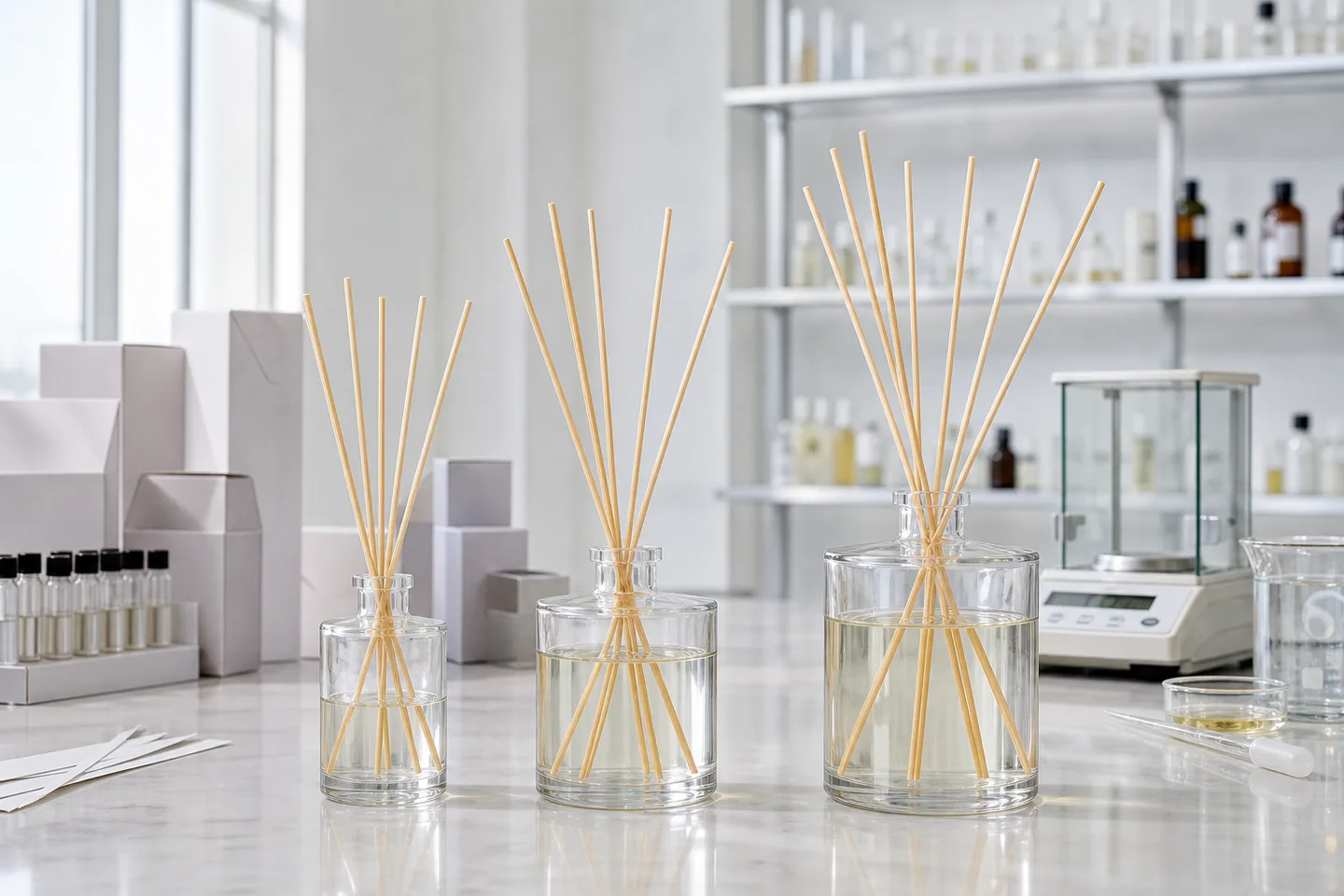
Quick answer: A 100 ml reed diffuser commonly lasts about 6-12 weeks in moderate indoor conditions, but bottle size alone cannot predict performance. Formula volatility, fragrance composition, reed material and count, bottle-neck opening, temperature, airflow, humidity, reed flipping, and storage all change the result. For a private label project, treat any duration claim as a target that must be verified with the finished formula, bottle, closure, and reeds.
Reed Diffuser Lifespan at a Glance
- Useful planning benchmark: many 100 ml products are designed around roughly 6-12 weeks of use, not a fixed universal duration.
- Strong scent vs. long life: faster liquid movement and evaporation can improve scent throw while shortening refill life.
- Finished-pack testing matters: changing the bottle neck, reed count, fragrance, or carrier can change the result.
- Storage is different from use: an unopened diffuser should be evaluated for leakage, seal quality, color, odor, and packaging stability.
How Long Do Reed Diffusers Last in Real Use?
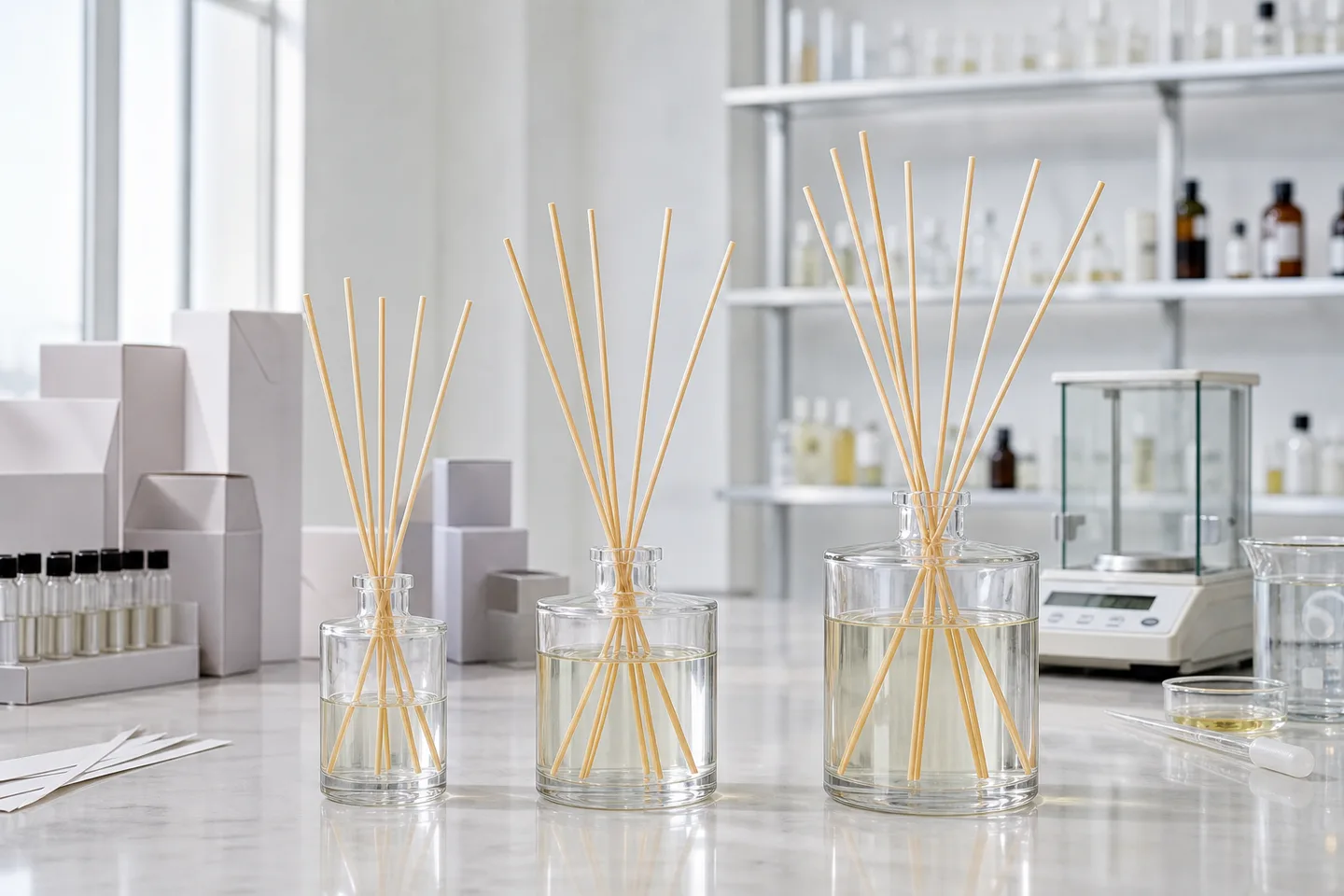
The honest answer is a range, not one number. A small diffuser in a warm entrance beside an air-conditioning outlet may lose liquid much faster than the same product in a stable bedroom. Two 100 ml products can also perform differently because one uses more reeds, a wider bottle neck, or a more volatile carrier system.
A useful B2B specification separates three questions: how quickly the liquid level falls, how long a user can perceive the fragrance in the intended room, and how the product remains stable before opening. These are related, but they are not identical. A slow-evaporating formula may remain in the bottle for months while delivering weak scent throw. A powerful diffuser may satisfy the user early but empty sooner.
The Netherlands National Institute for Public Health and the Environment treats capillary reed or wood diffusers as a distinct air-freshener category in its Air Fresheners Fact Sheet and provides parameters for standardized exposure assessment. Those parameters support safety evaluation; they are not product-performance warranties for a particular formula or room.
Typical Duration by Bottle Size
Volume gives buyers a starting point for planning, but not a claim that should be printed without testing. The table below shows broad market-planning ranges under moderate indoor use. Results can fall outside these ranges.
| Fill Size | Broad Planning Range | Common Project Use | What to Confirm |
|---|---|---|---|
| 50 ml | About 4-8 weeks | Gift sets, bathrooms, trial sizes | Enough scent throw with a limited reed count |
| 100 ml | About 6-12 weeks | Core retail home-fragrance SKU | Balanced evaporation, room coverage, and refill life |
| 150-200 ml | About 10-20 weeks | Living rooms, premium ranges, hospitality | Reed length, neck size, stability, and packaging weight |
| 500 ml or larger | Project-specific | Large rooms and decorative commercial formats | Room test, vessel safety, reed structure, and refill strategy |
If your label needs a specific claim, ask the manufacturer to test the exact private label reed diffuser configuration. Scaling a 100 ml result directly to 200 ml can be misleading because larger vessels often use longer or more numerous reeds and a different neck opening.
9 Factors That Control Reed Diffuser Lifespan
1. Liquid Fill Volume
More liquid usually creates more potential service time, but the relationship is not perfectly linear. A larger bottle may use more reeds to cover a larger room, increasing the exposed evaporating surface. Buyers should compare grams of liquid lost per day as well as the calendar duration.
2. Carrier Formula and Volatility
The carrier must move through the reeds and release fragrance into the air. If it evaporates too quickly, the diffuser may smell strong but finish early. If it moves too slowly, the liquid can remain while scent performance disappoints. Formula development should therefore balance diffusion, clarity, odor, low-temperature behavior, and the desired lifespan.
3. Fragrance Composition and Use Level
Fragrance oils are mixtures of materials with different volatility, color, solubility, and diffusion behavior. A citrus-led fragrance may not behave like a woody or resinous fragrance in the same carrier. Increasing fragrance concentration does not automatically create a longer-lasting product; it can change viscosity, wicking, clarity, and scent balance.
4. Reed Material, Diameter, Length, and Count
Natural rattan reeds use internal channels to draw liquid upward. Fiber sticks are engineered for consistent capillary movement and can offer broader color and diameter options. Neither type is automatically best for every formula. More or thicker reeds generally increase exposed surface area and may strengthen scent throw while consuming liquid faster. Review our fiber vs. rattan diffuser stick guide before fixing the component specification.
5. Bottle Neck and Inner Opening
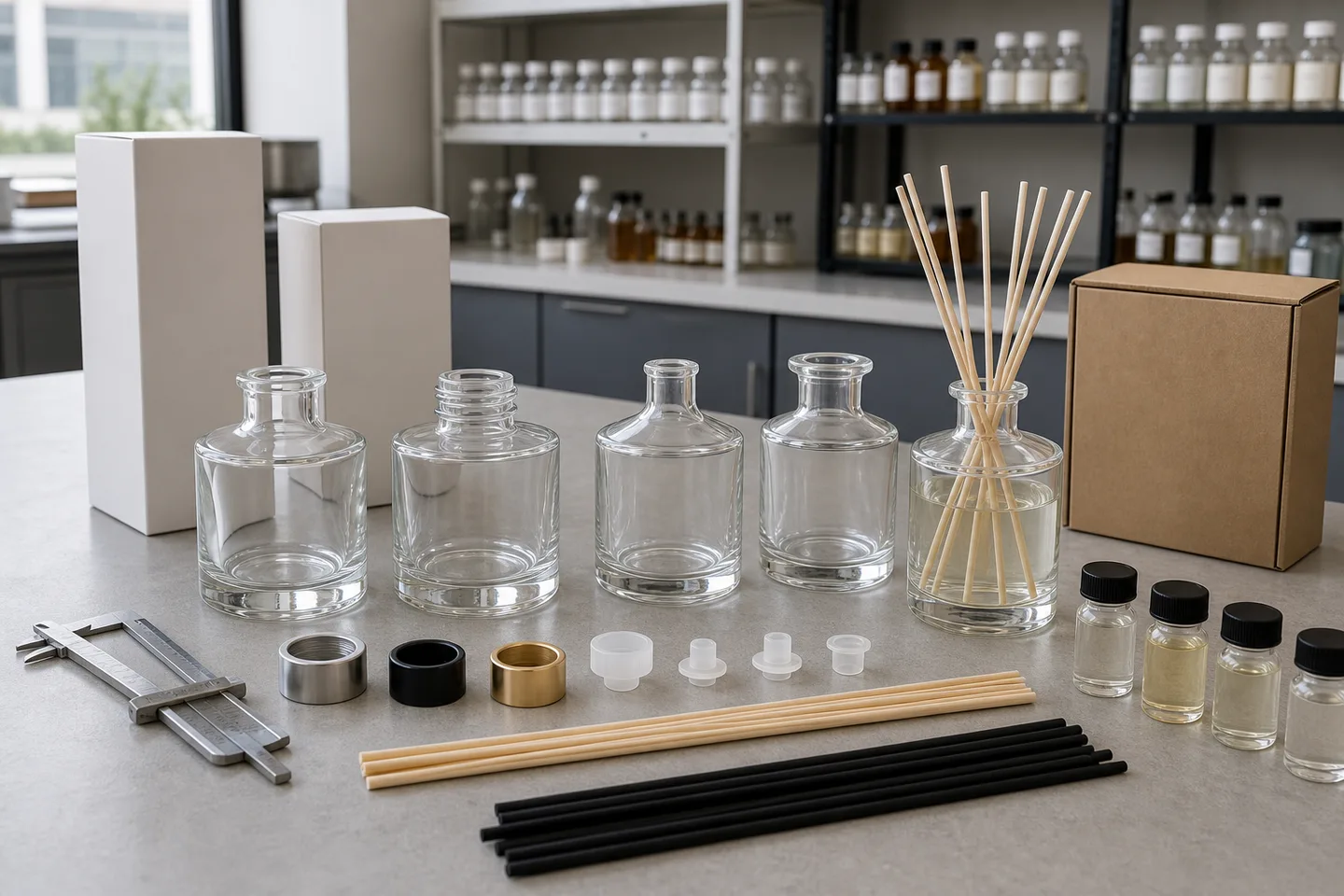
Liquid can evaporate directly from the bottle opening, not only from the reeds. A wider neck exposes more surface area and may also allow buyers to insert more sticks. Inner plugs and collars should fit the chosen reeds without squeezing them into one dense bundle or leaving an unnecessarily large open gap.
6. Room Temperature and Direct Sunlight
Higher temperature generally increases evaporation. A diffuser on a sunny windowsill or near a radiator can run faster and may also face color or odor changes. Performance testing should record temperature rather than describing a room only as normal. Export buyers should also consider how seasonal heat may affect storage and transport before the product reaches the consumer.
7. Airflow and Room Conditions
Moving air helps carry fragrance through a room, but direct drafts from fans, windows, or HVAC outlets can speed consumption. Room size, door-opening frequency, humidity, and background odors also affect perceived strength. A product designed for a small bathroom needs a different performance target from one intended for a hotel lobby.
8. Reed Flipping and Consumer Instructions
Flipping reeds exposes a freshly saturated end and can temporarily increase scent. Frequent flipping can also accelerate liquid loss and create spill risk. The instruction card should state a practical routine, protect surrounding surfaces, and advise users to handle wet reeds carefully. Do not build a duration claim around one test method and give consumers a different flipping instruction.
9. Seal Quality, Storage, and Shelf Stability
An unopened reed diffuser is protected by the cap, plug, liner, and retail pack. Shelf-life review should check net-weight change, leakage, formula clarity, color, odor, compatibility with the bottle and closure, and packaging appearance. A product can pass an in-use test but still fail commercially if it leaks during transport or discolors on the shelf.
How B2B Buyers Should Test Reed Diffuser Duration
- Freeze the specification. Record the formula batch, fill weight, bottle, neck opening, plug, collar, reed material, reed dimensions, and reed count.
- Set controlled and real-room samples. Use multiple units in a stable test area and additional units in the intended room type.
- Measure, do not only smell. Record initial weight, weekly weight loss, liquid appearance, leakage, reed condition, and a consistent scent panel score.
- Define the end point. Decide whether the test ends when the liquid reaches a set level, when scent falls below an agreed score, or when the target number of days is reached.

Our fragrance expert says: "The longest-lasting sample is not always the best diffuser. Buyers need a balanced target: noticeable scent in the intended room, controlled liquid loss, stable appearance, and packaging that survives storage and shipment."
Compliance Checks Still Apply to Long-Lasting Formulas
Performance testing does not replace a safety and market review. IFRA guidance places reed diffusers and non-cartridge liquid air-freshener refills in Category 10A. Ask for fragrance documentation for the intended use and finished concentration, while remembering that an IFRA certificate does not replace a complete product assessment or local law.
For the European market, hazardous mixtures must follow applicable classification, labeling, and packaging duties. The European Chemicals Agency CLP guidance explains that labels may require supplier information, product identifiers, nominal quantity, hazard pictograms, signal words, and precautionary information where applicable. The required file set depends on formula and destination, so confirm it before artwork approval.
RFQ Checklist for a Longer-Lasting Reed Diffuser
- Target market, room type, desired scent strength, and target duration.
- Fill size, bottle material, neck opening, plug, collar, and cap.
- Fragrance direction, carrier preference, clarity and color expectations.
- Rattan or fiber reeds, dimensions, color, count, and flipping instructions.
- Test conditions, sample quantity, measurement frequency, and pass criteria.
- Required SDS, fragrance documentation, label review, transport checks, and market files.
- Quantity per scent, target launch date, delivery location, and Incoterm.
Develop a Reed Diffuser with a Measurable Lifespan
Send us your target bottle size, room type, fragrance direction, reed preference, sales market, and quantity per SKU. We reply within 24 hours with the next practical sampling step.
Frequently Asked Questions
How long does a 100 ml reed diffuser last?
A 100 ml reed diffuser commonly lasts about 6-12 weeks under moderate indoor conditions. Formula, fragrance, reeds, bottle opening, room temperature, airflow, and flipping frequency can shorten or extend that range.
How can a reed diffuser be made to last longer?
Keep it away from direct sunlight, radiators, fans, and strong HVAC drafts; use only the number of reeds needed for the room; and avoid flipping the reeds more often than the product instructions recommend. Manufacturers can also adjust the carrier, reeds, bottle neck, and fragrance system, but must retest scent throw.
How long do reed diffuser sticks last?
Sticks are normally evaluated for the intended life of one fill. Replace them when they become dusty, damaged, saturated with an old fragrance, or no longer wick consistently. Reusing reeds with a different fragrance can mix odors and produce unreliable performance.
Do unopened reed diffusers expire?
Unopened diffusers can change over time. The formula may discolor, lose top notes, interact with the closure, or slowly lose weight if the seal is poor. Use the manufacturer's stated shelf life and storage conditions, and verify them through packaging and stability review.
Do fiber sticks or rattan reeds last longer?
Neither material guarantees a longer lifespan. Fiber sticks can provide consistent engineered capillary performance, while rattan uses natural channels. The result depends on stick dimensions, quantity, formula compatibility, bottle opening, and desired scent strength.
You May Also Like
- Reed Diffuser Manufacturer in China
- Private Label Reed Diffuser Portfolio
- Fiber vs. Rattan Diffuser Sticks
- Reed Diffuser Bottle OEM Buyer Checklist
Explore our fragrance OEM/ODM process, review our factory and quality background, or send your product brief.