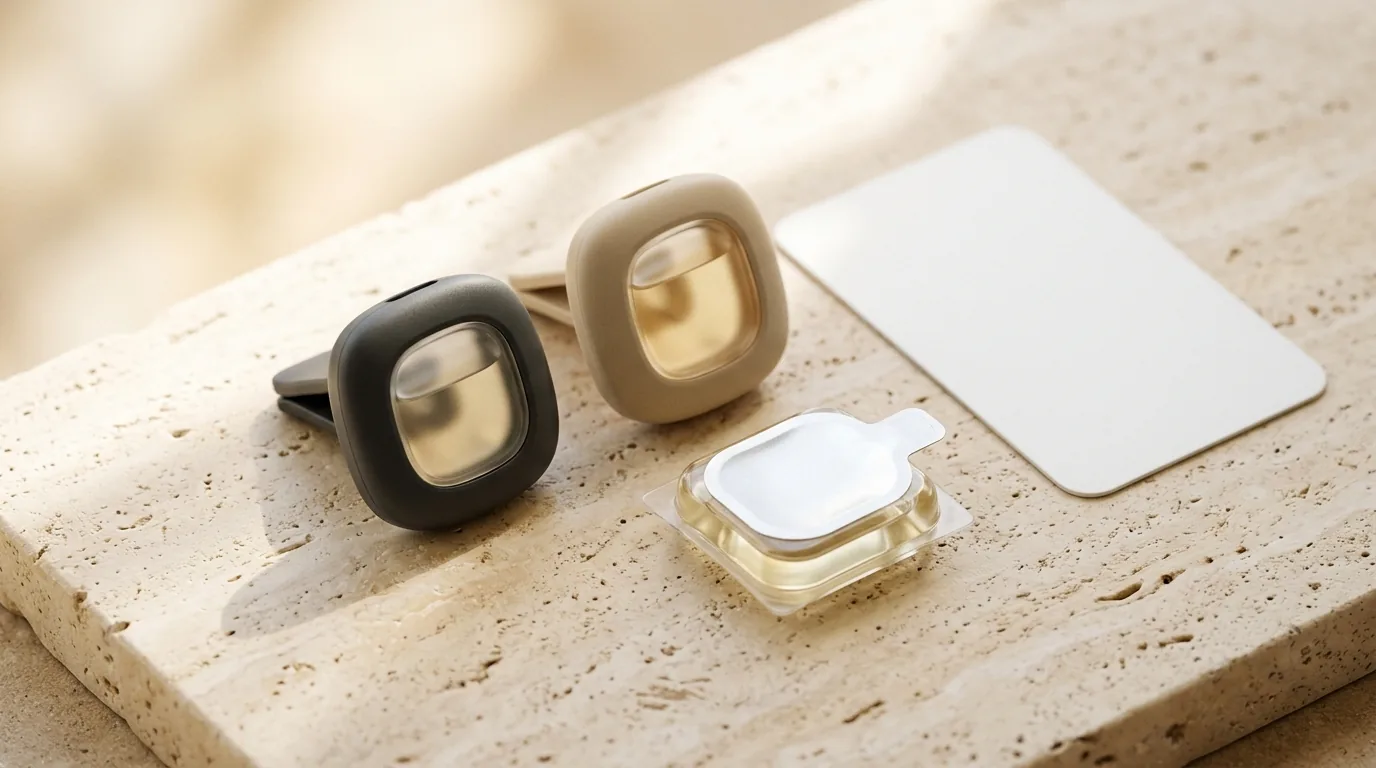
Quick answer: A private label membrane air freshener pairs a thermoformed liquid fragrance capsule with a microporous breathable polymer membrane and an outer aluminum-foil barrier tab. Before placing an OEM order, buyers should approve the complete sealed assembly together—matching fragrance viscosity to membrane porosity, verifying smooth foil-tab peel activation without tearing the membrane, and testing cabin heat and inverted storage on filled samples.
Retail chains, automotive accessory programs, and home-care brands often add membrane perfume diffusers when buyers want visible liquid level cues without open-bottle spill risk or broken glass in parcel transit. Because fragrance vapor diffuses through a dry outer membrane only after the user pulls the foil barrier tab, shelf stock remains sealed until activation.
This checklist explains how to define a clear technical brief, compare housing routes, plan order quantities, and inspect samples before mass production.
1. Choose Between Car Vent Clips and Small-Space Formats
The sealed liquid pod works in both airflow-assisted vehicle cabins and passive household enclosures, but the outer frame, mounting hardware, and retail card differ. Confirm where the end customer will place the unit before selecting a stock housing or commissioning custom tooling.
| Format route | Mounting & airflow | Typical retail pack | Planning reference |
|---|---|---|---|
| Vehicle vent membrane clip | Rear clip engages AC louvers; cabin airflow accelerates diffusion across the exposed membrane face | Blister card, twin-pack clamshell, or peggable window tuck box | Custom MOQ ref: 1,000 units; duration ref: 30–45 days |
| Small-space stand / adhesive pod | Freestanding frame, hook slot, or removable adhesive pad for closets, lockers, and bathrooms (10–15 sq m ref) | Printed folding carton, multi-pack sleeve, or pegboard blister card | Custom MOQ ref: 1,000 units; duration ref: 30–45 days |
| Refillable frame + replacement pods | Reusable outer bezel paired with snap-in sealed membrane cartridges | Starter kit carton plus 2- or 4-pod refill packs | Confirm cartridge fit tolerance and per-scent MOQ split |
If your automotive range also includes dry ceramic or sintered polymer cores without visible liquid, compare this format against our car vent diffuser options or review our OEM car air freshener supplier format overview.
2. Specify the Capsule, Foil Pull-Tab, and Breathable Membrane
A membrane unit succeeds or fails at the heat-seal perimeter. Three layers work together: a solvent-compatible thermoformed blister reservoir, a microporous polymer membrane that retains liquid while allowing vapor release, and an impermeable foil barrier laminated over the membrane until consumer activation.
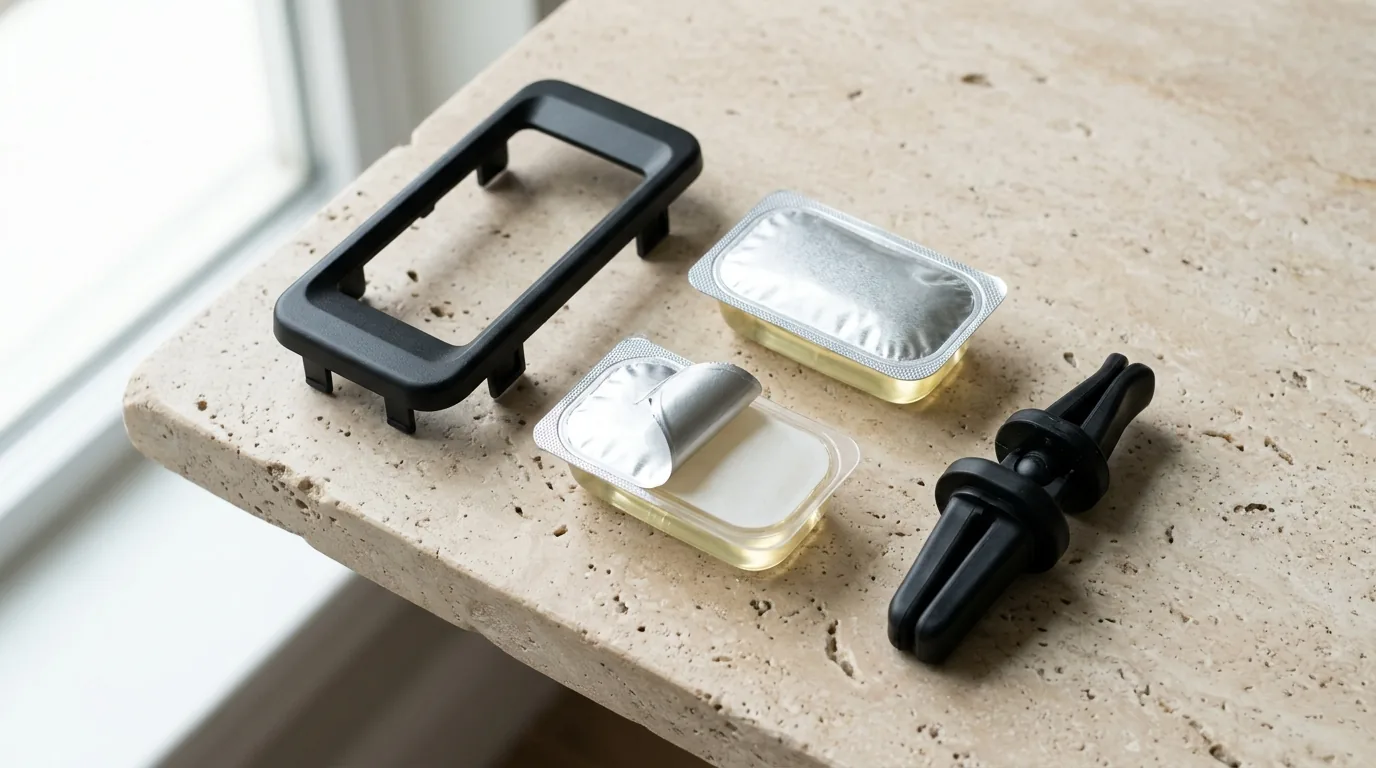
Include four component checks in your sampling brief:
- Membrane-to-formula pairing: Different fragrance solvents and essential oil loads evaporate at different rates. Never approve a fragrance oil in a blotter vial alone—evaluate throw and depletion curve inside the sealed membrane pod over an agreed observation window.
- Foil pull-tab peel force: When the customer pulls the silver barrier tab, it must release cleanly across the full window without delaminating the underlying white breathable membrane or leaving adhesive residue.
- Reservoir clarity and color stability: Because many buyers choose clear front windows so users know when to replace the pod, note whether vanillin-, citrus-, or spice-heavy formulas may darken under dashboard light and decide early whether tinted oil or a semi-frosted window is preferable.
- Clip tension and louver clearance: For automotive SKUs, verify clip grip thickness, silicone pad protection, and rotational clearance on common horizontal and vertical vent blades.
Planning a multi-scent membrane program? Share your target format (car vent clip or small-space pod), scent count, and packaging direction through our OEM project inquiry form to review available stock housings, sample timing, and MOQ splits.
3. Plan MOQ, Housing Molds, and Blister Card Packaging
At LoyalCrafts, the published custom MOQ planning reference for membrane perfume diffusers is 1,000 units, with stock-format samples typically prepared in 1–3 days, custom samples in 7–14 days, and bulk production in 30–40 days after sample approval and deposit. Actual minimums and schedules depend on how much customization sits in the plastic housing versus the printed card.
- Stock housing + custom printed card: Using an existing outer frame in standard matte black, white, or neutral tones while customizing the fragrance formula and full-color blister card is the fastest route for initial market testing.
- Custom Pantone injection color or pad printing: Molding the frame in a custom resin color or adding subtle logo printing may introduce color-batch minimums per shell color.
- Custom 3D housing mold: Developing a proprietary bezel silhouette requires mold engineering, T1 sample fitting around the blister flange, and tooling lead time before mass production begins.
If you are launching three or four fragrances at once, check our car air freshener MOQ and multi-SKU RFQ guide to see how shared shells and master cartons reduce component waste.
4. Pre-Shipment Seal, Orientation, and Document Verification
Before signing off on golden samples, evaluate filled, sealed pods inside their actual retail blister or carton. Copy the blank record below into your quality file and confirm the test conditions with your supplier.
| Check item | Method & conditions to define | Target observation | Sample result & owner |
|---|---|---|---|
| Unactivated barrier seal | Weigh and store sealed pods prior to pulling foil tab under agreed temperature/time | No visible liquid seepage, edge lift, or premature weight loss | To record |
| Foil pull-tab activation | Manual peel test across multiple samples from the same sealing batch | Smooth tab removal; microporous membrane remains intact and dry | To record |
| Activated inverted & heat check | Place activated units face-down and upright at agreed elevated cabin/storage conditions | Dry membrane surface with no free oil droplets or plastic crazing | To record |
| Retail card & transit fit | Drop/vibration check on packed inner boxes and export cartons | Pod stays locked in blister cavity; backing card stays flat | To record |
Because the capsule contains concentrated liquid fragrance mixture prior to evaporation, confirm hazard classification and retail back-card warnings early. IFRA conformity certificates address safe fragrance use levels for the specified product category, while ECHA Safety Data Sheet rules and U.S. CPSC FHSA guidance govern mixture hazard communication and consumer cautionary labeling in their respective markets. Use our fragrance compliance documents checklist to align document scope with your importer or regulatory reviewer before printing cards.
FAQs
What is the typical MOQ for private label membrane air fresheners?
Our planning reference starts at 1,000 units when using available housing molds with custom fragrance selection and printed retail packaging. Custom resin colors, multi-pod blister packs, or proprietary housing molds are quoted against the exact project specification.
How long does a membrane diffuser last once activated?
As a planning reference, standard vehicle vent and small-space membrane formats release fragrance for roughly 30 to 45 days. Actual duration depends on net liquid volume, formula volatility, ambient temperature, and AC airflow speed.
Does the liquid leak if the unit is tilted or mounted vertically?
When properly heat-sealed with a compatible formula, the microporous polymer membrane retains the liquid phase inside the capsule while letting fragrance vapor pass through. Buyers should still verify inverted and warm-environment performance on approved pre-production samples for each scent.
What information should I include in an RFQ for faster sampling?
Specify whether you need a car vent clip or small-space housing, preferred shell color, scent profiles, single- vs. twin-pack retail format, destination country for label space planning, and target order quantity per SKU.
5. Start Your Membrane Air Freshener Sample Brief
Ready to compare stock bezels or develop a custom membrane air care line? Compare vehicle formats on our custom car air freshener manufacturer page, review our OEM fragrance sampling process, or submit your target format, scent count, and market requirements via our project inquiry page for a tailored quotation and sampling schedule.