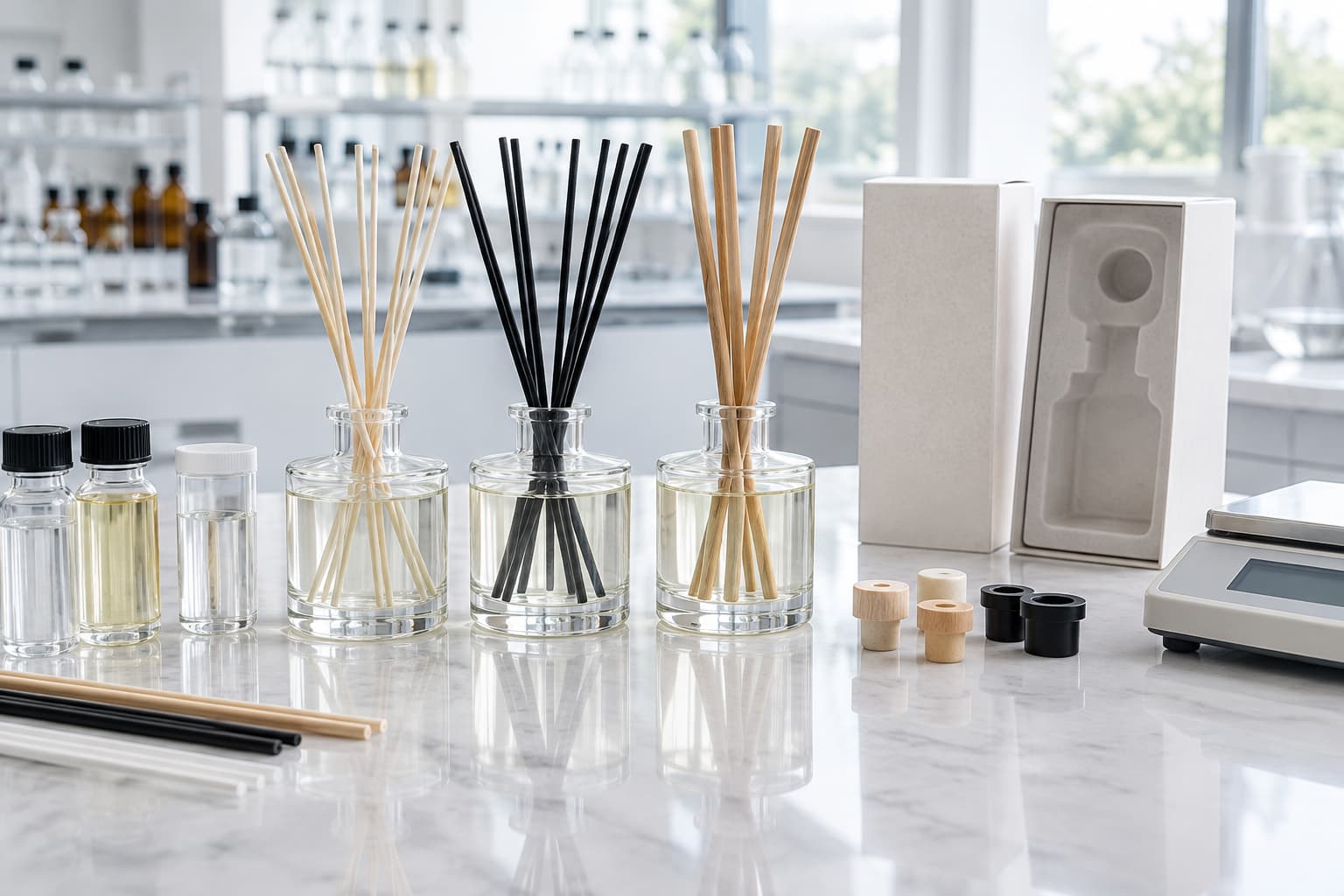
Reed diffuser formulation is the development of a fragrance-and-solvent blend for a defined bottle, reed set and use environment. For private-label sourcing, the approval target is the assembled diffuser—not a fragrance percentage in isolation.
Quick answer: Use this reed diffuser formulation guide to brief suppliers on destination countries, room conditions, scent expectations, formula restrictions, bottle specifications and reeds. Request a matched sample proposal, documented comparison conditions and market-specific document review. Evaluate unopened storage stability separately from after-opening fragrance performance.
What should the supplier know about the market and use scene?
Provide named markets and a realistic application scenario before asking for a formula recommendation. “Global distribution” and “strong fragrance” leave too much open to interpretation.
First, define the use scene: a compact bathroom, residential living room or reception area. Describe approximate room size, ventilation, temperature conditions, product position and whether users will be instructed to turn the reeds. Mark unknown conditions as open rather than inventing precise values.
Then explain what matters commercially. Is the priority a noticeable initial impression, a more even fragrance experience, a particular bottle design or a target refill interval? Treat a requested duration as a development objective requiring evidence, not an approved claim.
Include destination countries, retail or hospitality channels, intended launch timing, buyer-specific ingredient restrictions and proposed label claims. Provide a target cost for the complete set—not just the liquid—so the supplier can propose alternatives without silently changing other components.
A useful supplier response restates these priorities and identifies conflicts before offering samples. For example, if your signature bottle and reed appearance are fixed, ask the supplier to develop within those constraints rather than demonstrate the fragrance in unrelated laboratory packaging.
How should a supplier explain the fragrance and solvent pairing?
The supplier should explain why a candidate blend suits the chosen fragrance and application, rather than recommending a concentration alone. A fragrance percentage is an input, not a finished-product specification.
Start with an identifiable fragrance reference. Provide a physical sample where available, the desired fragrance family, notes to avoid and the aspects of the reference that matter: its opening character, room impression or later-stage scent. Make clear that a reference guides development; it does not authorize a claim of identical performance.
The solvent discussion should address keeping the fragrance dissolved, background odor and evaporation behavior. Solvay’s air-care technical information identifies solubilization, odor and evaporation rate as relevant characteristics of its fragrance-carrier offering. This supports asking about those properties, not assuming that one base suits every project.
Ask the supplier to state its proposed formula revision, fragrance level and measurement basis. Clarify whether any restriction means a specific substance must be excluded, or whether a broader marketing claim needs further definition.
Request the reason for each alternative: is it intended to address visible separation, scent character, consumption or another agreed concern? When evaluating proposals, favor explanations linked to your sample conditions over unsupported promises that a higher fragrance percentage will solve everything.
Ingredient data should remain separate from finished-product evidence. For example, Kuraray’s technical information for 3-methoxy-3-methyl-1-butanol describes evaporation testing in dishes and compatibility testing with fragrance chemicals. Those test configurations are not your assembled diffuser; use such data to screen candidates, then validate the actual product.
Which bottle, reed and packaging details belong in the formulation brief?
Supply the intended components or enough specifications to reproduce them in sampling. A formula proposal should identify the bottle and reeds used during evaluation, not arrive as an untraceable liquid sample.
In a conventional reed diffuser, the bottle holds the liquid while the reeds draw it upward through capillary action and release it through evaporation. This documented reed-diffuser mechanism explains why evaluating the liquid separately cannot settle how the assembled delivery system performs.
For private-label reed diffuser development, give the supplier the following details and distinguish fixed requirements from options it may recommend.
| Component | Information to provide | What the supplier should confirm |
|---|---|---|
| Bottle | Physical sample or drawing, dimensions, neck opening and intended net fill | The exact bottle and fill used in evaluation |
| Reeds | Material, length, diameter, color and number per set | Identifiable reed specification and any proposed alternatives |
| Closure | Transport stopper, cap, liner and other relevant materials | Which parts will be reviewed with the filled bottle |
| Decoration | Coating, printing, label materials and artwork status | Compatibility observations included in sampling |
| Packaging | Retail box, insert, reed protection and shipping configuration | Whether tests use the intended finished pack |
| Instructions | Placement, reed insertion and proposed turning routine | The use protocol followed during comparison |
Do not accept “standard reeds” as the only production reference. Ask whether the proposed material is natural rattan, fiber or another construction, and record the supplied specification.
Equally, do not assume every fragrance in a collection can inherit the same approval because its bottle looks identical. Request a rationale for which fragrance-and-reed combinations need separate review.
If the packaging is still provisional, identify that limitation explicitly. A sample can answer a formulation question without also approving a closure, decorated bottle or retail pack that was not tested.
What sample evidence should you request before selecting a formula?
Request a comparison that explains the recommendation, not simply several bottles to smell. Agree on the questions, sample quantities, conditions, inspection intervals and acceptance criteria before evaluation begins.
A focused supplier comparison can address three questions:
- Does the proposed liquid remain acceptable in the closed pack? Review the actual filled bottle and closure under agreed storage conditions. Record appearance, visible separation, fragrance character after opening, leakage observations and relevant changes to contacting materials.
- Does the assembled diffuser meet the intended in-use experience? Use the specified bottle, fill and reeds in the agreed environment. Record perceived intensity and fragrance character at consistent intervals, together with temperature, ventilation and reed-handling conditions.
- Does an alternative solve a defined problem? Where practical, change one variable at a time. Compare candidate liquids with the same hardware, or compare reed options with the same liquid; otherwise, the reason for a different result remains unclear.
Use separate samples for closed-pack and in-use evaluation, and identify each sample by formula and component references. Ask for observations, not only a pass/fail conclusion.
If product mass is tracked, keep that measurement separate from sensory scores. Liquid consumption alone does not demonstrate an acceptable fragrance experience.
Unopened stability and after-opening scent performance are separate approval questions. A closed-pack review cannot, by itself, substantiate a claim about fragrance duration in a consumer’s room.
Before approving, test the finished system with the selected liquid and production-intended components. A preliminary scent sample may help shortlist a direction, but it does not settle packaging compatibility or the performance of a later reed substitution.
Which documents need review for the actual formula and destination?
Request documents tied to the fragrance reference and finished-formula revision, and identify who will review them for each market. Do not treat a generic certificate folder as approval of the product you intend to buy.
For the International Fragrance Association (IFRA) Standards, request a Certificate of Conformity identifying the fragrance mixture, intended application, applicable amendment and permitted use level. IFRA explains that suppliers issue these certificates and that they do not replace a safety assessment or applicable national requirements. See IFRA’s guidance on understanding the Standards.
Standards tracking also matters. IFRA’s 31 August 2026 end-of-consultation announcement states that formal notification of the final 52nd Amendment is expected in January 2027. Do not treat that consultation update as immediate implementation; ask which requirements and transition dates apply to the project.
For the European Union (EU), the European Chemicals Agency (ECHA) explains that mixture classification determines relevant requirements under the Classification, Labelling and Packaging (CLP) Regulation. Even some mixtures not classified as hazardous can require supplemental labeling. Request the finished-mixture classification, relevant Safety Data Sheet (SDS) and label review rather than relying only on raw-fragrance paperwork; ECHA’s classification and labeling guidance explains the relationship.
Where poison-centre notification applies, confirm submission responsibilities and the Unique Formula Identifier (UFI). ECHA states that a UFI links a product to its notified mixture composition; generating the code alone does not complete notification. See ECHA’s UFI guidance.
For other destinations, obtain the relevant local review rather than reusing EU artwork by default. Keep claims, shipping documentation and any additional required formula information on the project review list.
What should you send for a useful formulation proposal?
Send one coordinated brief containing your market and use assumptions, fragrance reference, fixed component specifications, proposed claims, target cost and evaluation priorities. Ask the supplier to return a proposed configuration, alternatives with reasons, a comparison plan and the documents it can support.
Select the proposal that makes its assumptions and unresolved questions visible. After the agreed review, retain the approved reference together with the formula code, bottle, closure, reed specification, packaging version and evaluation record.
Approval belongs to a defined configuration, not to a scent name. An approved sample does not automatically validate a later variation in fragrance, solvent, reeds or contacting packaging; review the changed version again according to what changed.
Before converting the selected proposal into a purchase order, link the approved formula and component revisions to the supplier's quotation, the purchase specification and the retained sample. Record any provisional parts, open document reviews and the person responsible for release. Use the bottle and closure sample approval checklist for component references and change-review records, so the formulation decision and the production brief identify the same finished configuration.
LoyalCrafts focuses on finished fragrance products and private-label development, including fragrance selection, material matching, packaging development, sampling and mass production. Submit a reed diffuser technical inquiry with the assembled brief so the proposed formula can be reviewed alongside the bottle, reeds, market and intended use.