
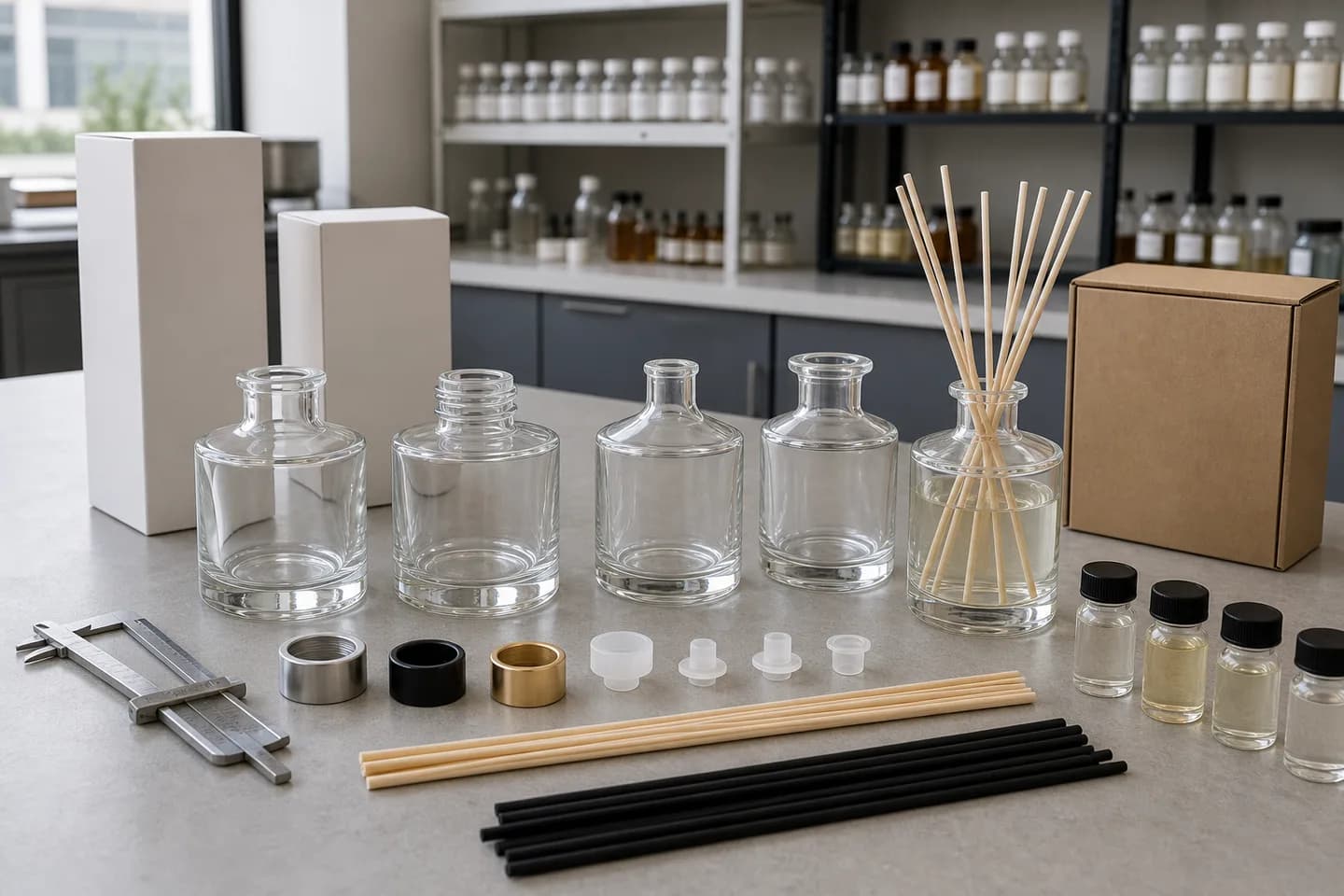
Quick answer: A reed diffuser bottle should be selected as part of the finished system, not as a standalone decoration. Before approving a private label sample, confirm the intended fill capacity, bottle material and neck finish, cap and plug fit, reed opening, label area, individual pack and the handling or leakage checks relevant to the actual project.

Why Bottle Selection Comes Before a Final Quote
Two reed diffuser bottles can look similar online but create very different production questions. Their usable fill volume, neck opening, glass weight, shoulder shape, label panel, cap thread or stopper fit, and carton protection can all affect how the finished product is sampled and packed. For a retail buyer, the bottle is part of the brand presentation. For the factory team, it is one part of a complete product containing fragrance base, reeds, cap, decoration and packaging.
Start with the customer use scene. A compact gift diffuser, a hotel room diffuser and a larger home-fragrance program may need different capacities and different packaging priorities. It is more useful to define the desired retail position and bottle reference than to request a generic diffuser-bottle quotation. For broader options, see our Reed Diffuser Manufacturer page.
1. Define Capacity as a Product Decision
Capacity is not only a number printed on a label. The buyer should confirm the target fill, usable headspace, bottle shape and intended retail position. A bottle that appears large may have a narrow shoulder or base that changes usable volume. The chosen fill also affects carton size, shipping weight, label layout and the visual relationship between liquid and bottle.
- Target fill: the volume the approved product is intended to contain.
- Headspace: room needed for the selected closure and normal handling.
- Neck opening: practical space for reeds, plugs and caps.
- Retail use: whether the item is for gifting, hospitality or repeat home use.
Do not treat a visual reference image as a final specification. Ask for the sample bottle or a drawing that identifies the relevant size and finish, then review the filled version before production approval.
2. Check the Neck Finish, Plug and Cap Together
The neck finish is where bottle, plug, cap and reeds meet. A cap can look correct on an empty bottle but fit differently once a plug, fragrance base and reeds are involved. Identify whether the product needs an inner plug, decorative collar, threaded cap, wood cap, or another closure route. This also determines what the customer will remove or open before use.
Review the finished combination rather than approving components separately. Check whether the cap sits squarely, whether the plug is consistent, whether the reeds fit without forcing the opening, and whether the finished presentation remains clean after filling and packing. A changed cap, stopper or bottle supplier should trigger a review of the revised finished sample.
- Identify the interfaces: record the bottle supplier and drawing revision, neck finish or thread reference, opening dimensions and agreed tolerances. Match these to the plug, cap and liner part numbers. A shared nominal diameter is not sufficient evidence of fit.
- Separate transport from use: identify the closure that seals the filled bottle in transit and the collar or opening used with reeds. Ask the supplier to show what the customer removes and retains; do not assume a decorative collar is a transport seal.
- Specify assembly: ask for the intended plug insertion or cap application method and any supplier-defined settings. Review opening and removal on the actual sample. Record applicable limits from the component supplier instead of inventing a universal torque or insertion force.
- Confirm the contacting materials: identify the plug, liner and any seal in contact with the liquid. Review the actual formula with those parts, including fit and visible condition after agreed storage and handling.
3. Build a Practical Leakage and Pack Review
Reed diffusers are normally displayed upright, yet handling, warehousing and shipment can introduce other positions. The relevant check is not a universal promise that every bottle will never leak. It is a project-specific review of the actual bottle, closure, liquid, label and pack under agreed handling conditions. Record what version was tested and what result the buyer accepted.
| Area | What to confirm |
|---|---|
| Bottle and neck | Glass condition, neck finish, fill appearance and compatibility with the selected plug or cap. |
| Closure | Plug, cap, collar and any seal used in the approved sample. |
| Decoration | Label position, print or coating condition, and visible marks after review. |
| Packaging | Inner support, retail box, divider and shipping-carton arrangement for the actual product. |
Suggested verification, not a reported test result: agree the sample count, fill, closure application, orientations, temperature range, duration and acceptance criteria with the supplier or test provider before testing. Link observations and photographs to each sample ID. This checklist reports no completed LoyalCrafts leakage test and sets no universal pass threshold.
For an EU-bound liquid classified as hazardous, ECHA's CLP packaging guidance requires packaging that prevents unintended escape and resists damage by its contents. Ask the responsible market reviewer to assess the actual product and pack; a buyer's sample checklist is not evidence of regulatory compliance.
4. Keep Bottle Design and Reed Choice Connected
Reeds are part of the final appearance and use. Fiber and rattan sticks have different visual and material characteristics, while length, diameter, color and count should be selected with the bottle opening and retail presentation in mind. A short, wide bottle and a tall, narrow bottle can need different stick proportions even when the fragrance direction is similar.
Use the Reed Diffuser Stick Size Guide for a focused review of diameter, length and material selection. The purpose is not to promise one universal scent result; it is to define the physical components that need to be present in the approved sample.
Use the reed diffuser formulation guide for the liquid proposal and comparison conditions. Keep the bottle and closure references consistent between that brief and this component checklist.
5. Clarify What the Supplier Is Quoting
State whether you need an empty bottle, a filled reed diffuser, a refill, or fragrance material. These are different purchasing scopes. For a finished retail product, list the bottle, liquid, closure, reeds, decoration and packaging in the same brief. Ask the supplier to confirm which items are included and which require a separate quotation.
Separate your pilot quantity from the intended repeat order, and give the quantity per fragrance and packaging variant. If you prefer an existing bottle to avoid developing a new mould, say so before sampling. A reference capacity or photograph is a request for review; it does not establish that a suitable bottle, filling process or export arrangement is available.
| Purchasing scope | Include in the request | Confirm separately |
|---|---|---|
| Empty bottle or component set | Bottle drawing, finish, decoration, protective pack, and any requested plug or cap. | Which closures are included; who sources the liquid, fills and assembles the product, and validates the completed combination. |
| Filled retail reed diffuser | Ready-to-use liquid reference and net fill, bottle, transport seal, cap or collar, reeds, labels, instructions and retail/shipping pack. | The complete component list, filling and packing responsibilities, and approvals needed for the destination. |
| Ready-to-use refill | Refill liquid reference and fill, refill container and closure, pouring route, label and compatible original diffuser. | Whether replacement reeds or accessories are included; whether the refill-and-bottle combination has been reviewed. |
| Fragrance concentrate or base | The exact material requested and its intended role in formulation. | Availability, formulation responsibility and further processing. Do not describe an ingredient as a ready-to-use refill. |
If a refill is part of the range, use the refillable diffuser buying guide to define the pouring and packaging route. Listing a scope here does not confirm that LoyalCrafts supplies every component or ingredient separately.
6. Keep a Reed Diffuser Sample Approval Record
A sample approval record identifies the exact product version a buyer has reviewed: bottle, fill, fragrance reference, closure, reeds, decoration and pack. Use it to make differences between samples visible. It is a purchasing worksheet, not a laboratory certificate or a guarantee that an untested combination will perform the same way.
Copy the fields below into your project brief. Mark unresolved items as “to confirm” and record who will confirm them. Do not label an entire product approved when only the bottle appearance has been accepted.
| Record field | What to write |
|---|---|
| Project and sample version | Your reference, sample ID, review date and reviewer. |
| Purchasing scope | Empty bottle, filled product or refill; list included components and exclusions. |
| Bottle and fill | Bottle supplier and drawing revision, material, dimensions, target fill and agreed tolerances; plug, cap and liner part numbers and materials. |
| Fragrance and reeds | Fragrance and finished-formula revision; reed supplier or part code, material, diameter, length and count. |
| Decoration and packaging | Artwork revision, label or coating, retail box and shipping-pack references. |
| Market and order | Destination, pilot quantity and intended quantity per fragrance or pack variant. |
| Review conditions and evidence | Test-plan revision, sample count and IDs, assembly settings, conditions, acceptance criteria, observations and linked evidence. Use “not evaluated” where no result exists. |
| Decision and open points | Approved scope only, rejected items, open questions, named decision owner, approval date and retained-sample location; link the accepted version to the purchase order and production specification. |
When a bottle, closure, fragrance, reed specification or pack changes, identify the revised version and agree which checks need repeating before approval. Keep the earlier record for comparison. A component change should not inherit approval merely because the product name remains the same.
Keep document revisions beside the component record. A fragrance supplier's IFRA Certificate of Conformity addresses the fragrance mixture for its intended use; it does not replace a finished-product safety assessment. Record which formula, use and document version were reviewed, without presenting this worksheet as certification.
7. Decide What Must Be Rechecked After a Change
The following is a suggested change-review map. The responsible reviewer should set the actual repeat checks and document any justified carry-over of prior evidence.
| Changed item | Review before releasing the revised version |
|---|---|
| Bottle supplier, mould, neck dimensions, plug, liner or cap | Drawing and tolerance match, assembly/removal, filled closure compatibility, leakage observations and pack fit. |
| Fragrance, solvent or fill target | Closed-pack compatibility and appearance; filled transport configuration; document and label applicability; in-use comparison with the chosen reeds. |
| Reed material, supplier, diameter, length or count | Opening fit, presentation, protection in transit and in-use performance under the agreed comparison conditions. |
| Coating, label, ink or adhesive | Artwork identity, fit and legibility, contact marks and relevant compatibility observations. |
| Refill pack, carton, insert, assembly process or shipping arrangement | Opening/pouring where relevant, closure and component protection, and the handling review appropriate to the revised route. |
Record the old and new versions, the reason for change, evidence required and the person authorizing release. Keep approval of appearance separate from approval of liquid compatibility, handling or documentation. An unresolved item remains open until the agreed evidence is reviewed.
8. What to Send in the First OEM Inquiry
Start with the purchasing scope, bottle reference, target fill, fragrance direction, destination and quantity per variant. Add your reed, closure and packaging preferences, plus the points you want the sample to resolve. If a detail is undecided, write “to confirm” rather than selecting a specification only to complete the form.
Ask LoyalCrafts to confirm component availability, sample timing, minimum order requirements and documentation for the specific project. These should be confirmed against the selected product and destination before you commit to a launch schedule.
Need a reed diffuser bottle sample review?
Send the bottle reference, fill target, cap or plug idea, reed preference, target market and packaging reference. We can organize the next sample questions around the actual finished system.
FAQ
What should a reed diffuser sample approval record include?
Record the sample ID and version, bottle and fill target, fragrance reference, closure, reed specification, artwork and packaging. Add the agreed review conditions, results, reviewer and open questions. Keep this record with the sample so a later component change can be compared with what was actually reviewed.
Does the bottle neck finish matter for a reed diffuser?
Yes. It affects the fit of plugs, caps and reeds, as well as the finished appearance and sample checks needed before production.
Should buyers test the bottle empty or filled?
Review the filled finished system where possible. The fragrance base, plug, cap, reeds, decoration and packaging can affect the result together.
Can one bottle be used for several fragrance variants?
Often yes, but each fragrance, decoration and packaging combination should still be reviewed as the actual project requires.
Summary
A reed diffuser bottle OEM decision is a finished-system decision. Confirm capacity, neck finish, cap and plug fit, reed presentation, decoration and packaging together, then retain the approved sample as the project reference.