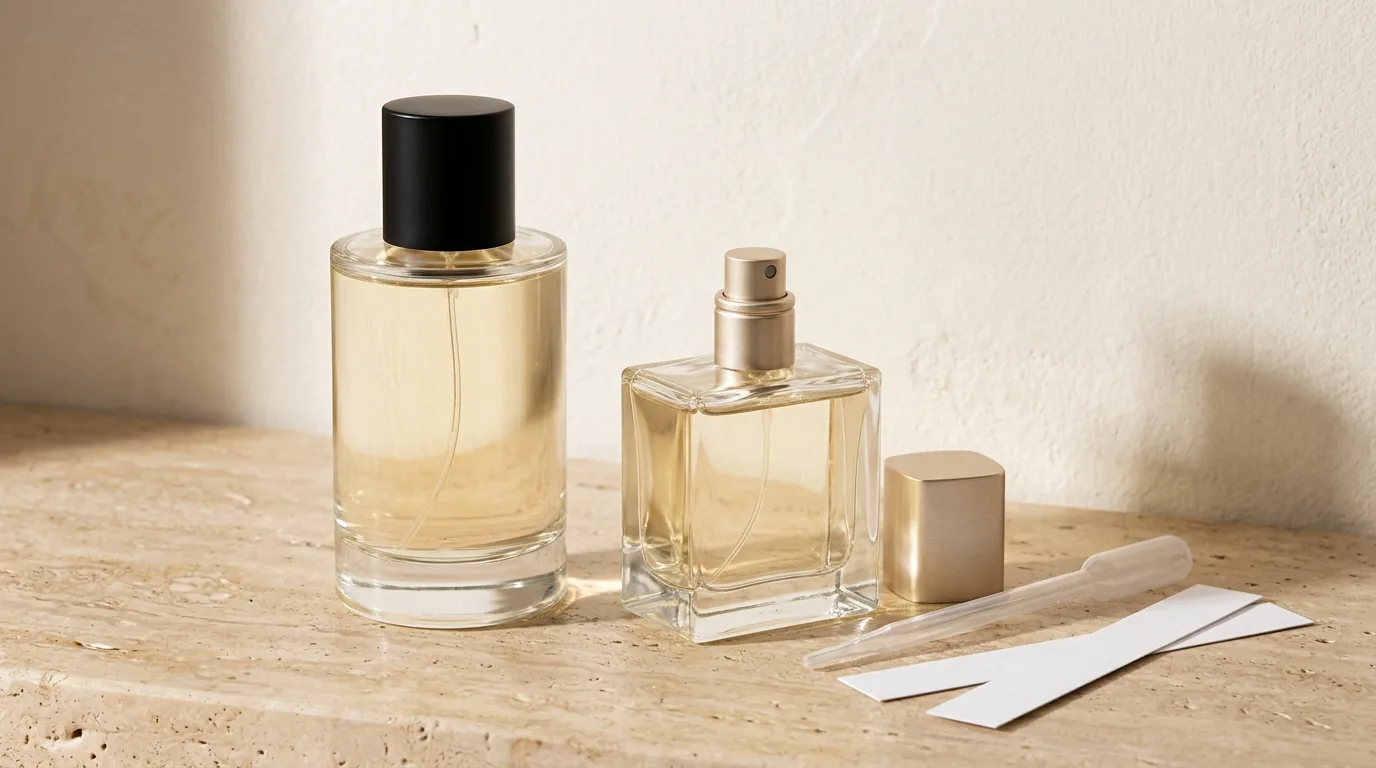
Quick answer: A commercial private label body perfume succeeds when carrier purity and oil concentration, tank maceration and sub-zero chill filtration, flacon neck finish (FEA15 crimp vs. screw-neck) and dip-tube geometry, and IFRA Category 4 cosmetic compliance are locked together before filling. Under our Cosmetics Production License (obtained 2025), LoyalCrafts develops Eau de Parfum (EDP, 8–12 hour wear planning reference), Eau de Toilette (EDT), and alcohol-free body mists starting from 1,000 units custom MOQ (planning reference)—pairing vacuum leak inspection and UV stability screening with project-specific UN1266 Class 3 dangerous-goods or non-DG export documentation.
Most private label perfume briefs open with mood boards, reference bottle silhouettes, and target unit FOB pricing. Yet post-launch retail claims rarely fail on top-note appeal—they fail when un-filtered musk or resin waxes cloud inside cold air-freight cargo holds, when loose screw-neck atomizers seep in transit, or when sweet vanillin formulas turn dark amber under retail display spotlights.
At our 11,000 sq m Jinhua facility—operating 6 automated lines backed by fragrance manufacturing experience since 1998, a 3,500+ formula library, and our Cosmetics Production License—our private label body perfume OEM team treats the liquid, glass flacon, pump crimp collar, and destination compliance dossier as a single engineered system. Use this guide to write an unambiguous technical RFQ and approve your Golden Sample without downstream surprises.
1. Define Concentration Tier, Carrier Ethanol Grade, and Color Stability
In contract perfumery, requesting "strong EDP" or "alcohol-free mist" without locking solvent purity, water ratio, and antioxidant protection creates wide discrepancies between competing quotes. Compare the four commercial personal-fragrance architectures before briefing sample trials:
| Product tier | Typical fragrance load ref. | Primary carrier & solvent system | Clarity & UV stability focus | Export freight & compliance profile | Primary channel fit |
|---|---|---|---|---|---|
| Eau de Parfum (EDP) | 15%–20% (varies by IFRA Cat. 4 cap and oil density) | High-purity denatured cosmetic ethanol (e.g., SD Alcohol 40-B) + deionized water | Requires maceration, sub-zero chill filtration, and UV absorber / BHT checks for vanillin-rich formulas | Closed-cup flash point ≤ 60 °C; ships as UN1266 Class 3 DG or Limited Quantity | Signature luxury collections, specialty beauty retail, and hotel gift programs (8–12h wear ref.) |
| Eau de Toilette (EDT) | 8%–14% depending on top-note volatility | Cosmetic-grade denatured ethanol + balanced deionized water ratio | Higher water ratio demands strict chill-cloud testing on citrus and woody oils | UN1266 Class 3 DG; verify net volume per inner pack for air/parcel lanes | Everyday lifestyle lines, travel sprays, and multi-scent discovery kits |
| Ethanol Body Mist | 3%–6% light, fast-flashing profile | Hydro-alcoholic carrier tuned for wider plume dispersion | Monitor alcohol odor masking at low fragrance load during blotter test | Check closed-cup flash point and PET vs. glass alcohol stress compatibility | High-volume personal-care chains, seasonal launches, and layering sets |
| Water-Based / Alcohol-Free Mist | 2%–5% solubilized micro-emulsion | Purified water + non-ionic solubilizers + cosmetic preservative system | Requires preservative efficacy screening and pH / phase-separation cycling | Non-flammable profile (flash point > 60 °C / non-DG subject to batch SDS) | Sensitive-skin positioning, aviation-friendly travel sizes, and youth retail |
Never skip UV and vanillin color-shift screening on transparent glass flacons: Gourmand, amber, and vanilla accords oxidize and darken rapidly under fluorescent retail lighting or summer warehouse heat. During custom sampling, confirm whether your formula requires UV stabilizers, antioxidants, or tinted/lacquered glass—and review our body perfume vs. body mist positioning guide when deciding which tiers belong in your launch assortment.
2. Why Maceration and Sub-Zero Chill Filtration Prevent Cold-Weather Clouding
Freshly compounded fine fragrance is not ready for immediate bottling. Alcohol, deionized water, aromatic esters, and natural absolutes require controlled resting (maceration) so trace water-alcohol hydrogen bonding stabilizes and the top-to-base drydown rounds out cleanly.
- Eliminating cold-chain precipitation: Natural citrus terpenes, plant waxes, and heavy synthetic musks that look crystal-clear at 22 °C inside a factory lab can precipitate into visible haze or microscopic flakes when air cargo or winter sea containers drop near 0 °C.
- Sub-zero chill filtration before filling: After tank maceration, bulk fine-fragrance batches are cooled under controlled conditions (commonly down to sub-zero chill temperatures suited to the oil system) and passed through fine micron polishing filter pads. Filtering while chilled removes insoluble wax fractions permanently, keeping retail bottles optically clear across winter store displays.
- Headspace and filling tolerance: Leave calibrated bottle headspace (thermal expansion allowance) inside sealed glass flacons so liquid expansion at 45 °C transit temperatures does not force liquid into the pump valve or rupture weak gaskets.
3. Match Flacon Neck Finish (FEA15 Crimp vs. Screw-Neck) and Atomizer Specs
For buyers sourcing custom body perfume OEM packaging, the bottle neck finish is a mechanical engineering decision—not just an aesthetic detail. A single mismatch of 0.2 mm on glass neck land height or gasket compression can cause 10% alcohol evaporation within six months on retail shelves.
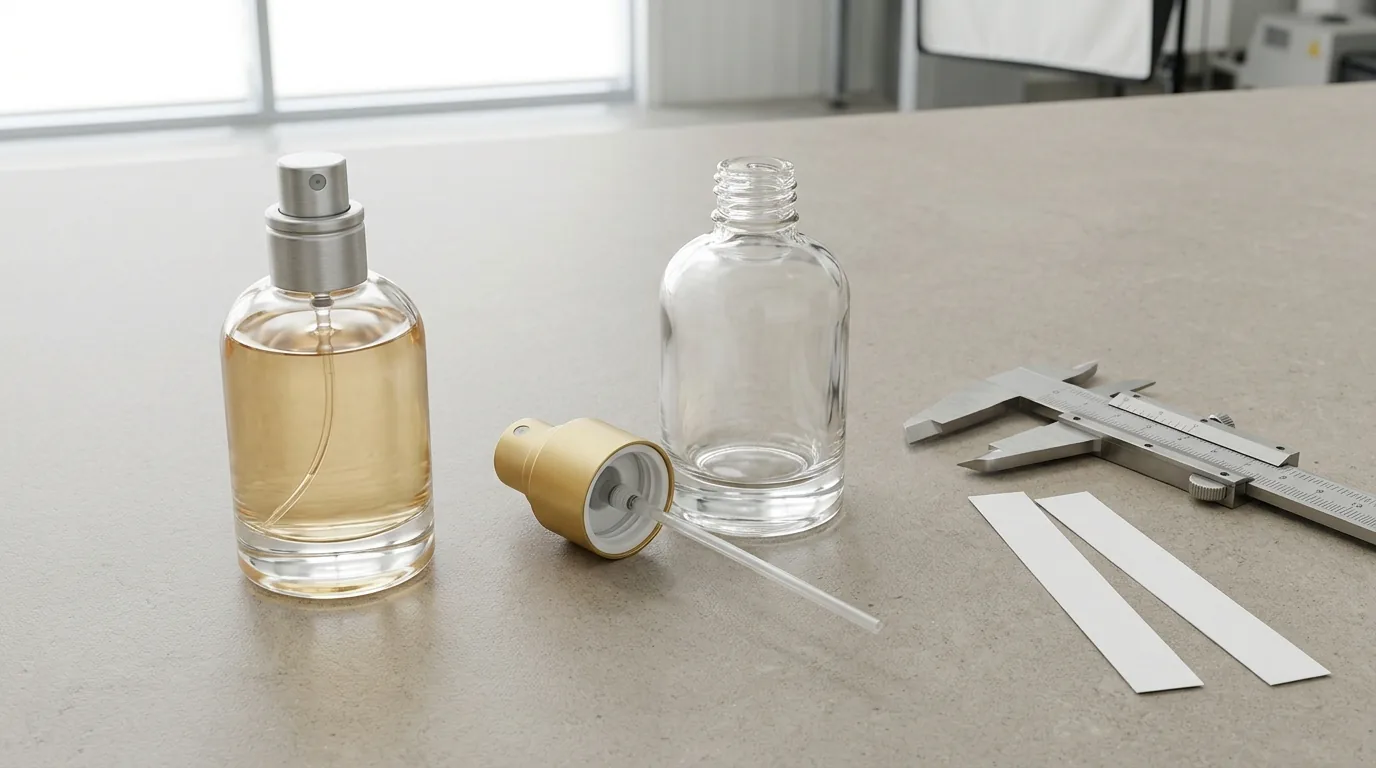
- FEA15 Crimp-Neck Atomizer (Industry Standard for EDP/EDT): Uses a standardized 15 mm glass rim sealed permanently by a mechanical crimping head that rolls an aluminum ferrule underneath the bottle neck lip. Crimp pumps deliver superior hermetic vapor sealing against ethanol evaporation, tamper resistance for brick-and-mortar retail, and clean decorative collar seating. Require incoming glass neck-ring dimensional checks with calipers before scheduling high-speed crimping.
- Screw-Neck / Refillable Atomizer (GPI Thread): Allows hand-torque or chuck-capper assembly without specialized crimping jaws and supports consumer refill concepts. However, screw threads require elastomeric liners calibrated for ethanol resistance and strict torque retention checks so vibration during ocean freight does not back off the collar and trigger leakage.
- Dip-tube length and J-curve corner trim: Specify dip-tube cut length relative to bottle internal height so the tube arches smoothly into the lower corner (typically leaving ~1–2 mm clearance without kinking or pushing upward against the valve housing).
- Actuator dosage and spray plume: Confirm micro-dose output per press (commonly 70–120 mcL depending on fine-mist vs. wider mist nozzle inserts) and inspect spray cone uniformity using the actual finished formula—water test sprays do not replicate ethanol surface tension.
- Vacuum chamber leak testing: During Golden Sample sign-off and inline QC, invert filled bottles inside a vacuum test chamber to detect hairline crimp micro-leaks or gasket bypasses before master cartons are sealed.
4. Align IFRA Category 4, EU 1223/2009 / U.S. MoCRA, and UN1266 Export Freight
Unlike reed diffusers or candles, body perfume is applied directly to human skin—moving your project out of general home-fragrance air care and into regulated cosmetics territory:
- IFRA Category 4 (Fine Fragrance Leave-On Limit): Category 4 governs hydroalcoholic and non-alcoholic products applied to unshaven skin (perfumes, EDT, body mists). Never repurpose an indoor air-care oil blend (Category 10A/12) into a skin spray without re-issuing a project-specific IFRA Category 4 certificate verifying restricted sensitizers such as oakmoss, bergapten, or cinnamal.
- EU Cosmetics Regulation (EC) No 1223/2009 & Allergen Disclosure: Placing fine fragrance on the EU/UK market requires an appointed Responsible Person, a Product Information File (PIF), a qualified Cosmetic Product Safety Report (CPSR), GMP conformity, CPNP notification, and full INCI ingredient plus regulated fragrance allergen labeling on outer cartons. Confirm which raw formula, IFRA, SDS, and allergen percentage breakdowns your safety assessor needs before locking box artwork.
- U.S. FDA MoCRA Compliance Context: Under the Modernization of Cosmetics Regulation Act (MoCRA), U.S. brands acting as the Responsible Person must plan for facility registration, product listing, safety substantiation records, adverse event contact labeling, and upcoming fragrance allergen disclosures. Request GMP-aligned production records and ingredient disclosures from your factory partner early in onboarding.
- UN1266 Class 3 Dangerous Goods vs. Non-DG Freight: Because ethanol-based EDP and EDT carry a closed-cup flash point at or below 60 °C, ocean and air shipments classify as UN1266 (Perfumery Products, Class 3) requiring UN-certified 4G outer cartons, batch SDS Section 14, and DG freight booking. Check carton packing limits and drop protection in our fragrance export shipping and drop-test guide and B2B fragrance compliance document checklist.
5. Blank Body Perfume Golden Sample & Pre-Production Sign-Off Sheet
Copy this verification record directly into your RFQ or pre-production Golden Sample protocol before releasing glass decoration and rigid box printing. As LoyalCrafts planning references, custom body perfume MOQ starts at 1,000 units (stock glass flacons with custom branding; bespoke glass molds carry separate tooling minimums), stock samples prepare in 1–3 days, custom scent/bottle samples prepare in 7–14 days (allow additional calendar time when extended maceration and chill-filtration stability observation is requested), and bulk production runs 30–40 days after sample approval and deposit.
| Inspection checkpoint | Specification & test condition to lock | Target acceptance criteria | Status & owner |
|---|---|---|---|
| Formula code, wear & solvent grade | Confirm EDP/EDT/mist concentration tier, denatured ethanol grade (or alcohol-free solubilizer), and blotter/skin drydown vs. signed scent reference | Matches approved odor profile across top, heart, and base drydown (8–12h EDP wear planning reference) | To record |
| Maceration & chill-filtration clarity | Hold filled sample through cold cycle (e.g., 0 °C to -5 °C) and 45 °C heat cycle; inspect under bright light against white card | Optically clear liquid; zero haze, wax precipitation, flocculation, or phase separation | To record |
| UV & color-shift screening | Expose filled clear-glass sample to UV / window-light cycle vs. dark-stored control sample | No severe amber darkening or ink/lacquer peeling; UV additive verified if needed | To record |
| FEA15 crimp / screw seal & vacuum test | Measure bottle neck ring tolerances, crimp collar engagement or screw torque, and invert filled sample in vacuum chamber | Zero bubbling, weeping around collar, or weight-loss drift across vacuum/thermal cycle | To record |
| Atomizer spray cone & dip-tube fit | Actuate 10+ consecutive sprays to verify prime speed, mist cone dispersion, cap pull-force, and corner-curved dip-tube reach | Fine uniform mist without streaming jet; dip tube reaches lower corner cleanly without kinking | To record |
| Cosmetic dossier & UN1266 carton spec | Confirm IFRA Cat. 4 certificate, allergen table, SDS Section 14 flash point, INCI box artwork, and inner-divider drop protection | Document set aligned with destination market (EU 1223/2009 / U.S. MoCRA) and carrier UN1266 or non-DG packing | To record |
Ready to move from concept to filled evaluation flacons? Explore our licensed private label body perfume OEM capabilities and body perfume flacon portfolio, or send your target bottle volume (30 ml, 50 ml, 100 ml), concentration tier, fragrance direction, and destination market via our B2B fragrance inquiry form.
FAQs
What is the MOQ and lead time for private label body perfume manufacturing?
As planning references, custom private label body perfume orders start at an MOQ of 1,000 units when pairing stock glass flacons with custom spray/silkscreen branding, labels, and printed cartons. Stock reference samples dispatch in 1–3 days, custom formula and bottle samples prepare in 7–14 days, and bulk production runs 30–40 days after Golden Sample sign-off and deposit (excluding extra custom glass mold tooling timelines if required).
Why should buyers choose an FEA15 crimp-neck pump over a screw-neck bottle for EDP?
An FEA15 crimp-neck atomizer mechanically rolls an aluminum ferrule beneath the glass neck lip, creating a permanent hermetic vapor seal that prevents ethanol evaporation, avoids cap torque back-off during sea freight, and provides tamper-evident retail presentation. Screw-neck pumps are better suited to refillable packaging concepts and require ethanol-compatible gaskets plus strict torque checks.
What does sub-zero chill filtration do in contract perfume production?
After bulk perfume oil and cosmetic alcohol finish tank maceration, chilling the blend below freezing before micron filtration precipitates out insoluble plant waxes, heavy musks, and trace resin fractions. Removing them on the factory floor ensures finished clear-glass bottles will not turn cloudy during cold air cargo or winter retail storage.
Can alcohol-based private label perfumes ship by sea or air without dangerous-goods paperwork?
No. Ethanol-based Eau de Parfum and Eau de Toilette typically carry a closed-cup flash point at or below 60 °C and must be declared under UN1266 (Perfumery Products, Class 3 Flammable Liquid) with a batch SDS Section 14, UN-certified cartons, or qualifying Limited Quantity packing. Only water-based or high-flash-point alcohol-free mists can be reviewed for Non-DG general cargo once verified by lab flash-point testing.