
Quick answer: In international fragrance export, a liquid SKU's closed-cup flash point relative to 60 °C (140 °F) determines whether freight sails as Class 3 Flammable Liquid (such as UN1266 Perfumery Products) or qualifies for review as Non-Dangerous Goods (Non-DG). Ethanol-heavy body perfumes and hydro-alcoholic sprays usually require Class 3 DG or Limited Quantity handling, whereas high-flash-point Augeo/DPM reed diffusers, purified water-based mists, poured wax candles, and dry solid EVA or vermiculite sachets typically move as general cargo once verified by batch SDS Section 14 and carrier transport identification reports. Before booking ocean or air freight, pair your transport classification with vacuum/inversion leak checks and corrugated carton drop protection.
Many private label buyers calculate unit landed cost using FOB bottle pricing alone, only to encounter surprise dangerous-goods (DG) surcharges, air-courier refusals, or crushed inner cartons at destination ports. Fragrance products cross two distinct regulatory and physical hurdles during international shipping: chemical flammability classification under UN transport rules and mechanical impact stress on heavy glass vessels across multi-tier palletized sea containers or parcel hubs.
From our 11,000 sq m Jinhua manufacturing facility—operating 6 automated filling and packing lines and supported by a 3,500+ fragrance formula library—LoyalCrafts OEM/ODM teams coordinate carrier selection, closed-cup flash point documentation, and export carton engineering before bulk filling begins. Use this operational guide to align formulation chemistry, UN1266 vs. Non-DG planning, and transit packaging checks before releasing purchase orders.
1. How Closed-Cup Flash Point Separates UN1266 Class 3 from Non-DG Freight
Under the UNECE Model Regulations for the Transport of Dangerous Goods (which underpin IMDG Code ocean rules, IATA air rules, and ADR road rules), liquid flammability for transport is governed by closed-cup flash point—not by fragrance oil percentage or retail brand positioning:
- Flash point ≤ 60 °C (Class 3 Flammable Liquid): Finished liquids with a closed-cup flash point of 60 °C or lower fall inside Class 3. Alcohol-based private label EDP/EDT body perfumes and hydro-alcoholic room sprays are most commonly classified under UN1266 (Perfumery Products)—or UN1993 (Flammable Liquid, n.o.s.) depending on formula profile and carrier rules—split between Packing Group II (flash point < 23 °C) and Packing Group III (flash point 23 °C to 60 °C).
- Flash point > 60 °C (Non-DG General Cargo Review): When a finished liquid formulation is compounded with high-flash-point solvents—such as Augeo Clean Multi, dipropylene glycol methyl ether (DPM), or purified water dispersions—and laboratory closed-cup testing confirms a flash point above 60 °C with no secondary transport hazards, the SKU typically qualifies for Non-Dangerous Goods sea or air identification reporting.
- Dry solids and poured waxes: Molded EVA polymer cards, vermiculite paper/linen sachets, and poured wax scented candles contain no free flammable liquid pool at ambient transit temperatures and generally travel as standard general cargo (subject to carrier thermal-stowage notes for low-melt natural soy waxes).
Never request generic or altered flash-point paperwork: Misdeclaring a high-ethanol perfume as Non-DG risks container holds, customs fines, and carrier bans. If your supply chain requires lower-cost air express or standard LCL consolidation without DG booking premiums, shift carrier architecture at the brief stage rather than during pre-shipment inspection—for example, selecting a water-based room & linen mist or an alcohol-free reed diffuser base.
2. Fragrance Category Export Classification & Packaging Risk Matrix
Transport rules, freight-mode economics, and physical leakage mechanisms vary sharply across LoyalCrafts' core product categories. Use the planning matrix below when budgeting FOB, EXW, DDP, DDU, or FCA shipments (always confirm final classification against the batch-specific SDS and transport report):
| Product category | Typical carrier base | Flash point & UN class tendency | Primary transit risk | Recommended OEM safeguard |
|---|---|---|---|---|
| Body Perfume (EDP / EDT) | Denatured cosmetic ethanol + deionized water + fragrance oil | Typically ≤ 23–30 °C closed-cup; Class 3 (UN1266); check Limited Quantity vs. full DG thresholds | Air-freight cabin pressure drops causing pump weeping; DG carton labeling and UN-spec packaging limits | Crimp-neck FEA15 precision pumps, negative-pressure leak testing, verified UN/LQ inner-outer pack weights |
| Reed Diffuser (Liquid Vessel) | Alcohol-free Augeo/DPM/MMB base or hydro-alcoholic blend | High-flash-point alcohol-free bases (> 60 °C) commonly review as Non-DG; ethanol bases fall into Class 3 | Cap backing off under vibration; glass-to-glass impact shattering inside retail gift boxes | Inner PE travel stopper plug + torque-checked collar, custom EPE foam or 5-ply corrugated cell partitions |
| Water-Based Room & Linen Spray | Purified water micro-emulsion / low-odor aqueous dispersion | Typically > 60 °C / non-flammable; supports Non-DG air & ocean review after lab test | Trigger unlocking or actuator dip-tube leakage; chill/freeze-thaw haze in winter transit | Lock-clip mist triggers, induction/liner neck seals, 4–5 °C to 45 °C stability check prior to booking |
| Scented Candle (Glass / Ceramic) | Soy-blend, coconut, or paraffin wax | Non-DG general cargo; verify wax melt point against summer container heat | Heavy jar corner breakage; surface sweating or partial melt during unventilated summer sea transit | Double-wall master cartons with bottom crush pads, molded pulp/foam cradles, heat-reflective container planning |
| Dry Car & Closet Formats (EVA / Sachets) | Solid EVA copolymer, cellulose board, or infused vermiculite | Non-DG general cargo (contrast with liquid hanging glass car bottles) | Top-note evaporation or oil migration staining outer shipper boxes in warm holds | Heat-sealed multi-layer aluminum/KOP barrier pouches, silica desiccant where needed, inner poly liners |
When exporting small retail bottles of Class 3 perfumery products, ask your freight forwarder early about Limited Quantity (LQ) exemptions under IMDG Code or U.S. DOT PHMSA hazardous materials rules (which set strict per-inner-bottle volume caps and 30 kg gross outer package ceilings). Limited Quantity packing can eliminate full UN-specification outer carton surcharges while keeping shipments 100% compliant.
3. Align SDS Section 14, Transport Identification Reports, and Bottle Markings
Even a legitimate Non-DG formulation will stall at customs or airport security if paperwork conflicts across suppliers. As detailed in ECHA Safety Data Sheets guidance, a 16-section finished-product SDS—especially Section 9 (Physical and Chemical Properties: Flash Point) and Section 14 (Transport Information)—must describe the exact finished liquid ratio, not the raw 100% concentrated fragrance oil.
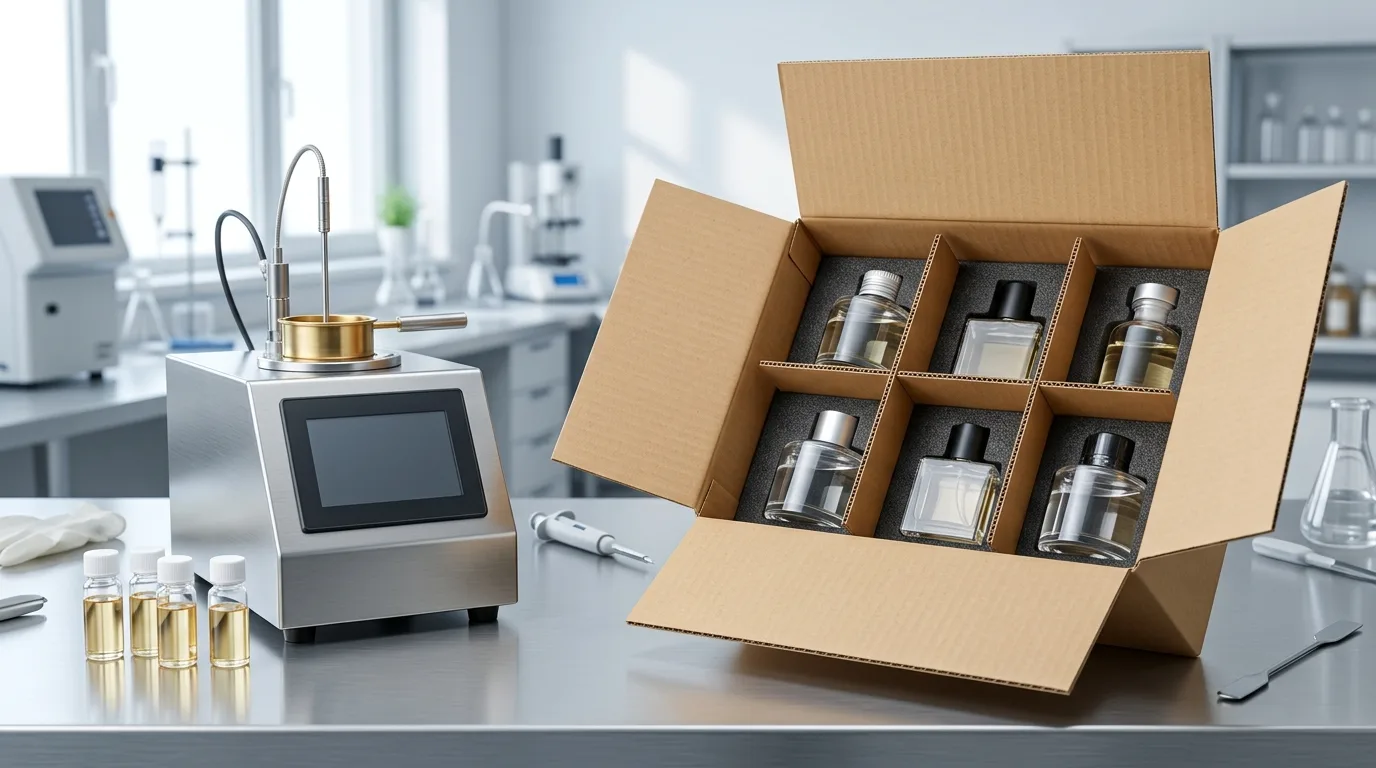
Confirm four document checkpoints before your factory books container space or air courier pickup:
- Finished-formula SDS vs. concentrate SDS: A pure fragrance compound at 100% concentration often has a different flash point and GHS classification than a 15% reed diffuser or 4% water-based linen mist. Cross-check our B2B fragrance compliance document checklist to verify that the SDS title, formula code, and Section 9 flash point match your purchase order.
- Third-party Air & Sea Transport Identification Reports: Chinese ports and international air hubs (such as Shanghai PVG, Ningbo, Hangzhou, or Shenzhen) routinely require current calendar-year Identification and Classification Reports for Transport of Goods issued by accredited labs. Confirm whether your order requires air, sea, or both modes before sampling concludes.
- Single-shipment consistency across labels and invoices: Ensure commercial invoice HS codes, packing list gross weights, SDS Section 14 UN status, and outer carton marks (including LQ diamond marks or fragile/orientation arrows) align cleanly.
- Cosmetics licensing and market registrations for body perfumes: For skin-contact body perfumes and mists, confirm cosmetic export documentation alongside transport files—supported by LoyalCrafts' Cosmetics Production License obtained in 2025 alongside IFRA Category 4 conformity statements.
4. Specify Leak Prevention and Carton Drop-Test Engineering for Glass Vessels
More than half of real-world B2B breakage claims stem not from a defective glass jar, but from under-engineered inner partitions and missing closure safeguards. Review bottle-neck tolerances in our reed diffuser bottle OEM checklist and build these four mechanical protections into your packaging specification:
- Inner transit plugs and calibrated closure torque: Never ship filled screw-neck reed diffusers or car bottles relying solely on decorative wooden or plastic outer caps. Require snug-fitting PE inner travel plugs, induction/foam cap liners, and line torque checks so caps cannot back off during 30-day ocean vibration.
- Negative-pressure (vacuum) chamber testing: For air-freighted samples, e-commerce gift sets, and high-altitude inland trucking, run inverted vacuum-chamber checks on filled, capped glass bottles and crimp-neck perfume sprayers to catch micro-weeping before bulk packing.
- Die-cut EPE/EVA foam vs. 5-ply corrugated cell partitions: Standard gift boxes wrapped in thin chipboard crack immediately when stacked 5–6 cartons high on humid sea pallets. For heavy-base 100–200 ml glass diffusers and candles, specify precision die-cut charcoal EPE foam cavities, molded pulp cradles, or double-wall (BC-flute) corrugated grid dividers that isolate every bottle neck and base from outer carton walls.
- Drop-test protocols aligned with ISTA transit procedures: Define master-carton drop heights and sequence (corner, edge, and flat-face drops per carton gross weight—commonly referencing ISTA 1A for basic integrity or ISTA 3A for parcel/e-commerce channels) inside your pre-production QC checklist, and keep carton gross weight practical (typically ≤ 15–18 kg for hand-handled fragile glass cartons).
5. Blank Pre-Shipment Export Logistics & Drop-Test Verification Sheet
Use this pre-shipment sign-off sheet with your OEM factory QC engineer and freight forwarder before releasing finished goods for container loading. As factory planning references, existing stock samples take 1–3 days, custom scent/packaging samples take 7–14 days, and bulk production runs 30–40 days after sample approval and deposit.
| Verification item | Test setup & document scope to define | Target pass criteria | Status & owner |
|---|---|---|---|
| Closed-cup flash point & SDS Section 14 | Verify 16-section finished-product SDS matches exact bulk formula code, closed-cup flash point (°C), and UN1266/UN1993 or Non-DG status | Section 9 flash point aligns cleanly with Section 14 transport statement and current air/sea transport report | To record |
| Inverted & vacuum leak check | Condition capped/plugged bottles and crimped perfume sprayers inverted under ambient/warm cycle and vacuum chamber pressure drop | Zero neck seepage, zero inner carton staining, and intact foil/PE inner stoppers | To record |
| Master-carton drop & partition check | Drop packed master carton onto concrete across corner, 3 edges, and 6 flat faces at weight-calibrated height (referencing ISTA 1A/2A/3A) | Zero shattered bottles, chipped glass rims, split gift-box corners, or collapsed corrugated dividers | To record |
| Ullage headspace & carton edge-crush | Check bottle fill headspace for thermal expansion and master-carton ECT / burst strength + pallet stack height | Adequate expansion headspace; dry outer cartons resist top-load deformation during ocean transit | To record |
| Shipping marks & DG / LQ labeling | Audit outer carton gross/net weight, SKU barcodes, fragile/up-arrows, and UN or Limited Quantity diamond labels if Class 3 | 100% match across carton print, commercial invoice, packing list, and forwarder booking manifest | To record |
Budgeting master cartons, foam inserts, and inner partitions early also protects unit margins—review how inner-pack architecture impacts landed cost in our private label fragrance packaging cost checklist.
FAQs
Does a reed diffuser always ship as Dangerous Goods (DG) by sea or air?
No. Reed diffuser classification depends on the finished liquid's closed-cup flash point. Diffusers formulated with high-flash-point alcohol-free bases (such as Augeo or DPM blends testing above 60 °C closed-cup) typically review as Non-Dangerous Goods when supported by a finished-product SDS and valid transport identification report, whereas high-ethanol bases testing at or below 60 °C are regulated under Class 3.
What is UN1266, and when does it apply to private label fragrance orders?
UN1266 (Perfumery Products) is the standard UN transport identification number for Class 3 flammable liquid perfumes, colognes, and fragranced sprays containing ethanol or volatile solvents with a closed-cup flash point of 60 °C or less. Depending on container volume and destination mode, small retail bottles may qualify for Limited Quantity (LQ) packing rather than full UN-specification drum/box shipping.
How can brands lower air-freight or express-courier costs on room sprays and perfumes?
When air delivery is essential for launch deadlines or e-commerce fulfillment, switching household ambient sprays to a water-based micro-emulsion above the 60 °C flash-point threshold—or launching alcohol-free solid EVA, paper card, or scented sachet SKUs—can remove Class 3 flammable liquid restrictions after laboratory verification.
What inner packaging works best to prevent glass bottle breakage during LCL ocean shipping?
For fragile glass reed diffusers, candles, and perfume flacons, combine an inner PE travel plug or induction seal with custom die-cut EPE foam cavities or double-wall (5-ply) corrugated cross-dividers inside a high-strength master carton, keeping individual carton gross weight manageable and verifying performance with a pre-shipment drop sequence.
Which trade terms and factory lead times should buyers plan around for export fragrance orders?
LoyalCrafts supports FOB, EXW, DDP, DDU, and FCA export terms depending on destination and project scope. As planning references, allow 1–3 days for stock samples, 7–14 days for custom formula and packaging samples, and 30–40 days for bulk production after sample sign-off and deposit.
6. Lock Your Export Spec and Sample Check Before Booking Freight
Whether you are scaling an ethanol-based EDP perfume collection requiring UN1266 / Limited Quantity documentation, or switching your reed diffuser and room spray lineup to high-flash-point Non-DG bases with drop-tested corrugated dividers, confirming transport chemistry and carton protection during sampling eliminates expensive port surprises. Explore our home fragrance OEM/ODM capabilities or send your target SKUs, bottle volumes, destination port, and freight mode via our B2B OEM inquiry form.