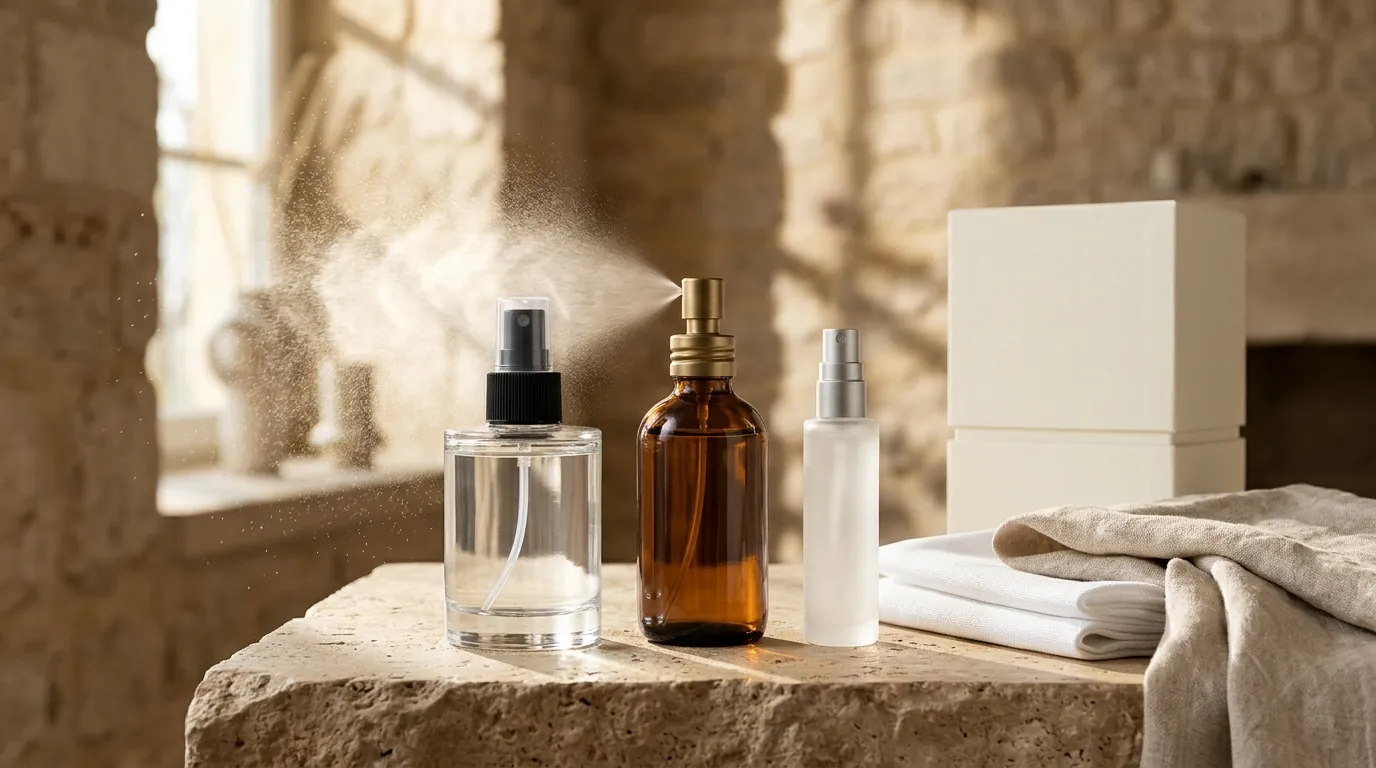
Quick answer: Private label water-based room sprays and linen mists replace volatile high-ethanol bases with purified water dispersions or low-odor micro-emulsions—softening the opening scent profile, protecting household textiles, and simplifying non-hazardous ocean freight review when verified by closed-cup flash point testing. Before releasing an OEM production run, buyers should sign off on freeze-thaw liquid stability, fine-mist pump atomization (typically 0.10–0.15 ml per stroke without nozzle spitting), 48-hour non-staining checks across light and dark fabrics, and SKU allocation around our 3,000-unit custom MOQ planning reference.
Hospitality groups, bedding and homeware retailers, wellness boutiques, and lifestyle brands rely on private label room and linen sprays for instant atmospheric refresh—whether misted into guest suites before check-in or positioned beside wardrobe sachets as a daily bedding ritual. Yet liquid sprays fail quickly when a generic alcohol formula stings the nose, clouds inside clear flint glass, or leaves faint oil halos on hotel percale sheets.
This OEM buyer guide details how to specify carrier chemistry, fine-mist pump hardware, IFRA category boundaries, preservative stability, and pre-shipment textile testing before locking bulk packaging.
1. Compare Water-Based vs. Ethanol-Heavy Spray Architectures
Choosing the liquid base early determines everything from glass clarity and fabric care copy to export freight rates. Use the planning matrix below to align your formula direction with channel and logistics priorities.
| Spray architecture | Carrier & appearance | Textile & logistics traits | Planning reference |
|---|---|---|---|
| Water-based micro-dispersion / solubilizer-free mist | Purified water base engineered as a clear micro-emulsion or clean shake-to-mist dispersion without harsh solvent bite | Gentle on dry-clean-safe household linens when misted from distance; high closed-cup flash point typically supports standard non-DG cargo review | Custom MOQ ref: 3,000 units; confirm bottle transparency vs. amber/frosted finish |
| Hydro-alcoholic room spray | Cosmetic- or denaturant-grade ethanol blended with deionized water for rapid evaporation in open air | Brisk top-note lift and fast dry-off, but elevated alcohol levels commonly lower flash point into Class 3 flammable dangerous-goods (UN1266/UN1993) freight | Confirm destination VOC limits and DG sea/air surcharges early |
| Travel & pillow-mist mini pack (30–50 ml) | Water-based odor-neutralizing or calming botanical blend in compact glass, barrier PET, or aluminum bottles | Fits airline carry-on sizing, hotel turndown kits, and multi-piece holiday sets alongside candles or diffusers | Custom MOQ ref: 3,000 units; verify neck finish and overcap retention |
When building a multi-SKU seasonal capsule—such as pairing a 100 ml home mist with matching reed diffusers and closet sachets—consolidate scent evaluation through our home fragrance OEM/ODM program so fragrance top notes stay consistent across aqueous and oil-based bases.
2. Match Bottle Material, Dip-Tube Geometry, and Fine-Mist Actuators
Even a balanced non-staining formula will spot pillowcases if the pump actuator spits heavy droplets at the end of a stroke. Evaluate the bottle, closure, and atomizer assembly as one integrated mechanical system during sampling:
- Fine-mist pumps vs. mini trigger sprayers: Standard 20/410 and 24/410 crimp or screw atomizers with precision swirl chambers deliver a light, symmetrical cone (commonly around 0.10–0.15 ml per actuation), allowing micro-droplets to disperse in air before settling onto fabrics. For 250 ml+ household refresher formats, specify mini trigger heads with lock clips and anti-drip check valves.
- Dip-tube length and gasket chemistry: Water-based formulas have higher surface tension than pure alcohol. Specify an angled V-cut dip tube sized to reach the bottom corner curve without kinking, paired with fragrance-resistant PE/PP gaskets that will not swell or stick after warm warehouse storage.
- Flint glass, UV-filtering amber glass, or barrier PET: Heavy-base flint glass highlights crystal-clear formulations, while amber or frosted vessels protect citrus, tea, and vanillin-containing scents from UV color shift. If selecting lightweight PET bottles for e-commerce or travel lines, always run accelerated compatibility checks with the exact scented bulk to rule out environmental stress cracking or wall paneling.
Planning a signature hotel turndown mist or retail room-and-linen spray line? Share your target bottle volume, vessel material (glass, PET, or aluminum), spray head style, and destination market on our B2B inquiry page to review stock bottle options and custom sample schedules.
3. Align IFRA Category Scope, Preservative Stability, and 3,000-Unit MOQ Planning
Water-rich formulations introduce microbiological and regulatory checkpoints that differ from anhydrous reed diffusers or wax candles. Clarify three commercial and technical parameters before approving label dielines:
- Intended use claims and IFRA category scope: Pure ambient air sprays and household textile sprays without routine skin contact are typically evaluated under different IFRA limits (such as Category 10B) than pillow mists marketed for direct facial/skin contact or dual-purpose body-and-linen mists (which may require Category 4 cosmetic evaluation). Lock your exact front-panel claims before final fragrance dosing so your compliance dossier matches retail positioning.
- Broad-spectrum preservation and thermal cycling: Because water-based sprays lack high-proof ethanol self-preservation, formulas require a cosmetic- or household-compliant preservative system paired with deionized water filtration. Condition pre-production samples across chill (4–5 °C) and elevated warmth (40–45 °C) cycles to verify zero phase separation, oil ringing, or haze shift.
- 3,000-unit MOQ and component standardization: Our custom MOQ planning reference for private label scented sprays starts at 3,000 units. Sharing one glass bottle mold and anodized aluminum pump collar across two or three core fragrances—differentiated via waterproof film labels and tuck cartons—reduces component minimums and setup spend; review our packaging cost checklist for SKU budgeting tips.
4. Pre-Production Sample & Fabric-Safety Verification Sheet
Before authorizing bulk compounding and automated filling, evaluate filled golden samples in the final bottle-and-pump assembly using the five checks below.
| Inspection item | Test setup to define | Target observation | Sample status & owner |
|---|---|---|---|
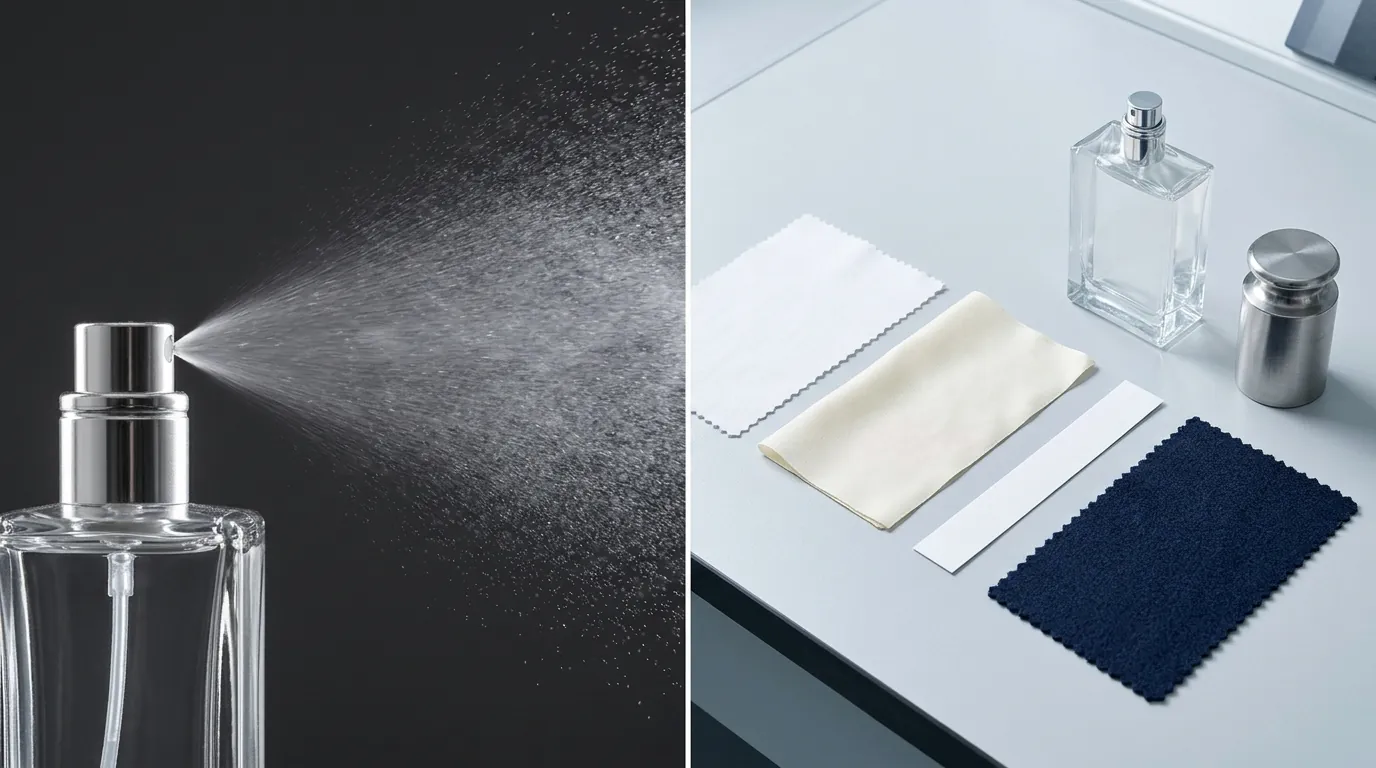
| Atomizer plume & nozzle cutoff | Prime pump and actuate 20 consecutive strokes against dark backdrop with illuminated side light | Even, fine mist cone; crisp actuator rebound with zero nozzle dribbling or foaming | To record |
| Light & dark textile stain check | Mist white cotton, cream silk/satin, and dark navy fabric swatches from 25–30 cm; inspect at 1 h, 24 h, and 48 h | Clean dry-down; zero oil halo, water-ring tide mark, yellowing, or tacky residue | To record |
| Chill & warm stability cycle | Store filled glass control bottles in cold (4–5 °C), ambient, and warm (40–45 °C) chambers | Stable clarity/dispersion profile; no oil layer floating, sediment, or off-odor | To record |
| Closure torque & vacuum leak check | Test screw-neck removal torque or crimp tightness and inverted/vacuum chamber conditioning | Zero neck seepage; overcap stays seated; waterproof label adhesive remains flat | To record |
| Room coverage & fabric dry-down | Evaluate enclosed test room and misted cotton pillowcase at 5 min, 1 h, and 6 h | Immediate odor neutralization and true-to-brief scent dry-down without sour base note | To record |
Verify market-specific labeling and safety paperwork before releasing print files. IFRA conformity certificates document safe concentration thresholds for the designated product category, while EU ECHA CLP guidance and U.S. CPSC FHSA requirements govern sensitizer disclosures, precautionary statements, and net-contents formatting. Cross-check required files in our B2B fragrance compliance document checklist alongside your regulatory advisor.
FAQs
What is the minimum order quantity for private label water-based room and linen sprays?
Our planning reference starts at 3,000 units for custom private label scented sprays. Final unit pricing and component MOQs depend on bottle material (stock glass, custom colored glass, barrier PET, or aluminum), fine-mist pump finish, fill volume, and outer gift carton specifications.
Are water-based room sprays classified as dangerous goods for ocean or air freight?
Unlike high-ethanol sprays that typically carry a low closed-cup flash point and ship as Class 3 flammable liquids (such as UN1266), properly formulated water-based mists generally exhibit high flash points or no flash point under closed-cup testing—often qualifying as non-hazardous cargo after carrier review of the project-specific SDS and transport test report.
How do we prevent linen mists from leaving water rings or oil spots on bedding?
Pair a balanced, low-residue aqueous dispersion with a fine-mist atomizer that breaks liquid into micro-droplets rather than coarse jets, validate 25–30 cm spray-distance dry-down on both white cotton and dark/delicate swatches during sampling, and print clear consumer usage instructions advising patch testing before misting delicate silk or untreated upholstery.
What are the typical sample and mass-production lead times for custom room sprays?
As planning references, allow 1–3 days for existing stock quality samples, 7–14 days for custom fragrance and bottle/pump compatibility samples, and 30–40 days for mass production after golden-sample approval, label sign-off, and deposit confirmation.
5. Plan Your Room Spray & Linen Mist Sample Brief
Ready to develop a non-staining home mist, hospitality turndown spray, or travel-size linen refresher? Review our OEM fragrance sampling workflow or submit your target bottle capacity, atomizer finish, scent profile, and destination market through our project inquiry form.