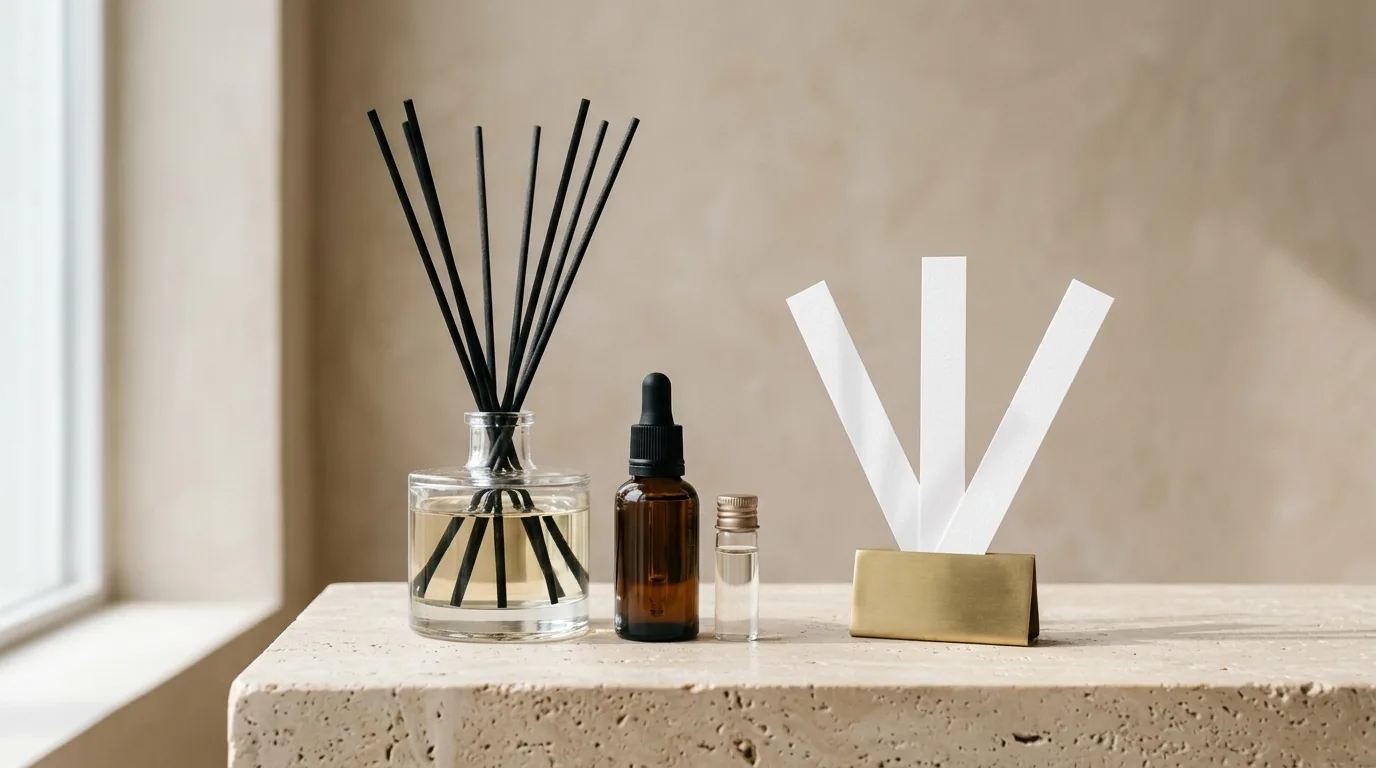
Quick answer: Pouring a single fragrance oil concentrate unchanged from a benchmark perfume into a reed diffuser, soy candle, and room spray is the fastest way to trigger shelf discoloration, winter freight clouding, or failed IFRA limits. Reliable OEM scent matching couples project-specific GC-MS target profiling with carrier-matched accord reconstruction, IFRA allergen ceiling tuning, and vessel-level thermal, freeze-thaw, and UV light observation before locking the Golden Sample. At LoyalCrafts' 11,000 sq m Jinhua plant, buyers can pull directly from 3,500+ vetted stock formulas (1–3 day stock sample dispatch) or run bespoke matching and stability trials in 7–14 days, backed by 500–10,000+ unit MOQs by format and 30–40 day bulk production windows (all planning references).
Retail buyers and brand founders frequently courier a department-store candle, a boutique glass reed diffuser, or a fine fragrance bottle to our Jinhua laboratory with one straightforward request: "Match this exact scent across our diffuser, candle, and linen spray, keep the oil water-clear in flint glass, and ensure every repeat order smells identical."
With fragrance manufacturing roots dating to 1998, 6 automated production lines, and a library of over 3,500 formulas, our home fragrance OEM/ODM engineering team sees the same bottleneck on every cross-format launch: a scent concentrate does not perform in isolation. Solvent polarity, wax pouring heat, atomizer shear, bottle neck headspace, and UV display lighting constantly reshape what the consumer smells and sees. Here is how experienced sourcing teams manage custom scent matching, stability testing, and batch-to-batch quality control before signing off a production deposit.
1. 3,500+ Stock Library vs. Project-Specific GC-MS Matching
Before paying for custom fragrance R&D or shipping benchmark bottles overseas, decide which development track fits your margin, timeline, and regulatory exposure:
- Track A — Stock Formula Selection (1–3 Days Dispatch Planning Ref.): When speed to shelf or tight initial MOQ (such as 500 units on reed diffusers or 1,000 units on candles and sachets) outweighs bespoke exclusivity, selecting from LoyalCrafts' 3,500+ existing formulas removes raw-material sourcing lag. These bases already carry baseline compatibility history in Augeo solvents, soy-blend waxes, or vermiculite carriers.
- Track B — Project-Specific GC-MS Benchmark Matching (7–14 Days Custom Sample Ref.): When you supply a physical retail benchmark, our lab supports project-specific GC-MS compositional profiling to map the volatile and base-note architecture. Crucially, perfumers do not blind-copy an aged retail sample—oxidized top-note artifacts are stripped out, restricted substances flagged under the IFRA Standards Library or RIFM safety assessments are replaced, and the accord is rebuilt for your actual carrier base.
- Track C — Brief-Driven Original Accord Creation (7–14 Days Custom Sample Ref.): If your brief targets strict constraints—such as a water-white sweet gourmand without heavy vanillin browning, or a low-VOC profile compliant with U.S. CARB spray caps—our perfumers compose an original accord calibrated to your target landed cost per kilogram and target market rules.
| Product format & MOQ ref. | Carrier medium & thermal/chemical stress | Scent reconstruction priority | Key sample acceptance check |
|---|---|---|---|
| Reed Diffuser (500 units ref.) | Alcohol-free Augeo or glycol ether base drawn upward via capillary fiber or rattan reeds | Balance molecular weight so heavy wood/resin base notes do not clog 3–4 mm reed pores mid-cycle | Blotter dry-down + 60–90 day planning evaporation curve with actual diffuser sticks |
| Scented Candle (1,000 units ref.) | Soy-blend, coconut, or paraffin wax poured warm (typically 65–75°C processing window) | Select high-flash-point aromatics soluble in non-polar wax to prevent syneresis (surface oil sweating) | 48h cure cold throw, multi-cycle melt pool, soot check, and ASTM F2417 fire-safety alignment |
| Water-Based Room & Linen Spray (3,000 units ref.) | Purified water phase paired with non-ionic solubilizers for low-VOC micro-emulsion clarity | Restructure hydrophobic citrus/wood terpenes to stay optically clear without excessive surfactant foam | Cold-clouding clarity check, fine-mist atomizer clog test, and cotton/silk non-staining check |
| Paper, Linen Sachet & EVA (1,000–3,000 units ref.) | Infused mineral vermiculite granules or heated EVA polymer compression molding | Filter out solvents that soften heat-seal adhesives, stain uncoated paper, or bleed across polymer surfaces | Barrier foil pouch seal integrity, paper grease-spot check, and 30–45 day cabin/closet release profile |
| Body Perfume EDP / EDT (1,000 units ref.) | High-purity cosmetic ethanol produced under licensed cosmetics manufacturing controls | Verify cosmetic safety and IFRA Category 4 limits, followed by maceration and chill filtration | Cold-haze clarity after chill filtration, FEA15 crimp-pump seal test, and 8–12h EDP skin-wear check |
2. Cross-Carrier Engineering: Why One Concentrate Cannot Fit Every Base
A common procurement error on multi-SKU collections is requesting one single drum of fragrance oil to feed a reed diffuser, a soy-blend scented candle, and a water-based linen mist. Even when all three products share one scent name on the retail shelf, the underlying chemical concentrate must be tuned per carrier:
- Flash-off loss in hot candle wax vs. room-temperature diffusion: Delicate citrus and green aldehydes that sparkle at 22°C on a paper blotter flash off rapidly when stirred into molten wax or exposed to an active wick flame. Candle variants require anchored mid- and base-note bridges plus verified wick sizing to keep hot throw consistent from top to bottom of the jar.
- Capillary viscosity in reed diffusers: Resinous oud, thick balsam, or vanilla absolutes can raise solution viscosity in alcohol-free bases, slowing wicking speed after week three. Pairing the reformulated scent with high-porosity fiber reeds rather than dense natural rattan prevents premature fade—see our fiber vs. rattan diffuser stick comparison.
- Cosmetic maceration & chill filtration for fine fragrance: Unlike home air care, licensed body perfume blends require controlled tank maceration so top notes marry into the ethanol-water matrix, followed by low-temperature chill filtration to strip waxy naturals before filling into FEA15 flacons.
- Regulatory divergence across carriers: A scent formula compliant at 8% in a candle or 15% in an ambient diffuser may exceed EU CLP sensitizer thresholds or U.S. CARB 18% spray VOC ceilings in a mist format. Review those cross-market formulas early using our EU CLP, UFI & U.S. CARB VOC compliance guide.
3. Preventing Discoloration, Turbidity & Scent Drift
Nearly all post-shipment quality claims—liquid darkening on store shelves, cloudy sprays after winter transit, or plastic off-notes—stem from skipping finished-pack stability observation during the 7–14 day custom sampling window.
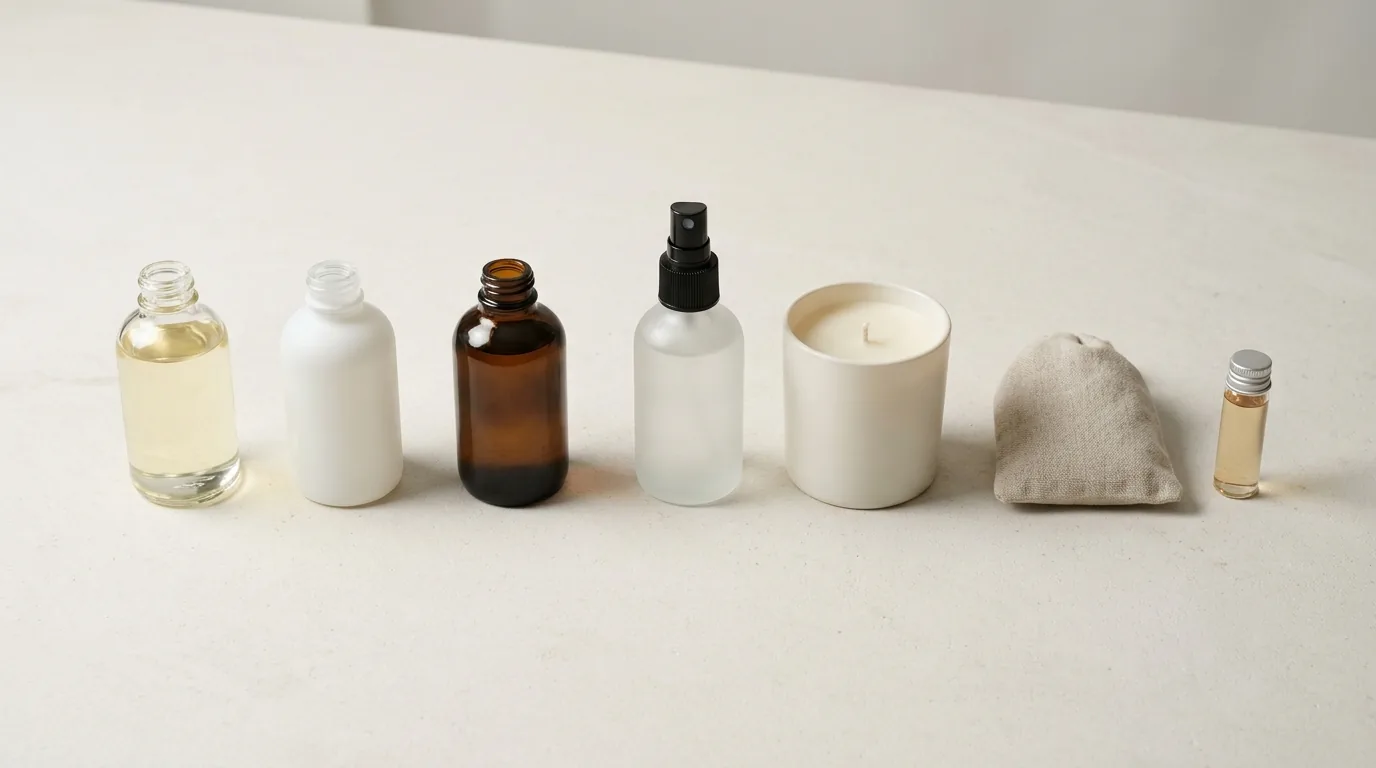
- Vanillin, indole & Schiff base discoloration: Sweet gourmand, warm amber, vanilla, and white-floral accords containing vanillin, ethyl vanillin, eugenol, or reactive aldehydes oxidize when exposed to bottle headspace oxygen and retail LED/UV light. Within weeks, water-white reed diffuser oil in a crystal-clear flint bottle can shift to deep amber or mahogany. Engineering fixes include capping vanillin ratios via non-browning lactone/maltol substitutes, adding project-approved UV absorbers/antioxidants, or switching the vessel finish to UV-amber glass or full-coverage matte spray coating as detailed in our vessel decoration engineering guide.
- Container-freight thermal & cold-cycle shocks: Ocean containers routinely cross extreme ambient swings—from sub-zero winter port yards in Northern Europe or North America to high-heat steel decks near the equator. If a water-based spray or EDP was filtered only at room temperature, cold transit precipitates cloudy haze or wax flocks. Conversely, high-heat warehouse exposure reveals candle syneresis (surface oil beads), gel shrinkage, or adhesive flagging on poorly masked neck labels.
- Four-checkpoint stability evaluation protocol: Before bulk blending starts, buyers and factory QA confirm project-specific pass criteria inside the actual production container and closure:
- Staged Blotter Dry-Down (0h / 2h / 8h / 24h): Confirms top-note lift, heart fidelity, and clean dry-down free of solvent harshness against the benchmark reference.
- Elevated-Temperature Chamber Observation: Evaluates sealed filled vessels at elevated ambient storage targets (commonly structured around 40–45°C planning benchmarks depending on product format) for color drift, cap-liner swelling, pump prime failure, or oil seepage.
- Freeze–Thaw Cycle Observation: Cycles liquid sprays, perfumes, and diffusers through sub-zero cold holds (commonly down to -5°C planning benchmarks where climate routes require) and back to room temperature to verify zero irreversible turbidity or crystallization.
- Shelf-Light / UV Exposure Comparison: Places a clear glass trial alongside an opaque/amber control under bright display light to establish realistic liquid tint tolerance before printing clear-label artwork.
4. Locking Golden Sample Retention & Batch-to-Batch QC
Matching a scent once on a 50 ml lab sample is only half the engineering job. Scaling that match cleanly to 5,000 or 50,000 units—and keeping Batch #4 indistinguishable from Batch #1 six months later—requires strict configuration locking across end-to-end OEM production:
- Dual-signed Golden Sample & light-shielded retain vials: Once your team signs off the custom sample, LoyalCrafts archives sealed, aluminum-capped retain vials under dark, temperature-controlled storage mapped to a locked Recipe ID. That physical retain—not just a digital PDF brief—serves as the master benchmark for every future batch.
- Incoming concentrate & pre-fill batch verification: Prior to automated line filling, QA verifies incoming fragrance oil lots and blended bulk tanks against the retained Golden Sample using trained olfactive panel checks alongside physical tolerances (visual clarity/color baseline, specific gravity, refractive index alignment, and online fill-weight precision such as ±2 g targets on candle pours).
- Zero silent substitution rule: If an aroma chemical supplier discontinues a natural essential oil crop or an IFRA amendment lowers an allergen ceiling mid-year, the formula cannot be silently swapped. Any reformulation triggers a revised Recipe ID, updated IFRA/SDS revision dates, and a fresh buyer-approved sample sign-off.
- Closure & gasket re-qualification on component swaps: Changing bottle glass suppliers, switching an LDPE inner plug to silicone, or changing a crimp pump vendor requires repeating the seal-leakage and compatibility check even when the fragrance oil remains identical.
5. Blank Custom Scent Matching & Stability Sign-Off Sheet
Copy this sign-off table directly into your RFQ or pre-production quality agreement. Planning references at LoyalCrafts cover 1–3 days for stock samples, 7–14 days for custom matching & stability samples, and 30–40 days for bulk manufacturing following Golden Sample sign-off:
| QC & R&D gate | Engineering & lab verification item | Buyer acceptance criteria | Status & owner |
|---|---|---|---|
| 1. Development track & Recipe ID | Confirm stock library code (3,500+ library) vs. project-specific GC-MS benchmark match vs. original brief, mapped per carrier | Unique Recipe ID issued per format (diffuser, candle, spray, sachet, or EDP) | To record |
| 2. Blotter & in-carrier olfactive match | Evaluate 0h / 2h / 8h / 24h blotter curves plus real-room cold/hot throw or reed wicking inside target vessel | Approved top/heart/base balance; zero harsh solvent burn or clogged reeds | To record |
| 3. Vanillin & UV color tolerance | Assess clear glass vs. amber/spray-coated vessel under display light; document expected natural oil tint range | Written liquid color tolerance band or opaque vessel protection confirmed | To record |
| 4. Thermal & freeze-thaw review | Run project-agreed heat hold and cold cycle inside production bottle, plug, pump, or candle jar | Zero irreversible turbidity, phase separation, wax syneresis, or closure leakage | To record |
| 5. Regulatory & allergen freeze | Lock finished-product IFRA category ceiling, 16-section SDS revision, and destination CLP/CARB VOC inputs | Recipe ID on SDS/IFRA matches approved Golden Sample without unapproved edits | To record |
| 6. Golden Sample retain & repeat QC | Seal dark-stored aluminum-capped retain vials and record specific gravity / clarity baseline for pre-fill lot checks | Batch #1 and repeat PO lots verified against locked physical retain before release | To record |
Ready to match a benchmark signature scent or stabilize an upcoming multi-format collection before bulk production? Review our 7–14 day OEM sampling workflow, compare vessel options in our reed diffuser and scented candle OEM programs, or send your target formats, fragrance direction, quantity per SKU, and destination market via our direct B2B OEM inquiry form.
FAQs
Can LoyalCrafts match an existing retail fragrance via GC-MS, and how long do custom samples take?
Yes. When buyers provide a physical benchmark sample, our Jinhua lab supports project-specific GC-MS aroma profiling paired with experienced perfumer reconstruction to adapt the accord for your target carrier and current IFRA limits. Custom scent-matching and carrier samples typically prepare in 7–14 days (planning reference), whereas selections from our 3,500+ stock fragrance library ship in 1–3 days.
Why can’t the exact same fragrance oil concentrate be poured unchanged into a reed diffuser, a soy candle, and a room spray?
Each carrier stresses fragrance molecules differently. Reed diffusers rely on capillary wicking through 3–4 mm fiber or rattan sticks in alcohol-free bases; candles expose oils to 65–75°C molten soy-blend wax and flame combustion; and water-based room sprays require solubilizer clarity below regional VOC limits. Re-balancing the formula per format prevents clogged reeds, wax syneresis, and spray clouding.
How do factories prevent vanilla or sweet fragrance blends from turning brown inside clear glass diffuser bottles?
Vanillin, ethyl vanillin, and certain spicy or floral compounds naturally oxidize and darken when exposed to oxygen and UV shelf lighting. Depending on your visual brief, our engineers mitigate color shift by replacing high-browning raw materials with color-stable sweet notes, adding formula-compatible stabilizers, or recommending UV-amber or opaque spray-coated glass vessels.
What quality checks ensure repeat bulk orders match our approved Golden Sample?
Once you sign off a Golden Sample, LoyalCrafts locks the exact Recipe ID and stores sealed, light-shielded physical retain vials as the master standard. Every subsequent bulk batch undergoes sensory panel comparison against the retain alongside physical checks—such as clarity, visual color baseline, refractive index, specific gravity, and automated fill-weight tolerances—with zero silent ingredient substitutions permitted.