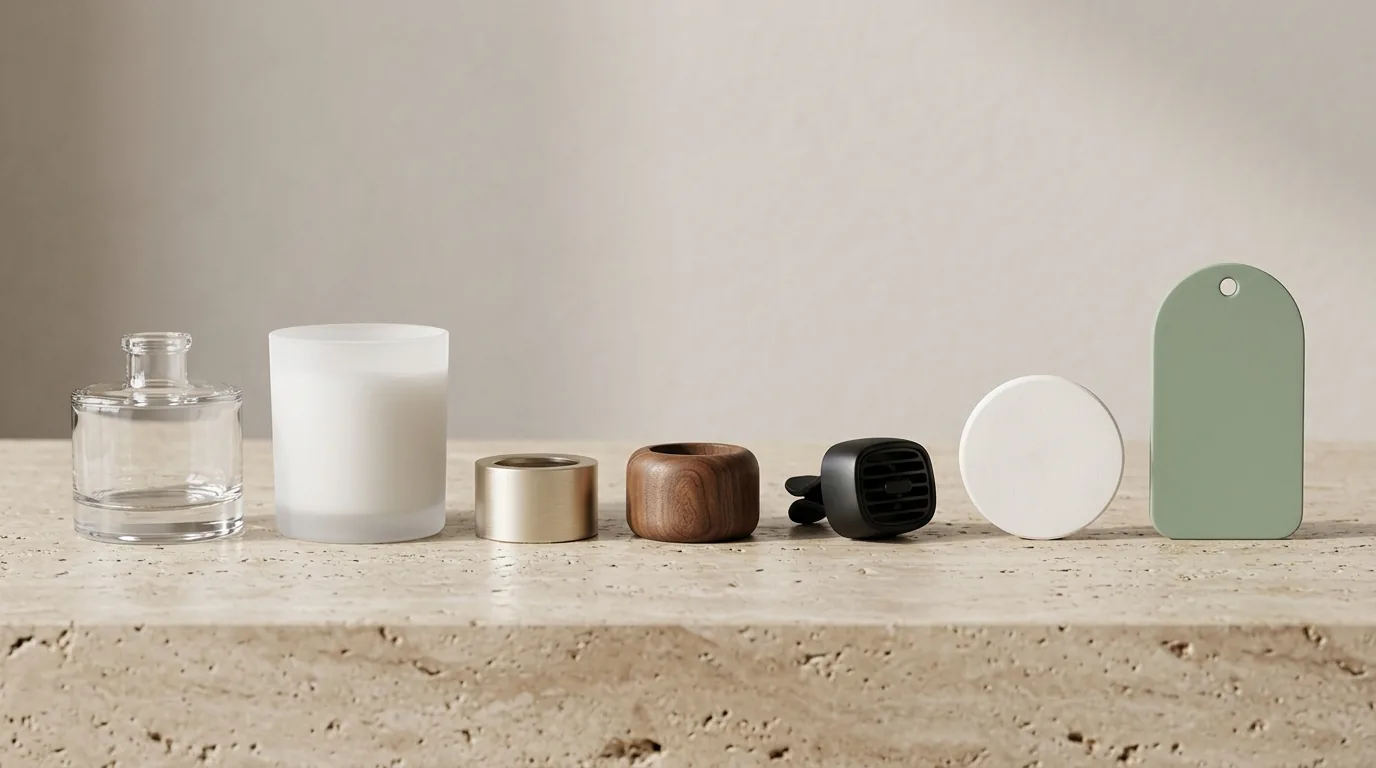
Quick answer: Most private label fragrance launches overpay on custom glass molds when stock mold decoration + semi-custom hardware achieves 80% of the shelf differentiation at standard entry minimums—500 units for reed diffusers and hanging car glass bottles, and 1,000 units for candles, body perfumes, and clip-on car vents (all planning references). Reserve dedicated private tooling for lines where structural silhouette or polymer geometry defines the SKU, such as custom 2D/3D molded EVA cards (3,000-unit MOQ ref), proprietary ABS vent housings, or multi-SKU retail programs amortizing tooling across repeat POs. Across LoyalCrafts' 11,000 sq m Jinhua facility, stock-format evaluations ship in 1–3 days, custom decorated or matched samples prepare in 7–14 days, and bulk runs require 30–40 days post-Golden Sample sign-off.
Procurement directors and brand founders regularly send us a clean 3D render of a bespoke faceted glass bottle or sculptural car vent diffuser and ask for 500 or 1,000 units per scent. On the factory floor, the gap between a CAD render and a fill-ready vessel comes down to mold cavity economics, neck-finish standardization, and post-molding surface chemistry.
At our Jinhua plant—backed by fragrance manufacturing experience since 1998, 6 automated filling and assembly lines, and a 3,500+ fragrance library—our home fragrance OEM/ODM team engineers primary vessels, closures, decoration stacks, and retail dielines as one unified bill of materials. Use this engineering breakdown to pick the right tooling tier before committing deposit funds or freezing packaging artwork.
1. Choose Between Stock Decoration, Semi-Custom Hardware & Private Tooling
Every fragrance format separates tooling decisions into three distinct capital and MOQ brackets. Choosing the wrong tier locks working capital into glass or steel molds that could instead fund multi-scent SKU breadth:
| Tooling tier | Typical component scope | Custom MOQ planning ref. | Sample & tooling timing ref. | Primary engineering watchout | Best commercial fit |
|---|---|---|---|---|---|
| Tier 1: Stock Mold + Custom Surface Decoration | Existing flint/amber glass jar, diffuser bottle, or crimp flacon + color spray, acid frosting, silkscreen, hot foil, or wrap label | 500 units (reed diffuser & car glass bottle); 1,000 units (candle & body perfume) | 1–3 days stock blank / 7–14 days custom decorated sample | Coating rub-off from fragrance oil or ethanol around neck shoulder; adhesive flagging on curved walls | Boutique brands, hotel amenities, seasonal capsules, and multi-scent market tests |
| Tier 2: Semi-Custom Collars, Clips & Polymer Cavity Molds | Stock vessel paired with custom-turned wood/aluminum collar, branded ABS vent clip bezel, die-cut paper card, or custom 2D/3D EVA cavity mold | 1,000 units (car vent, paper card, diffuser stick); 3,000 units (custom EVA card); 10,000 units (gravure barrier film) | 7–14 days custom sample once die/cavity drawing is approved | Neck-finish OD/ID tolerance mismatch between collar and glass thread; thermal shrinkage on EVA shapes | Automotive accessory lines, gift collections, and mid-tier retail rollouts needing distinct tactile branding |
| Tier 3: Full Private Glass or Multi-Cavity Injection Mold | Proprietary blown/pressed glass vessel geometry or multi-part injection-molded car vent shell and cap tooling | Confirmed per mold cavity count, glass furnace run weight, and multi-SKU volume plan | Extended mold-cut and T1 sampling prior to standard 30–40 day bulk production | Heavy-base annealing stress, uneven wall distribution at sharp corners, and FEA15/DIN neck distortion | Established national retailers, flagship signature flacons, and patent-protected hardware systems |
Why stock glass + bespoke hardware wins most early rollouts: Glass furnace minimums for a brand-new private flint bottle often exceed what a growing label wants to tie up in a single vessel SKU. By pairing a proven stock reed diffuser bottle or heavy-base candle vessel with custom matte color spraying, a walnut or brushed-aluminum collar, and an embossed rigid box, your unit landed cost stays predictable while keeping custom MOQ near 500–1,000 units (planning reference).
2. Surface Decoration Engineering on Stock Glass Vessels
A common assumption during brand concepting is that any Pantone color spray, metallic vacuum coating, or gold foil logo works identically across empty decorative jars and active fragrance bottles. On the filling line, solvents and fragrance oils aggressively test every outer coating layer.
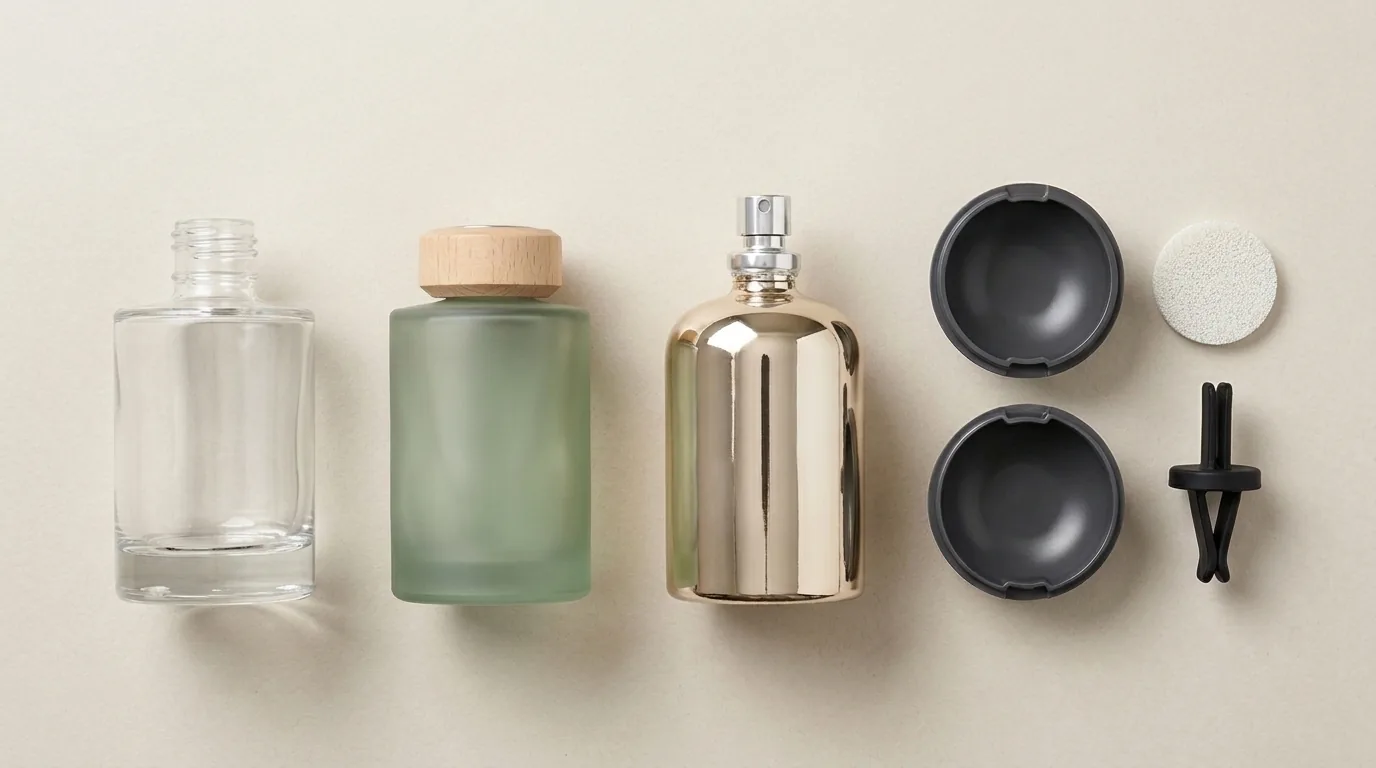
- Neck-finish masking is mandatory before spraying or electroplating: Never allow color lacquer, UV varnish, or metallic vacuum coating onto glass sealing lands—specifically reed diffuser bottle thread tops, body perfume FEA15 crimp lips, or the inner upper rim of a scented candle jar. Overspray on sealing surfaces causes LDPE plugs to weep, crimp collars to mis-seat, and painted rims to blister near candle flame heat. Specify a clear 2–4 mm masking step on the technical drawing.
- Ethanol & fragrance-oil rub resistance on coated shoulders: During bottle filling or consumer reed flipping, drops of alcohol-free Augeo diffuser base or high-proof EDP ethanol inevitably contact the bottle shoulder. Low-bake organic spray coatings swell, turn tacky, or peel when wiped with solvent. Require cross-hatch tape adhesion checks and fragrance-oil / ethanol rub verification on decorated Golden Samples before bulk coating begins.
- Acid-etched frosting vs. matte frost spray: Chemical acid etching creates a permanent micro-textured glass surface that never scratches off during carton transit, whereas matte frost spray coats clear glass with a translucent resin layer that allows custom gradient tints. For high-humidity bathrooms or fine fragrance flacons handled daily, verify scratch and moisture-soak durability across your chosen finish.
- Glass annealing & polariscope checks on heavy bases: Thick-bottom candle jars and square diffuser decanters cool unevenly inside glass molds. When a vessel undergoes high-temperature silkscreen ceramic firing or hot-wax pouring, residual internal strain can trigger hairline thermal cracks. Coordinate scented candle vessel checks alongside ASTM F2417 burn-test planning so vessel geometry and thermal stability are verified together.
3. Polymer, EVA & Injection Tooling Economics Across Car & Air Care
Unlike blown glass, automotive and small-space air care formats rely on die cutting, thermo-compression polymer molds, and precision plastic injection. Understanding where each tooling fee sits prevents mid-project budget surprises:
- Custom 2D/3D EVA polymer cavity molds (3,000-unit MOQ ref.): Scented EVA cards use steel compression molds to form custom shapes, raised relief logos, and ribbed surface textures that maximize surface area for scent evaporation. Tooling cost is modest compared with multi-cavity ABS injection molds, making custom 2D silhouettes viable at 3,000 units (planning reference). Always account for polymer post-molding shrinkage and specify an oil-barrier metallized pouch to prevent premature scent loss during warehouse storage.
- Car vent clip housings & replaceable cores (1,000-unit MOQ ref.): On car vent diffusers, full private injection tooling for a two-piece clip shell requires steel mold machining, gate balancing, and silicone sleeve over-molding. Most brands control launch cost by selecting an existing LoyalCrafts housing mold, applying custom Pantone resin matching, matte rubberized paint, or pad-printed/laser-etched metal badges, and reserving custom tooling strictly for high-volume automotive retail programs.
- Environmental Stress Cracking (ESC) in parked-car temperatures: Inside a sun-parked vehicle cabin, dark ABS vent housings experience sharp thermal spikes. Raw citrus terpenes and certain fragrance esters can craze or crack stressed injection-molded polycarbonate or low-grade polystyrene parts. Keep infused ceramic or sintered polymer fragrance cores physically isolated from load-bearing clip springs and verify high-temperature cabin soak stability during car media sampling.
- Gravure print cylinders vs. digital label runs: If your assortment includes scented moisture absorbers (10,000-unit MOQ ref.) or laminated foil refill pouches, custom-printed multi-layer film requires dedicated gravure cylinders per ink color. Splitting 10,000 units into five separate printed pouches multiplies cylinder charges; keeping one shared outer pouch film with scent-specific pressure-sensitive front labels dramatically trims upfront setup fees.
4. Dielines, Recyclability & Regulatory Alignment (EU PPWR, IFRA & CPSC FHSA)
Tooling geometry and surface finishes directly determine whether your finished artwork passes European and North American retail compliance audits:
- EU Packaging and Packaging Waste Regulation (PPWR) design impact: Heavy full-coverage opaque coatings, permanently glued multi-material wood/plastic collars over glass threads, or non-separable PVC sleeves complicate glass cullet optical sorting in Europe. Where EU circularity scores matter, favor removable friction-fit wood or mono-material PP closures, separable neck collars, and direct-print or cleanly washable paper/film labels—see our EU PPWR home fragrance packaging checklist.
- Flat label panel geometry & compound-curve flagging: Conical, spherical, or sharply faceted stock bottles look striking on mood boards, yet pressure-sensitive labels lift and crease along compound curves. Before approving a curved vessel, confirm the maximum flat-zone height and circumference on the factory CAD dieline, or switch to direct silkscreen / pad printing on curved shoulders.
- Mandatory hazard-panel real estate (U.S. CPSC FHSA, IFRA & EC No 1223/2009): Compact 30 ml perfume flacons, hanging car bottles, and vent clips rarely offer enough primary-vessel surface for multilingual CLP/GHS pictograms, UFI codes, INCI allergen lists, or U.S. FHSA cautionary text. Confirm whether mandatory regulatory copy lives on a peel-back booklet label or on the outer folding carton / blister backer card before locking tooling dimensions, and verify export drop-test and UN1266 carton spacing simultaneously.
5. Blank Tooling, Vessel & Decoration Golden Sample Sign-Off Sheet
Copy this verification matrix into your RFQ or pre-production dossier before releasing mold deposits or mass decoration runs. Across LoyalCrafts planning references, stock format samples ship in 1–3 days, custom decorated/matched samples prepare in 7–14 days, and bulk manufacturing runs 30–40 days after Golden Sample approval.
| Inspection checkpoint | Engineering spec & verification protocol | Target acceptance criteria | Status & owner |
|---|---|---|---|
| Vessel dimensions & neck finish | Measure bottle height, body OD, wall thickness, brimful vs. fill headspace, and neck-finish thread/FEA15 crimp land against approved drawing | All dimensions within mold tolerance; clean unmasked sealing land; consistent plug, pump, or collar seating | To record |
| Coating adhesion & solvent rub | Run cross-hatch tape adhesion test plus controlled rub with actual fragrance base / ethanol on sprayed, frosted, or metallized shoulder | Zero coating peel on tape pull; no tackiness, blistering, or color transfer after base contact | To record |
| Print registration & foil crispness | Check silkscreen / hot-foil alignment against mold parting seams, fine-type legibility (barcode & ingredient block), and scuff resistance | Sharp typography with zero broken hairlines; artwork centered within agreed seam-alignment tolerance | To record |
| Thermal & annealing integrity | Screen heavy-base candle/diffuser glass for annealing strain and verify car vent ABS/polymer housing under elevated cabin heat soak | Zero stress cracks, coating crazing, warping, or fragrance-oil ESC attack on plastic clips/collars | To record |
| Dieline, PPWR & legal label zone | Confirm label flat panel (zero corner flagging), removable closure/collar separation, and minimum font/pictogram sizing for destination market | Zero edge lifting on label wrap; mandatory IFRA / CLP / FHSA / EC 1223/2009 text legible on vessel or outer pack | To record |
| Partition & export drop protection | Inspect flute divider clearance, tissue/polybag sleeve protection against coating scuff, and master-carton drop resistance | Zero vessel-to-vessel abrasion or breakage post-transit simulation; clean retail presentation upon unboxing | To record |
Evaluating whether to decorate a proven stock bottle, tool a semi-custom collar or EVA silhouette, or open a dedicated mold for your signature line? Review our reed diffuser bottle OEM checklist, explore our reed diffuser and body perfume OEM capabilities, or share your target format, reference photos, quantity per SKU, and destination market via our B2B OEM inquiry form.
FAQs
When does a private label fragrance brand actually need a custom bottle mold?
Full custom glass tooling makes financial sense when your program requires an exclusive, trademarked silhouette across high repeat volume that justifies glass furnace minimums and mold fabrication lead time. For most retail launches at 500–3,000 units per SKU (planning reference), combining an existing stock vessel with custom spray color, acid frosting, hot-foil graphics, and a bespoke wood or metal collar delivers distinct shelf presence without tying capital into glass molds.
Can I customize color and branding at LoyalCrafts' 500–1,000 unit MOQ planning tiers?
Yes, provided the primary vessel uses an existing stock glass mold or housing. As planning references, reed diffusers and hanging glass car bottles start from 500 units, while scented candles, car vent diffusers, and body perfumes start from 1,000 units—final minimums depend on the selected bottle finish, decoration passes, and custom box construction. Stock blank format samples ship in 1–3 days, and custom decorated evaluations prepare in 7–14 days.
Why do coated fragrance bottles sometimes peel or turn sticky around the collar?
Peeling or tackiness around the bottle shoulder usually happens when low-bake organic spray coatings are applied too close to the sealing lip or are incompatible with alcohol-free diffuser solvents and perfumery ethanol. Specifying a 2–4 mm uncoated neck masking zone plus fragrance-base rub testing on the Golden Sample eliminates most field coating failures.
What is the most cost-effective custom tooling option for car air fresheners?
For low-investment bespoke shapes, die-cut absorbent paper cards (1,000-unit MOQ ref.) require only an inexpensive steel cutting die, while custom 2D/3D molded EVA polymer cards (3,000-unit MOQ ref.) use relatively economical compression cavity molds. For clip-on car vent diffusers (1,000-unit MOQ ref.), pairing an existing ABS clip housing with custom Pantone resin coloring, branded metal badges, and custom retail blister cards avoids multi-cavity injection mold fees.