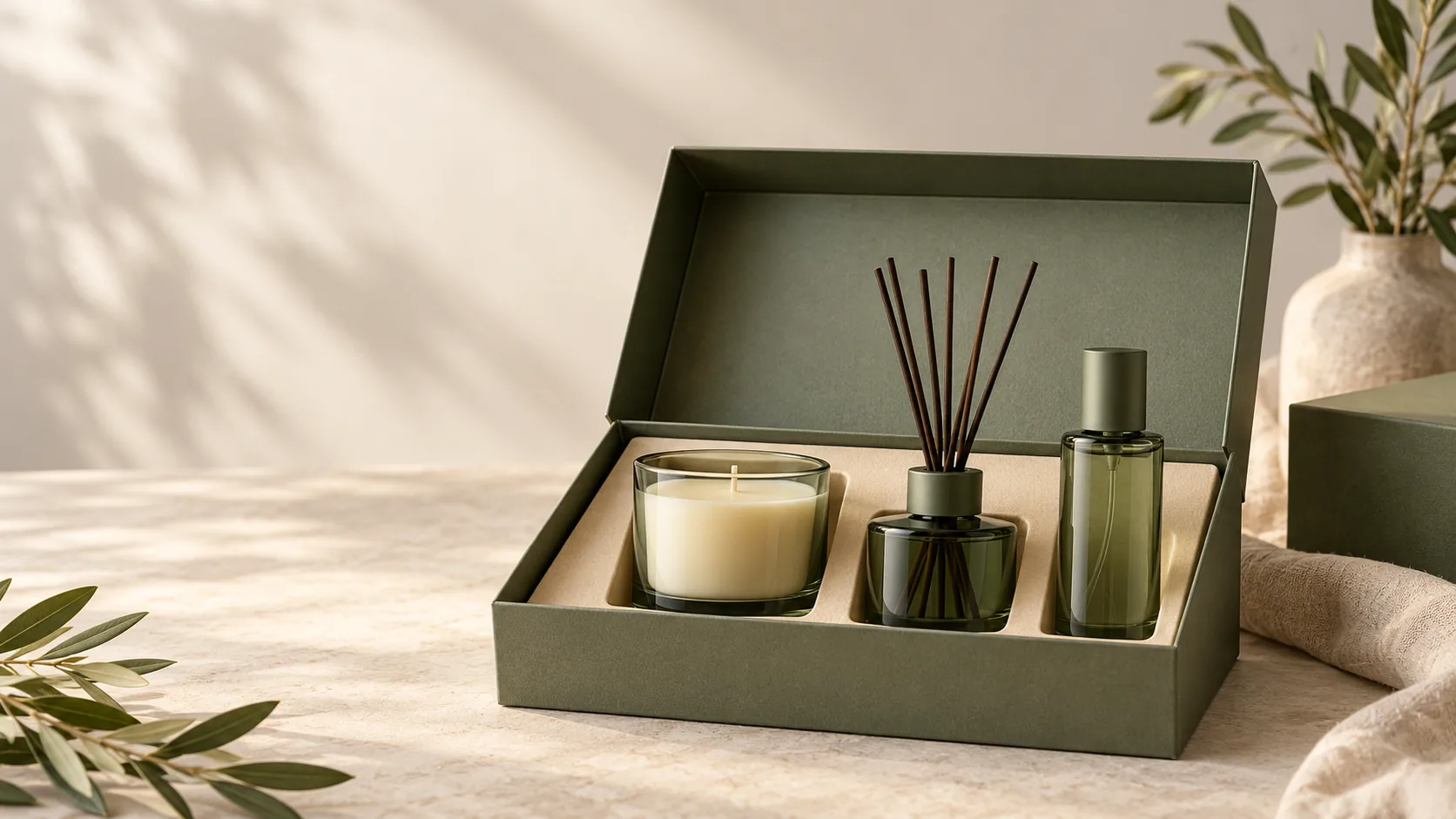
AI-generated editorial cover; the pictured set is a concept, not a record of an approved order or test.
A private label home fragrance gift set should be approved as one complete retail unit. Choose a useful product combination, define every component and fragrance variant, then check the filled products, insert, instructions and shipping pack together. A matching color or scent name helps the collection feel coherent; it does not prove that the individual formulas or packaging are interchangeable.
This guide is for brand owners and buyers combining candles, reed diffusers, room sprays or scented sachets. It explains how to build a set specification, compare quotations and prevent a change to one component from quietly changing the finished gift. The examples are planning routes rather than priced, ready-to-order SKUs.
1. Choose a Private Label Home Fragrance Gift Set Around Its Use
Start with what the recipient is expected to do with the products. A candle adds a lit-use experience, a diffuser provides passive fragrance release, and a room spray offers an on-demand option. A sachet belongs to a smaller-space use route. Including more formats can add choice, but also adds instructions, documents, pack positions and approval work.
The market already offers curated and customizable fragrance gifts: Diptyque describes both pre-composed and personalized sets. On the manufacturing side, BLF Private Label discusses sleeves, boxes and pouches for diffuser projects. These are examples of available approaches, not evidence of a particular sales result or a LoyalCrafts brand partnership.
| Combination | Reason to consider it | What the approval sample must answer |
|---|---|---|
| Reed diffuser + candle | Two ways to experience one fragrance collection. | Filled container fit, room for the packed reeds, separate use instructions and protection between glass items. |
| Candle + room spray | A lit-use item beside an on-demand spray. | Cap or actuator protection, candle presentation, separate fragrance approval and correct spray labeling. |
| Reed diffuser + candle + room spray | A collection with passive, lit and spray formats. | Insert layout, total packed weight, component identification and a clear instruction route for all three products. |
LoyalCrafts can supply diffuser-and-candle, candle-and-spray, and diffuser-candle-spray combinations. The exact container, fill, scent, finish and pack specification should be confirmed for each project. A photographed concept or a combination listed here does not establish stock availability, a universal minimum quantity or a fixed delivery date.
A diffuser-and-refill starter set is another route when repeat purchase is central to the brief. Use the refillable reed diffuser guide for compatibility and handling details; do not add a refill solely to make the box look fuller.
2. Build One Component List for the Finished Gift
Give the complete set its own code, then list the components under it. The set code identifies what the customer buys; component references identify what must be made, packed and checked. Keep the same list attached to the quotation, sample record and packing instruction so that a missing accessory is visible before assembly.
| Component group | Record | Common decision to resolve |
|---|---|---|
| Finished products | Product reference, format, fill or net content, scent and revision. | Which products are shared with individual retail SKUs? |
| Functional parts | Reeds, cap, stopper, wick, actuator or other relevant parts. | Which parts are packed separately and which arrive assembled? |
| Presentation | Container finish, label, decoration and artwork reference. | Which dimensions and artwork can genuinely be shared? |
| Retail pack | Box, insert, sleeve, protective wrap and instruction card. | Does the insert fit the actual filled and decorated components? |
| Shipping pack | Inner protection, export carton, set count and shipping marks. | Will the same pack serve store delivery and direct parcel fulfillment? |
A common box can simplify a range only when all approved variants fit it. For example, changing a spray cap height can affect lid clearance even if the bottle volume stays the same. Record that change against the set rather than treating it as an isolated purchasing substitution.
3. Share the Scent Direction, Approve Each Product Separately
A collection can use one scent name across several formats while needing separate finished-product evaluation. A fragrance judged in a diffuser liquid is not a substitute for evaluating the candle or spray. Record the approved reference for each product, the intended use and the formula version rather than asking for one universal “same fragrance” approval.
Ask reviewers whether the formats feel related, whether any one dominates the collection, and whether the scent description matches the approved samples. Keep these sensory observations separate from stability, packaging or candle safety results. A buyer preference score is useful within the agreed comparison; it is not a laboratory performance claim.
IFRA explains that a conformity certificate concerns a specified intended use. Do not treat one fragrance document as automatic approval of every product in the box. Maintain a document reference for each relevant item and have the destination-market reviewer confirm the finished-product requirements.
4. Compare Quantities and Costs at Set and Component Level
A set containing three items has one saleable set quantity and several component quantities. Component buying limits, print runs and scent splits may differ. Ask the supplier to show the proposed set quantity, any component excess and how those excess pieces would be stored or used, rather than comparing only the price printed beside the gift-set name.
As an arithmetic example, 1,000 planned sets with one diffuser, one candle and one spray require 1,000 of each finished item before any agreed allowance. Dividing those sets equally between two fragrance variants would require 500 of each product per variant. These figures illustrate the calculation; they are not LoyalCrafts minimum quantities or production recommendations.
Separate the quotation into finished products, decoration, packaging, assembly, agreed inspection or testing, and delivery terms. Check whether the quoted price includes filling, labeling, insert placement, reed packing and the final closed box. For detailed packaging cost questions, use the fragrance packaging cost checklist.
Calendar planning should identify which parts depend on fragrance approval, artwork approval or a new component. Ask for a written schedule for the chosen specification, including who signs off each stage. A delivery estimate for an undecorated stock item should not be carried over to a customized multi-product set.
5. Approve the Filled Products and the Closed Box Together
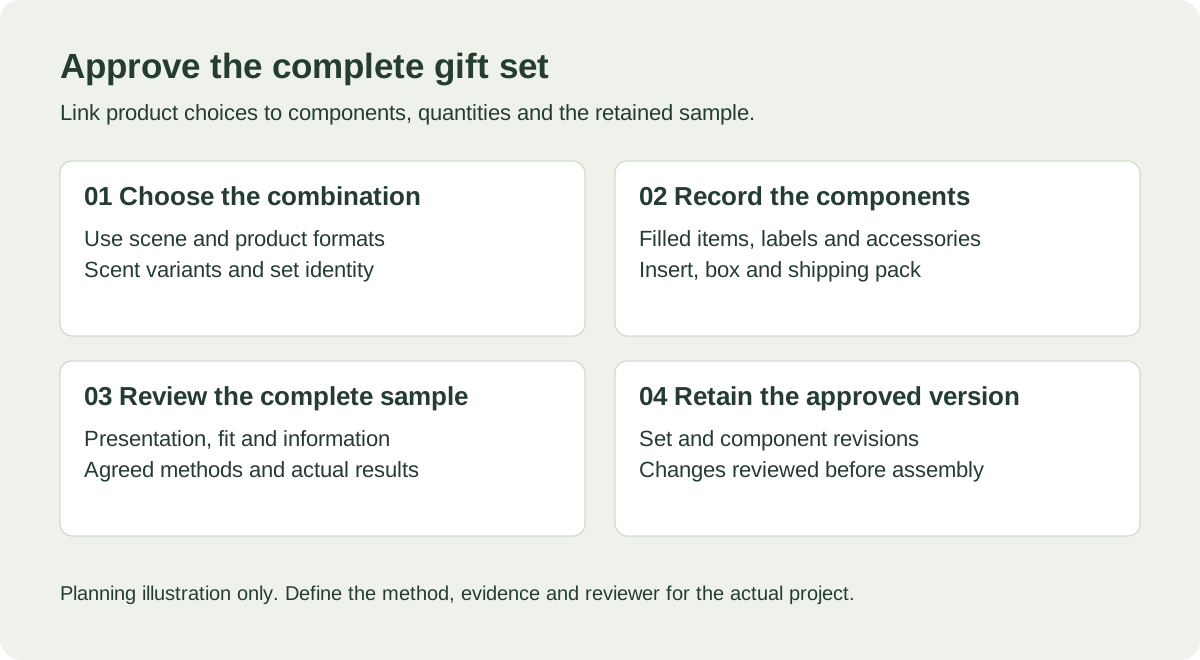
Approve the complete configuration that will reach the recipient. Separate component samples help early selection, but the final sample should use the intended products, accessories, artwork and protection. Review both the open presentation and the closed retail unit, then agree the handling or shipping checks appropriate to the sales channel.
| Review area | Question | Record to retain |
|---|---|---|
| Contents | Are the product variants and all accessories correct? | Set code, component references and count. |
| Fit and handling | Are components held as intended without damaging decoration or one another? | Insert revision, observations and agreed corrective action. |
| Product condition | Do filled products and closures meet the agreed review requirements? | Sample identity, method, conditions and actual result. |
| Information | Are product labels and instructions readable and matched to the items? | Approved artwork, languages and reviewer. |
| Release | Is the final closed set and shipping pack the version approved? | Retained reference sample and signed change record. |
If a sachet is included, its individual pack and surface-contact instructions also need review. The paper versus fabric sachet comparison explains why the visible pouch and storage wrapper should be specified separately. Do not let an attractive gift layout substitute for the individual product checks.
Retain the final set reference and identify which later changes trigger another review. Changes to glass dimensions, scent, wick, actuator, insert or artwork can affect different parts of the approval. Assign each change to its owner and record the accepted replacement before assembly begins.
FAQ
What should a home fragrance gift set include?
Include products that serve a clear use route and can be explained together. Diffuser-and-candle, candle-and-spray, and three-format sets are useful planning options. Each chosen item still needs its own specification and approval, while the whole set needs a component list, fitted packaging and clear instructions.
Can every product in the set use the same fragrance?
They can share a scent direction or collection name. Approve each finished format separately, however, because the candle, diffuser and spray are different product systems. Keep their formula references and relevant documents distinct, then evaluate whether the approved samples deliver the intended collection experience.
How is the minimum order quantity calculated?
Confirm quantities for the set, individual products, printed components and fragrance variants. Their buying or production constraints may differ. Ask the supplier to explain excess components and SKU splits in the written quotation. One general minimum cannot describe every custom combination, decoration and packaging route.
What should be approved before the set is assembled?
Approve the filled products, accessories, labels, insert, retail box and relevant shipping pack as the intended configuration. Retain the set code, component revisions, sample observations and signed approval. Recheck an affected part when a later substitution changes the fit, use route, documents or agreed presentation.
Prepare the brief: choose the combination, target market, set quantity, scent variants and packaging reference. Send those details through the home fragrance OEM project page so the product and packaging scope can be confirmed before quotation and sampling.