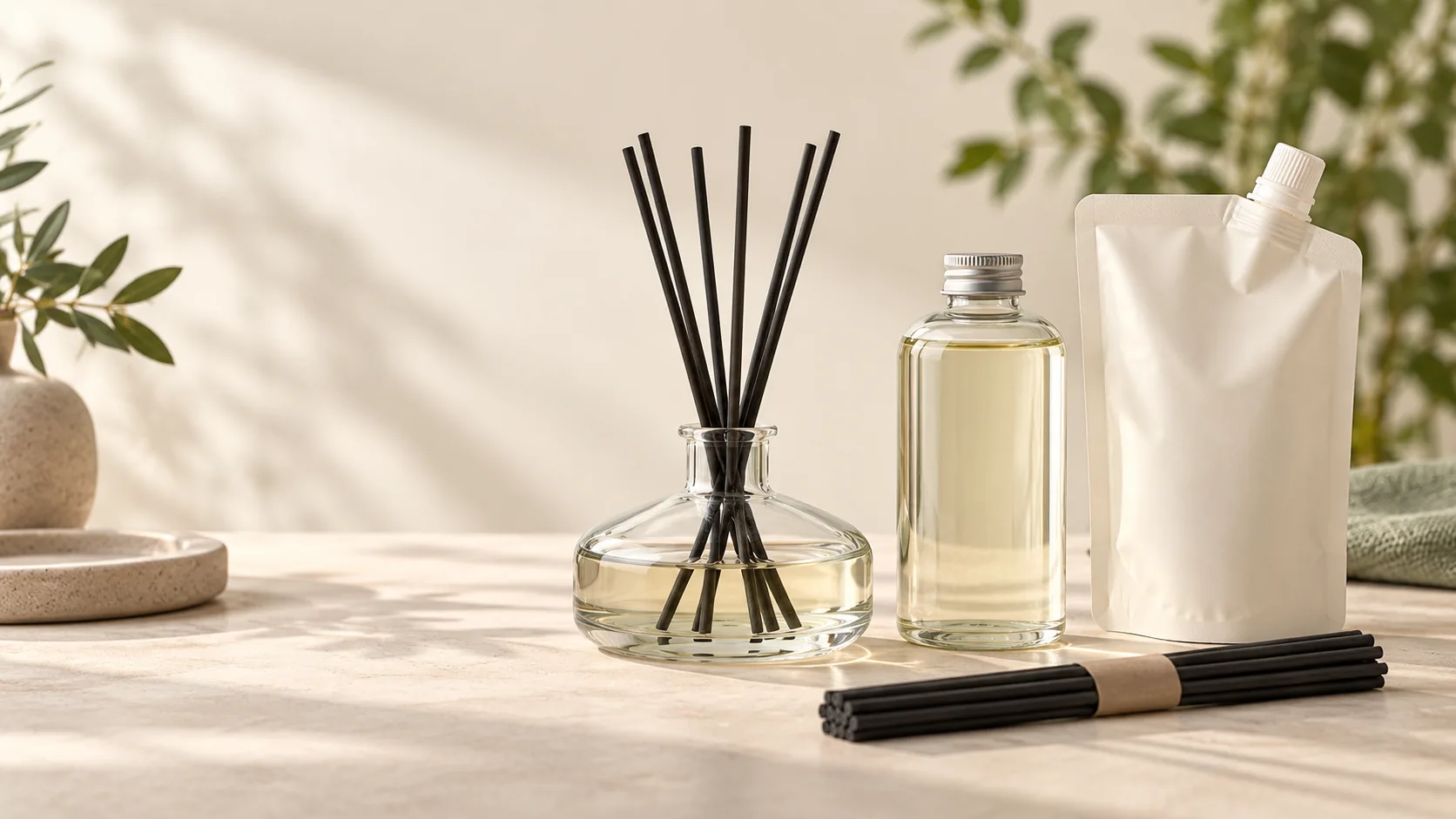
AI-generated editorial cover; the containers illustrate refill formats, not completed compatibility or leakage testing.
A refillable reed diffuser private label project should define the main bottle, refill pack, reeds and handling instructions together. Choose a refill bottle or pouch for the intended channel, record the compatible product references, and sample the actual filled combination. Specify when reeds are replaced and how the refill is identified. A refill pack beside an empty diffuser bottle does not establish successful handling, compatibility or scent performance.
This guide is for brands developing a starter set and repeat-purchase refill. LoyalCrafts can supply refill bottles and refill pouches; the material, closure, fill, fragrance and retail pack are confirmed for each project. Availability of those formats does not mean that every fragrance base or vessel combination has already been assessed.
1. Choose the Refill Format for the Sale and Handling Route
The refill has its own retail identity, even when it accompanies the first diffuser. Define whether it is sold separately, shipped by parcel or placed in a gift set. Decide whether the refill contains one intended fill or multiple portions, and ask the technical team to confirm the bottle's usable fill rather than relying on its nominal capacity alone.
| Route | Questions before selection | Sample to review |
|---|---|---|
| Refill bottle | Material and closure suitability, opening route, pouring control, label space and protection. | Filled bottle with actual cap, label and retail or shipping pack. |
| Refill pouch | Laminate or film specification, spout and cap, seals, handling and storage after opening. | Filled pouch with actual seal, spout, artwork and protection. |
| Starter or gift set | Which vessel, refill, reeds and accessories are included, and how they are separated? | Complete filled set, insert and instructions. |
A pouch can have a different pack weight and shape from a bottle, but the whole retail and shipping route still matters. Do not call it universally lower-impact or leak-proof without the relevant evidence. Compare material specifications and actual packaged units under the same project conditions.
2. Keep a Compatibility Record for the Whole System
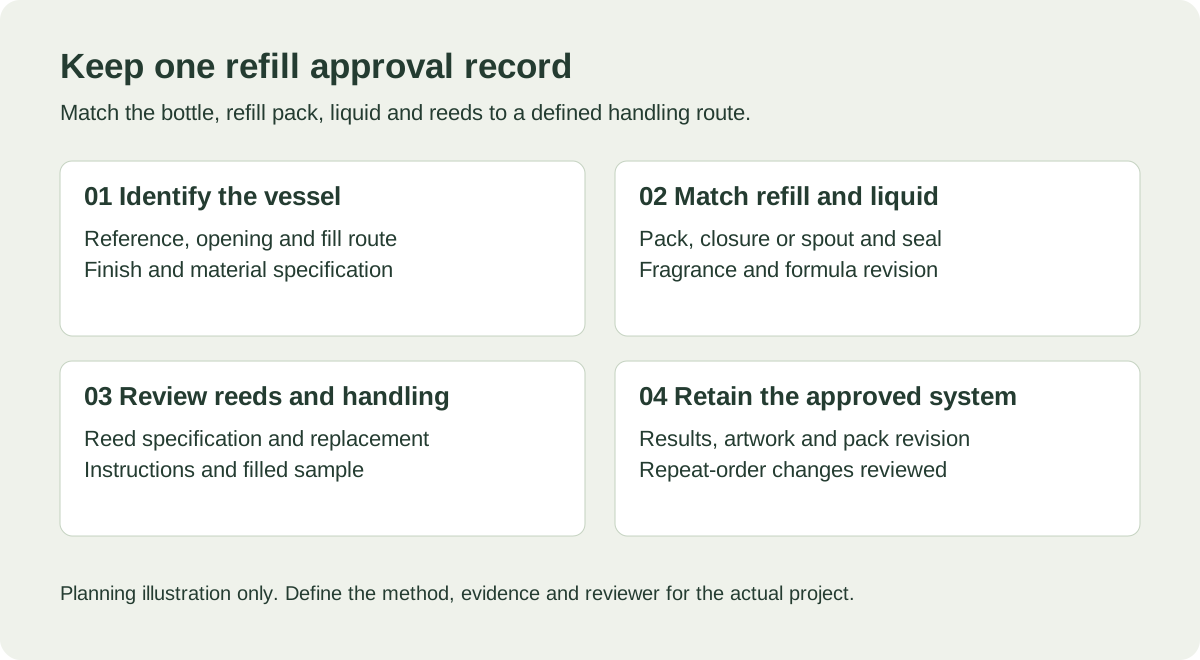
Link the main vessel reference to the refill product code, liquid formula revision, fill instruction and approved reeds. Specify the neck or opening route, closure, relevant materials and any supplied accessory. Keep the fragrance name as a customer-facing identifier while retaining the technical references behind it.
| Field | What to record | Change that needs review |
|---|---|---|
| Main vessel | Reference, material, opening and intended fill route. | Neck, internal capacity, finish or supplier change. |
| Refill pack | Bottle or pouch reference, closure, seal and material specification. | Film, liner, cap, spout or seal change. |
| Liquid | Fragrance and base references, formula revision and approved fill. | Scent or base formulation change. |
| Reeds | Material reference, dimensions, count and replacement instruction. | Diameter, length, finish, material or quantity change. |
| Information | Label, languages, compatibility wording and handling instructions. | Product identity, market or use-route change. |
Check the actual product after the agreed review conditions. Look for relevant changes to the liquid, pack, closure, seal, label or decoration and record the observation against the specimen. An empty container inspection does not establish compatibility with the intended liquid.
The diffuser bottle buyer checklist covers the vessel in more detail. Keep that specification connected to the refill record so that a later bottle change is not approved independently of the intended handling route.
3. Decide When the Customer Replaces the Reeds
Include the reed replacement decision in development. State whether the refill includes new reeds, which reference they match and how the user identifies replacements. If a project proposes keeping existing reeds, evaluate that route under the actual formulation and use conditions before writing a general reuse instruction.
Manufacturer instructions provide useful examples without becoming a universal rule. Diptyque's diffuser instructions call for new reeds with each new refill. That is a requirement for its specified product. A private label project needs its own supported instruction rather than copying the brand's soak time, duration claim or reed count.
A fragrance change is another decision to record: residual liquid and used reeds can affect the intended new scent experience. Ask the development team to define the supported preparation and replacement route. Do not instruct users to mix unrelated oils, add water or top up a different fragrance unless the actual system supports that use.
LoyalCrafts can make reed diameters from 2 mm to 20 mm with customized lengths. This is a dimensional capability, not evidence that every size suits the same liquid and bottle. Review the selected material, diameter, length and count in the actual system; use the fiber versus rattan comparison for the sample questions.
4. Review the Refill Operation With the Supplied Components
Use the filled refill pack, main vessel and draft instructions during the handling review. Check whether the intended user can identify the right liquid, open the pack, control the transfer and understand the fill limit. Record where instructions are unclear instead of treating a demonstration by the product developer as proof that all users will follow it correctly.
The development team should define the preparation route, surface protection and spill handling for the actual product. Cleaning instructions must also be product-specific: do not assume one solvent, washing method or leftover-liquid disposal route applies to all bottle finishes and formulations. Final wording should be reviewed alongside the product and destination market.
| Step | Question | Record |
|---|---|---|
| Identify | Is the refill clearly matched to the correct main vessel and scent? | Product references and label revision. |
| Prepare | Are preparation, surface protection and intended fill instructions clear? | Instruction version and reviewer observations. |
| Open and transfer | Does the actual pack support the designed opening and pouring route? | Closure or spout reference and observed handling issues. |
| Finish | Does the user know which reeds to fit and how to store a partly used refill? | Replacement and resealing instructions. |
| Review | Have unresolved issues been corrected and rechecked? | Revised sample, decision and retained reference. |
5. Approve Packaging, Documents and Repeat Orders Together
Evaluate the refill retail pack and shipping protection separately from the first diffuser's packaging. Agree handling or transport checks for the intended channel, with methods and acceptance points defined before testing. Keep observed pack condition separate from in-use scent assessment; neither should be converted into a universal leakage or lifetime promise.
Match product identity, relevant hazard information, instructions and required documents to the actual liquid and market. An SDS or historical report does not automatically cover a different formula or pack. The fragrance document checklist explains how to track scope and revisions.
For an EU packaging project, use the separate PPWR packaging checklist for component records and responsibilities. “Refillable” should not be treated as proof that all packaging obligations are satisfied, or as a requirement that every diffuser must have the same refill design.
Before a repeat order, compare the bottle, pouch materials, closure, formula, reeds and artwork to the retained approval record. Record substitutions and determine what needs reevaluation. Confirm quantities, sample costs, responsibility for tests and timing in the written project scope rather than relying on a generic refill-program quotation.
FAQ
Can the refill use the same scent as the starter bottle?
Yes, the collection can retain the same scent direction, but the actual formula, refill pack and main vessel must be matched. Identify the approved liquid and product references before ordering. A shared fragrance name does not establish compatibility of every bottle, pouch, closure or reed option.
Should reeds be replaced when a diffuser is refilled?
Define and evaluate the replacement route for the product. Some manufacturers supply new reeds with each refill; that should not be copied as a universal timing rule. Record whether new reeds are included, which specification they match and what the approved instructions require when the fragrance changes.
Is a bottle or pouch better for diffuser refills?
Compare the actual materials, closure or spout, fill route, retail presentation and shipping pack. Either format may suit a project. A pouch is not automatically leak-proof or environmentally superior, and a bottle is not automatically easier to pour. Approve the filled configuration under agreed review conditions.
What should be approved before ordering a refill range?
Approve the main vessel, refill pack, liquid reference, reeds, instructions, labels and relevant retail and shipping protection. Retain their revisions, sample results and remaining limits. Confirm quantities and test responsibilities in writing, then review an affected part whenever a repeat-order substitution changes the approved system.
Prepare a refill brief: send the main vessel reference, bottle or pouch preference, scent plan, market and handling questions through the reed diffuser project page. Use those details to agree the sample and evidence required for the actual refillable reed diffuser private label program.