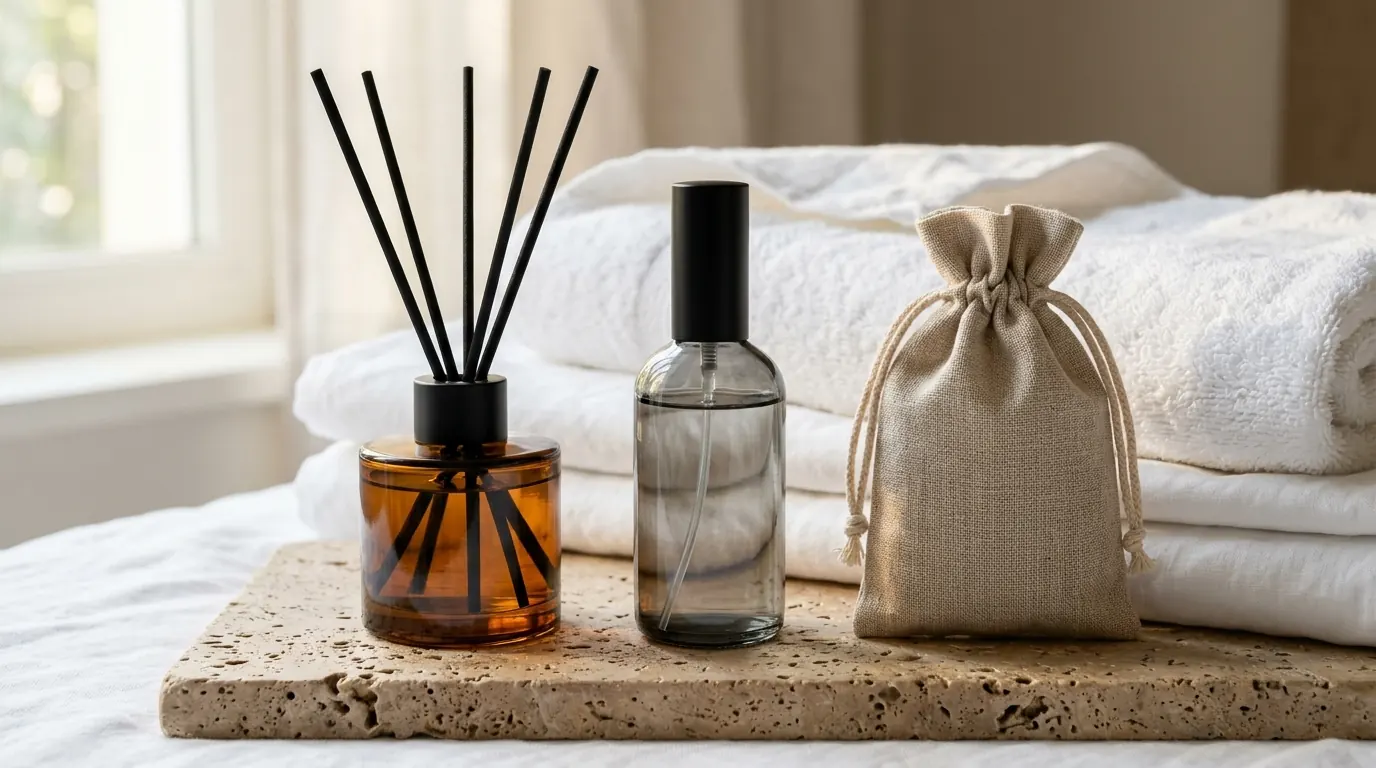
Quick answer: A hospitality or home-textile private label fragrance program fails or succeeds on cross-carrier adaptation rather than picking one scent blotter and duplicating it everywhere. A single signature accord must be re-balanced separately for alcohol-free lobby reed diffusers (60–90 days / 100 ml ref; 500-unit MOQ ref), water-based non-staining linen mists (3,000-unit MOQ ref), and oil-barrier paper or linen sachets (30–45 days ref; 1,000 units per design & fragrance ref). Across LoyalCrafts' 11,000 sq m Jinhua facility, stock format samples dispatch in 1–3 days, custom multi-SKU evaluation sets prepare in 7–14 days, and bulk manufacturing runs 30–40 days after Golden Sample sign-off (all planning references).
Hotel procurement directors, bedding labels, and department-store home buyers rarely lose sleep over top-note appeal during initial blotter evaluations. Post-rollout complaints almost always come from cross-material incompatibilities: water-based pillow sprays turning cloudy or spotting 400-thread-count white cotton sheets, wardrobe sachets weeping fragrance oil onto silk nightwear or lacquered dresser wood inside humid ocean containers, or lobby diffusers stalling halfway down the bottle because dense woody oils clogged natural rattan reeds.
At our Jinhua plant—backed by fragrance manufacturing experience since 1998, 6 automated production lines, and a 3,500+ fragrance library—our home fragrance OEM/ODM team engineers the fragrance carrier, primary vessel or pouch barrier, closure hardware, and export compliance dossier as one coordinated assortment. Use this engineering guide to write cleaner multi-SKU RFQs and sign off your Golden Samples without cross-category surprises.
1. Match Fragrance Format to Hospitality & Home Textile Zones
Because open-flame candles face strict fire-code bans across most guestrooms, spas, and apparel warehouses—and require ASTM F2417 vessel fire-safety verification when approved for retail gift lines—hospitality and textile buyers predominantly build assortments around four flameless formats:
| Zone & SKU format | Carrier & hardware system | Reference throw & duration | Primary engineering risk | Custom MOQ planning ref. | Core buyer fit |
|---|---|---|---|---|---|
| Lobby & Suite Reed Diffuser | Alcohol-free / Augeo base in thick-wall glass bottle + anti-clog fiber or rattan sticks (2–20 mm supply range) | 25–30 sq m; 60–90 days (100 ml reference) | Capillary clogging in heavy resins, neck collar corrosion, inverted transit weeping | 500 units (custom bottle/finish may raise component minimums) | Hotel reception counters, VIP suites, boutique showrooms, bedding gift boxes |
| Guestroom & Linen Mist Spray | Water-based micro-emulsion / solubilizer-calibrated formula + fine-mist trigger or crimp atomizer | Immediate room & textile refresh; variable persistence | Phase clouding, nozzle sputtering, oil-ring staining or dye bleeding on pale textiles | 3,000 units | Turn-down housekeeping service, pillow mists, bedding & upholstery care lines |
| Wardrobe & Apparel Sachet | 20–40 mesh infused vermiculite or scented beads in FSC paper envelope or cotton-linen pouch + BOPP/foil outer bag | Enclosed closets & garment bags; 30–45 days reference | Oil bleed through unlined paper/fabric, mineral dust sifting, premature scent loss in warehouse | 1,000 units per design & fragrance | Hotel closets, e-commerce bedding/apparel parcel inserts, bridal & retail gift sets |
| Dresser & Gift-Box Drawer Liner | Infused specialty paper sheets/rolls with controlled surface resin lock + sealed rigid pack | Drawer & shelf enclosures; 60+ days reference | Ink rub-off onto folded garments, edge curling in humidity, odor cross-contamination | 500 units | Luxury linen retailers, heritage department stores, wardrobe accessory collections |
Why alcohol-free reed bases and water-based mists dominate hotel logistics: Unlike ethanol-heavy fine fragrances that carry closed-cup flash points ≤ 60 °C and trigger Class 3 dangerous-goods routing, properly formulated alcohol-free reed diffusers and water-based room & linen sprays generally maintain higher flash points for smoother non-DG ocean or air consolidation—always subject to final batch SDS Section 14 verification.
2. Adapt One Signature Scent Across Distinct Solvents & Substrates
A frequent procurement misconception is assuming that once a brand approves a signature White Tea, Fig Leaf, or Cedarwood accord on a paper blotter, the factory can simply pour that same concentrate across bottles, sprays, and pouches. On the compounding floor, each matrix demands separate solvent polarity and fragrance-load tuning.
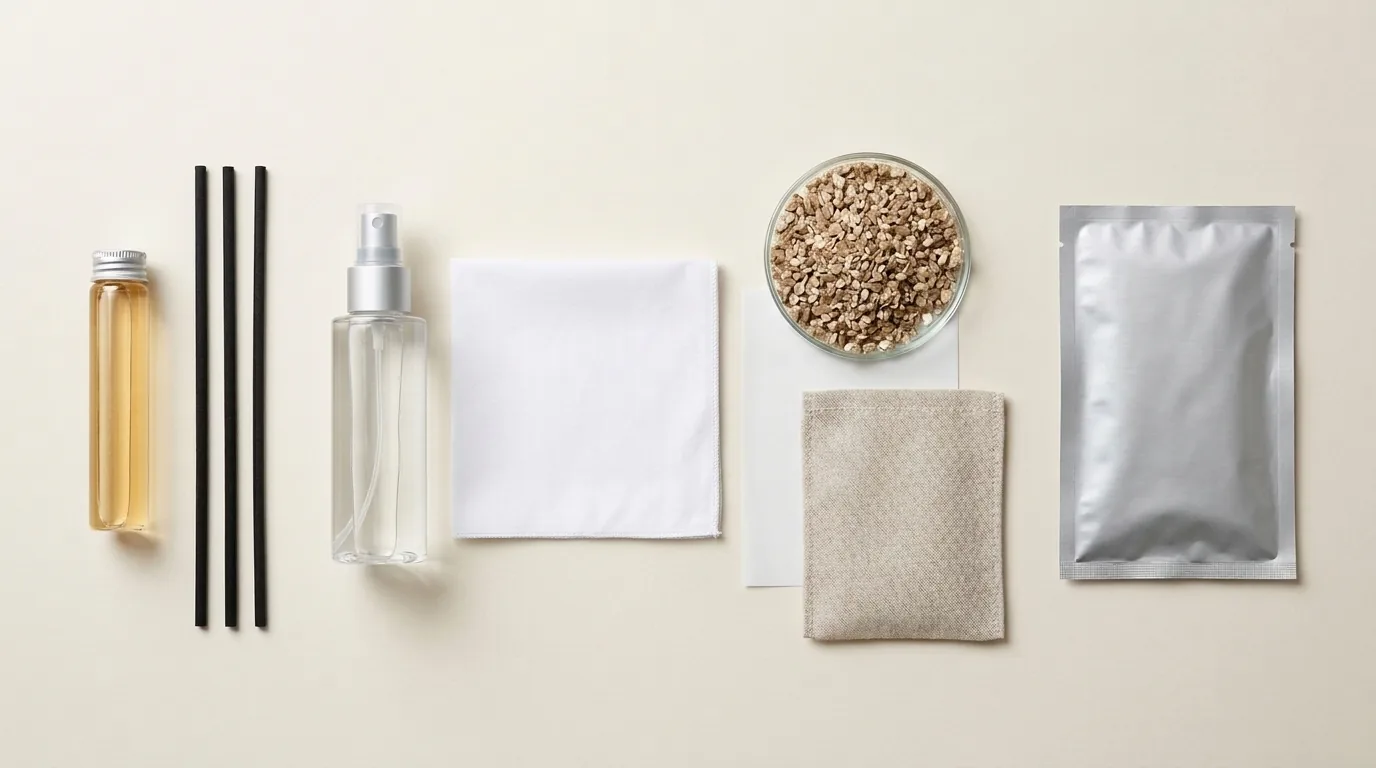
- Solvent polarity & cold/hot throw shifts: High-terpene citrus and delicate floral top notes lift rapidly off a blotter strip but behave differently inside alcohol-free Augeo reed bases versus dry vermiculite carriers. Our perfumers re-balance volatility curves per SKU so a guestroom linen spray opens cleanly without overpowering a bedside reed diffuser sharing the same signature scent family.
- Micro-emulsion clarity & non-staining textile checks: Pure fragrance oil is hydrophobic. Blending it into a water-based room and linen mist requires calibrated non-ionic solubilizers and freeze-thaw clarity screening so the liquid stays crystal-clear on clear-glass vanities and dries with zero oily halo on white cotton, linen, or polyester drapery.
- Vanillin oxidation & color drift across substrates: Warm amber, vanilla, and tonka accords naturally darken over time under lobby spotlights or heat. Specify UV-stabilized amber/tinted glass for liquid SKUs and check whether high-vanillin levels cause yellowing on cream cotton sachet pouches during accelerated oven aging.
- Stick porosity & neck-finish pairing: Thick resinous hotel accords slow capillary rise in natural rattan. Pairing high-porosity anti-clog fiber sticks with the exact bottle neck finish, plug aperture, and usable headspace keeps steady wicking across the 60–90 day planning window without drying out early.
3. Prevent Oil Bleed, Textile Staining, and Ocean-Freight Scent Loss
For home-textile brands bundling scented paper sachets or woven cotton-linen sachets directly inside folded sheet sets, garment boxes, or hotel wardrobes, containment failures cause immediate merchandise damage. Address these four physical barrier checkpoints in your spec sheet:
- Inner oil-barrier lamination on paper sachets: Standard uncoated paper absorbs oil rapidly and transfers stains onto adjacent textiles or coated gift boxes. Specify an internal oil-resistant PE/PET liner layer inside printed FSC paper sachets, and verify heat-seal platen widths (typically 5–8 mm) so fine vermiculite dust never sifts out of the seams.
- Granule mesh sizing & inner pouch for woven linen bags: Loose linen or cotton weaves have open interstices. Rather than pouring fine powder directly into an outer stitched pouch, house calibrated 20–40 mesh infused vermiculite or polymer fragrance beads inside a heat-sealed spunbond non-woven inner sachet so zero mineral grit rubs onto luxury bedding.
- High-barrier outer overwrap (MVTR defense): A breathable sachet or scented drawer liner starts diffusing the moment it leaves the filling line. Without an individual heat-sealed BOPP or metallized PET/AL/PE barrier pouch around each retail unit, multi-week ocean freight and warehouse dwell times strip delicate top notes before the guest or consumer ever breaks the seal.
- Closure torque, dip-tube clearance & master carton protection: For liquid diffusers and mists, validate PE inner-plug pull force, collar crimp or screw torque, spray pump locking clips, and double-wall corrugated master carton dividers during pre-shipment bottle leakage and drop checks.
4. Multi-SKU MOQ Splitting, Shared Dielines, and Print Amortization
Hospitality groups and textile retailers rarely launch one standalone SKU—they launch a coordinated collection (e.g., 100 ml diffuser + 100 ml pillow mist + wardrobe sachet). Because minimum quantities differ sharply by machinery and converting economics, smart MOQ splitting protects cash flow on your first rollout:
- Anchor low-MOQ visual tiers around stock tooling: Reed diffusers and drawer liners carry a 500-unit custom MOQ planning reference when built on existing factory glass bottles, standard aluminum collars, or stock sheet sizes. Avoid custom glass mold tooling on pilot launches; invest instead in custom Pantone spray finishes, hot-foil labels, and bespoke folding-carton dielines.
- Consolidate sachet print runs to clear the 1,000-unit per design & scent gate: Both paper and fabric sachets carry a 1,000-unit per design and fragrance MOQ planning reference because printing plates, die-cutting dies, and volumetric hopper clean-downs tie directly to each artwork and scent batch. Where a hotel needs three room variants, keep one shared outer pouch dieline and differentiate scents via coordinated color-coded ribbon loops or front-label zones.
- Plan the 3,000-unit spray run for housekeeping & retail refill volume: Water-based scented sprays carry a 3,000-unit custom MOQ planning reference driven by emulsion tank batching, trigger-pump procurement, and automated bottle labeling. Hotels frequently deploy 50–100 ml travel sizes for turn-down amenities alongside 200–300 ml housekeeping bottles from the same master emulsion batch to hit 3,000+ total units smoothly.
- Stage sampling before print cylinders lock: Use LoyalCrafts' 1–3 day stock sample reference to test bottle ergonomics, atomizer plume fineness, and sachet fabric drape first; then authorize 7–14 day custom evaluation samples containing your actual signature fragrance across all chosen carriers before releasing dieline plates for the 30–40 day bulk production cycle.
5. Cross-Border Compliance: IFRA Categories, EU CLP, U.S. FHSA & PPWR
Never treat one fragrance certificate as universal clearance across a multi-format hotel or textile assortment:
- Verify per-SKU categories under IFRA Standards: A reed diffuser or enclosed wardrobe sachet normally aligns with non-skin-contact air-care limits (IFRA Category 12), whereas a linen/room spray may trigger stricter inhalation or incidental textile/skin-contact exposure thresholds depending on intended use instructions. Always request separate project-specific IFRA Certificates of Conformity per product format and maximum oil percentage.
- EU CLP & U.S. CPSC FHSA Hazard Panels: Even non-cosmetic home and hotel fragrances require finished-mixture classification checks for skin sensitizers (H317), aquatic toxicity, eye irritation, and applicable UFI / Poison Centre notifications in Europe, or 16 CFR Part 1500 cautionary statements in the United States. Review our B2B fragrance compliance document guide before finalizing carton dielines.
- EU PPWR Material Reduction & Recyclability: Large retail groups increasingly audit secondary gift boxes for mono-material paperboard inserts over multi-polymer foam trays and minimal void-space ratios. Confirm recyclable carton and glass specs early using our EU PPWR home fragrance packaging checklist.
6. Blank Hospitality & Home Textile Golden Sample Acceptance Sheet
Copy this verification sheet directly into your purchase specification before releasing artwork plates or paying your bulk deposit:
| Inspection checkpoint | Engineering verification protocol | Target acceptance criteria | Sign-off owner |
|---|---|---|---|
| Cross-carrier scent parity | Side-by-side sensory check of diffuser, spray, and sachet after 24 h room equilibration | Recognizable signature brand character across formats without harsh solvent off-notes | Brand / Hotel R&D |
| Linen spray non-staining check | 3 full-actuation mist passes onto white 100% cotton & silk swatches; air-dry 24 h | Zero visible oil ring, halo discoloration, or dye bleed after drying | QC Lab / Textile Buyer |
| Sachet oil-bleed & wood-contact check | Pressed weighted contact against white cotton cloth and lacquered wood tile for 72 h at elevated warehouse temp | Zero oil migration, paper staining, mineral dust sifting, or lacquer softening | Factory QC & Buyer |
| Emulsion & liquid chill stability | Thermal cycling of filled glass spray & diffuser bottles (cold cargo simulation to warm display) | No haze, flocculation, phase separation, or unacceptable color darkening | Compounding Lab |
| Barrier overwrap & transit leak check | Vacuum/inverted hold on capped liquid bottles + heat-seal peel check on individual sachet BOPP/foil pouches | Zero liquid weeping past PE plugs/atomizers; airtight pouch seals with clean master-carton drop performance | Packaging QC |
| Per-SKU regulatory dossier | Match formula revision code to IFRA category cert, 16-section SDS, CLP/FHSA label table, and carton barcodes | Written destination sign-off completed before printing labels, boxes, or master cartons | Compliance / Importer |
Ready to consolidate a coordinated reed diffuser, linen mist, and wardrobe sachet brief for your hotel group or home-textile collection? Send your multi-SKU specification to Bruce Ding and our Jinhua engineering team to request 1–3 day stock format references or a custom 7–14 day cross-carrier evaluation kit.
FAQs
Can one signature hotel or textile brand fragrance be filled identically into a reed diffuser, linen spray, and scented sachet?
No. While the olfactory signature stays aligned, each product requires its own base chemistry and oil load. Alcohol-free Augeo diffuser bases, water-based micro-emulsion linen sprays, and dry 20–40 mesh vermiculite sachets differ in polarity, evaporation rate, and IFRA exposure category—so our R&D lab adapts the formula per carrier and validates all formats side by side before Golden Sample approval.
How do OEM buyers prevent scented sachets or drawer liners from staining white bed linens or lacquered wardrobe wood?
Specify an internal oil-barrier lamination (such as PE/PET inner lining) inside paper envelopes or a sealed spunbond inner pouch inside woven cotton-linen bags, paired with a sealed outer BOPP or metallized foil overwrap for transit. During sample approval, always run a weighted 72-hour elevated-temperature contact test against white cotton fabric and finished wood surfaces rather than relying on room-temperature visual checks.
Why is the custom MOQ 500 units for reed diffusers and drawer liners, 1,000 units per design & fragrance for sachets, and 3,000 units for linen sprays?
Each minimum reflects upstream component and production-line economics (all planning references). Stock-bottle reed diffusers and sheet drawer liners scale efficiently from 500 units, whereas custom printed sachets tie printing plates, die-cuts, and hopper clean-downs to 1,000 units per artwork and scent. Water-based linen sprays require 3,000 units to cover emulsion batching, solubilizer calibration, and pump/label automation.
What compliance documents should hotel and home textile buyers request before releasing packaging artwork?
Request format-specific IFRA Certificates of Conformity tied to each SKU's actual formula and use category, 16-section Safety Data Sheets (SDS/MSDS) confirming flash point and non-DG vs. regulated transport status, EU CLP allergen/hazard classifications (including UFI obligations where applicable) or U.S. CPSC FHSA warning text, and recyclable packaging material declarations aligned with EU PPWR rules.