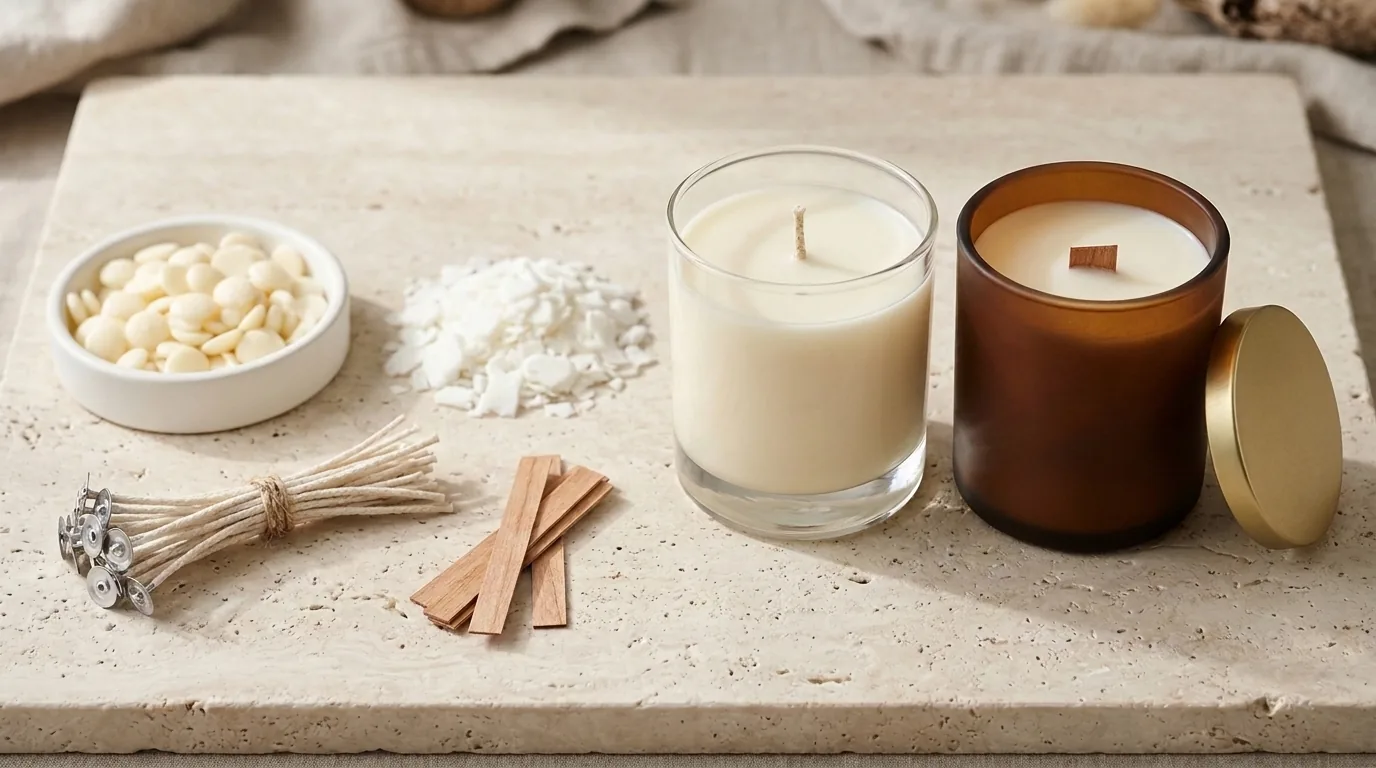
Quick answer: A private label scented candle succeeds or fails on the four-way match between wax blend melt point, wick gauge vs. vessel inner diameter, fragrance solubility (typically 6%–10% in soy-blend systems), and vessel-level burn testing. While 100% pure soy wax appeals to plant-based marketing briefs, it is prone to surface frosting and softening in warm ocean containers; most retail programs achieve smoother jar tops, stronger hot throw, and 40h+ reference burn time (200 g) using a custom soy-blend or coconut-soy wax paired with a calibrated lead-free braided cotton or wood wick verified against ASTM F2417 (fire safety) and ASTM F2179 (annealed glass thermal shock).
Many private label candle inquiries begin with vessel color, gift-box printing, and target unit FOB pricing—yet post-launch returns almost always trace back to combustion physics. Tunneling down the center, mushrooming carbon soot, surface frosting on clear glass, or fragrance oil sweating during summer transit can derail retail reorders even when the jar looks sharp on a showroom shelf.
At our 11,000 sq m Jinhua manufacturing facility—operating 6 automated lines with a +/- 2 g filling precision target and 3,500+ fragrance formulations—our private label scented candle OEM team engineers the wax matrix, wick architecture, vessel annealing spec, and multi-cycle burn protocol as one integrated system. Use this guide to write a tighter development brief and sign off sample burns without costly re-tooling.
1. Select Your Wax Blend by Retail Tier, Scent Throw, and Transit Climate
No single wax excels across every price tier, climate zone, and fragrance family. Fragrance oil polarity, ambient warehouse temperature, and glass opacity all govern which base formulation delivers the cleanest surface finish and strongest cold-to-hot throw.
| Wax architecture | Surface finish & glass adhesion | Cold & hot throw balance | Typical fragrance load ref. | Summer transit & frosting notes | Best retail fit |
|---|---|---|---|---|---|
| 100% Pure Soy Wax | Matte, opaque cream; higher tendency for rough tops and polymorphic crystal frosting | Gentle cold throw; moderate, slow-building hot throw | 6%–8% (excess oil risks syneresis / sweating) | Lower melt point (~48–52 °C); higher frosting and warm-container softening risk | Eco-positioned apothecary jars and matte ceramic vessels where natural texture is accepted |
| Soy-Paraffin Blend | Smooth, flat single-pour top; strong uniform jar wall adhesion | High immediate cold throw and brisk, room-filling hot throw (20–25 sq m) | 6%–10% depending on oil density and flash point | Higher thermal stability and minimal frosting; reliable across varied shipping climates | Department-store lines, seasonal collections, and multi-SKU commercial retail programs |
| Coconut-Soy Blend | Creamy, porcelain-like smooth finish with rich visual sheen | Strong, clean cold and hot throw with minimal soot when wicked accurately | 7%–10% (paired with plant hardeners to bind oil) | Requires plant-based melt-point modifiers for warm-climate shipping | Boutique lifestyle brands, spa lines, and luxury home fragrance collections |
| Refined Paraffin / High-Melt Pillar Blend | Crisp mold release, sharp edges, and vivid dye saturation | Maximum fragrance dispersion and crisp color clarity | 5%–8% tailored to crystal structure | Highest melt point tolerance (~56–62 °C); strong resistance to summer sagging | Travel tins, molded pillars, and high-temperature export corridors |
Do not confuse IFRA limits with physical wax capacity: Under the IFRA Standards Library, indoor scented candles fall under Category 12 (non-skin-contact air care), where many fragrance concentrates list a 100% or relatively high safety ceiling. That figure is a toxicological threshold—not a pouring recipe. Physically overloading soy or coconut wax beyond its saturation limit forces unbonded oil to migrate to the surface ("sweating"), fuels tall erratic flames, and compromises jar stability.
2. Match Wick Architecture and Diameter to Glass Vessel Geometry
In contract candle manufacturing, changing the fragrance scent—even inside the exact same jar and wax base—can require re-sizing the wick. High-vanillin gourmand oils, dense woody resins, and high-terpene citrus blends alter capillary viscosity inside the wick braid. A single wick spec cannot safely govern an entire six-scent collection without per-SKU burn verification.

- Vessel inner diameter and multi-wick thresholds: Standard 180–220 g cylindrical jars (roughly 70–82 mm inner diameter) generally burn cleanly on a single calibrated wick. Once inner diameter reaches ~88–90 mm or moves into oval/wide bowl vessels, specify two or three smaller wicks positioned symmetrically rather than over-sizing a single large wick that overheats the jar rim.
- Lead-free braided cotton wicks (flat, square, or coreless/paper-core): Remain the workhorse for scalable OEM programs. Braided cotton wicks offer tighter batch-to-batch capillary repeatability, predictable self-trimming curl to limit carbon "mushrooming," and higher pass rates on ASTM F2417 end-of-life self-extinguishing checks.
- Natural wood wicks (single-ply vs. boosted cross-ply): Deliver a tactile acoustic crackle and contemporary shelf presence for boutique brands. However, wood grain density and moisture content vary naturally—require multi-cycle re-light testing during sampling to prevent flame suffocation in high-viscosity blends or excessive char drop into the wax pool.
- Sustainer tab neck height and centering collars: Specify exact metal sustainer neck height (commonly 6–10 mm) so the flame self-extinguishes safely above the glass floor before thermal stress concentrates on the base corner, and verify automated line centering tolerances (+/- 1–2 mm) during bulk pouring.
3. Prevent Tunneling, Frosting, Wet Spots, and Summer Sweating Before Bulk Pouring
Resolving cosmetic and combustion defects on the filling line is dramatically cheaper than issuing wholesale credits at destination. Ask your scented candle OEM supplier to address these four failure modes in the production specification:
- Tunneling (residual wax ring stuck to walls): Triggered by an undersized wick, over-fragranced dense oil clogging capillary action, or inadequate first-burn duration. Confirm during sample review that a standard 3–4 hour burn cycle reaches an edge-to-edge melt pool (roughly 6–12 mm deep) without exceeding glass surface temperature limits.
- Frosting and sinkholes (white crystalline bloom on soy wax): Caused by natural polymorphic crystallization when pure soy cools too rapidly or undergoes temperature swings. Mitigate via balanced soy-coconut or soy-mineral blends, controlled vessel pre-heating prior to pouring, calibrated pouring temperatures, and gradual cooling tunnels—minimizing post-pour heat-gun remelting that drives off delicate top notes.
- "Wet spots" (localized wax detachment from clear glass walls): Caused by thermal contraction differences between cooling wax and rigid soda-lime glass during winter ocean freight or air-conditioned retail storage. While a wet spot does not impair scent throw or safety, brands selling clear transparent jars can reduce visibility by specifying frosted, matte-sprayed, amber, or ceramic vessels (compare vessel finish premiums in our private label candle packaging cost guide).
- Sweating and container melting in warm export lanes: Unventilated sea containers crossing tropical ports frequently exceed 50 °C. Verify the finished blend's drop melt point, run 45 °C accelerated thermal stability checks on capped samples, and coordinate heat-sensitive ocean stowage alongside our fragrance export shipping and drop-test guide.
4. Build ASTM F2417 / F2179 and EN 15493 / EN 15494 Into Sample Sign-Off
Retail compliance officers in North America and Europe treat container safety and finished-candle combustion as two separate gates. Sourcing an inexpensive decorative tumbler that was never engineered for candle service is one of the fastest ways to trigger a product recall.
- ASTM F2179 (Annealed Glass Container Standard): Applies to the empty soda-lime glass vessel itself—requiring proper furnace annealing (verified by polariscope strain inspection) and thermal-shock immersion testing so localized flame heat at the end of a burn will not shatter the jar.
- ASTM F2417 & NCA Fire Safety Principles: Evaluates the finished assembled candle across 4-hour burn intervals through final extinction, verifying flame-height limits, resistance to secondary ignition (where pooled wax or dried botanical toppings catch fire), tip stability, and container wall/base temperature limits. Avoid embedding dried flowers or flammable inclusions near the melt zone on commercial retail SKUs.
- European EN 15493, EN 15426 & EN 15494: For EU/UK distribution, align combustion fire safety (EN 15493, including post-extinction aftersmoke limits), soot-behavior limits (EN 15426), mandatory ISO 7010-W001 warning label pictograms and typography rules (EN 15494), plus CLP/UFI hazardous-mixture inputs covered in our EU candle manufacturer compliance checklist and B2B fragrance compliance guide.
- Refillable candle systems: If your roadmap includes reusable ceramic or heavy glass outer vessels with drop-in wax refills, verify first-burn and refill-cycle wick alignment using our refillable candle buyer checklist.
5. Blank Pre-Production Candle Burn & Vessel Sign-Off Sheet
Attach this record sheet to your candle sample approval before releasing bulk vessel decoration and carton printing. As LoyalCrafts planning references, custom MOQ starts at 1,000 units, stock samples prepare in 1–3 days, custom scent/vessel samples take 7–14 days (allow additional calendar days when full 40h+ multi-cycle burn logs are requested per SKU), and bulk production runs 30–40 days after sample approval and deposit.
| Inspection checkpoint | Test condition & specification to define | Target acceptance criteria | Status & owner |
|---|---|---|---|
| Vessel annealing & dimensions | Confirm annealed candle-grade glass/ceramic wall thickness, inner diameter (mm), base thickness, and polariscope / thermal-shock record (ASTM F2179 reference) | Zero visible internal strain defects; uniform neck/rim tolerance for lid or dust-cover fit | To record |
| Wax blend, fill weight & top finish | Lock wax formula code, fragrance load (%), pouring temperature, +/- 2 g net fill target, and cooling profile | Flat, smooth top surface without deep sinkholes, air pockets, or unbonded surface oil | To record |
| Wick model & 4-hour burn cycle | Run sequential 4-hour burn intervals (e.g., Cycles 1, 3, and End-of-Life) in draft-free room; log melt pool diameter, flame height, and soot/mushrooming | Full-edge melt pool by Cycle 2–3; calm flame within height limit; clean self-extinction at sustainer tab | To record |
| Thermal stability & sweating check | Hold sealed, labeled candles at 45 °C (heat-cycle) and chilled cycle to evaluate oil bleeding, label adhesive edge-lift, and jar wall detachment | Zero liquid oil pooling on top surface; labels remain flat with no adhesive ooze | To record |
| Safety labels & export drop pack | Verify bottom warning label (ASTM F2058 / EN 15494), IFRA Cat. 12 / SDS / CLP alignment, inner dividers, and master-carton drop test | Legible heat-resistant bottom warning label; zero glass chipping or breakage across carton drop sequence | To record |
FAQs
What is the best wax blend for private label scented candles—100% soy or a soy blend?
A custom soy blend (such as a soy-coconut or soy-paraffin blend) generally delivers smoother jar tops, stronger hot scent throw, and better stability during warm-weather export shipping than 100% pure soy wax. Pure soy remains viable for plant-only brand briefs, provided buyers accept occasional natural frosting and confirm transit melt-point limits during sampling.
Why do two candles with the same glass jar and wax need different wick sizes?
Fragrance oils vary significantly in density, flash point, vanillin level, and botanical resin content, all of which change how fast liquid wax travels up a cotton or wood wick. Each fragrance SKU should undergo an independent multi-cycle burn test so the wick gauge is tuned up or down to prevent tunneling or over-sized flames.
What is the difference between ASTM F2179 and ASTM F2417 for candle buyers?
ASTM F2179 specifies annealing and thermal-shock resistance requirements for the empty soda-lime glass candle container, whereas ASTM F2417 evaluates fire safety for the complete burning candle assembly (flame height, secondary ignition, tip stability, and end-of-life vessel heat). Both work together to prevent jar cracking and combustion hazards.
How much fragrance oil can a scented candle hold, and does IFRA Category 12 mean 100% load?
No. Although an IFRA Category 12 compliance statement often lists a high or 100% theoretical exposure limit for non-skin-contact candles, physical wax matrices typically hold 6%–10% fragrance oil depending on the wax blend and oil polarity. Exceeding physical saturation causes oil sweating and unsafe flames.
What are LoyalCrafts' MOQ and lead time references for custom private label scented candles?
As planning references, custom private label scented candle orders start at an MOQ of 1,000 units per SKU, stock samples prepare in 1–3 days, custom wax/wick/vessel samples take 7–14 days (plus burn-test observation windows), and bulk production runs 30–40 days after sample approval and deposit.
6. Lock Your Wax, Wick, and Burn-Test Brief Before Sampling
Whether you are launching a 200 g signature soy-blend glass collection for specialty retail, an amber-jar wood-wick spa line, or an EU/US-compliant seasonal gift set, locking your wax architecture, glass annealing spec, and per-SKU burn checklist upfront keeps development fast and predictable. Review our private label scented candle manufacturing capabilities or send your target fill weight, vessel dimensions, wax preference, fragrance directions, and destination market through our B2B OEM inquiry form.