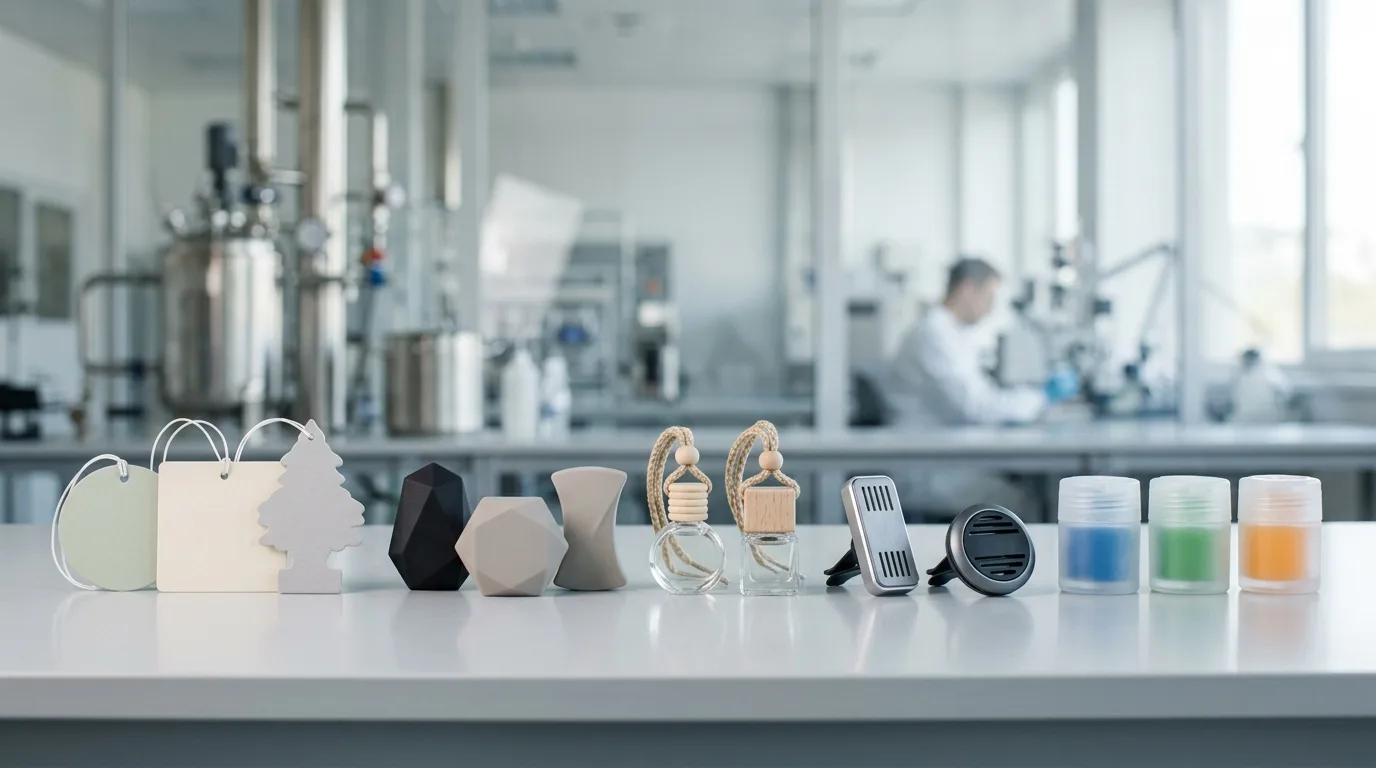
Quick answer: Selecting a private label car air freshener medium means matching unit-cost structure, mold tooling, scent release profile, and cabin heat tolerance to your retail channel. Based on our published factory planning references: scented paper cards (MOQ 1,000 units; 15–30 days) suit high-volume promotions and multipacks; molded EVA polymer (MOQ 3,000 units; 30–45 days) delivers dry-to-the-touch 3D shapes with zero free liquid; hanging glass bottles (MOQ 500 units; 45–60 days) offer low-MOQ visual luxury when paired with inner stopper plugs; car vent clips (MOQ 1,000 units; 30–45 days) use HVAC airflow across ceramic, polymer, or membrane cores; and solid gel canisters (MOQ 3,000 units; 30 days) provide spill-resistant odor control for cup holders and cabins.
Automotive air care is a high-repeat category for auto-parts chains, forecourt convenience stores, car-wash groups, and lifestyle merchandise brands, yet vehicle cabins punish poorly engineered products. Unlike climate-controlled living rooms, a parked car experiences steep winter freezes and summer windshield heat spikes that expose weak seals, oversaturated substrates, and low-barrier wrappers before a product ever finishes its scent cycle.
At our Jinhua Loyal Crafts car fragrance facility—operating 6 automated production lines across an 11,000 sq m plant—we manufacture all five core automotive scenting media under one roof. Use this selection matrix to compare carrier mechanisms, cabin heat risks, barrier packaging specs, and pre-shipment verification steps before locking your SKU lineup.
1. Understand How the 5 Automotive Scent Media Hold and Release Fragrance
Each car fragrance format binds aromatic oil differently, shaping both the opening scent throw and how evenly the fragrance fades in a compact 2.5–3.5 m³ passenger cabin:
- Absorbent Cotton Paper Card (Capillary Adsorption): High-porosity cotton/cellulose blotter board absorbs liquid fragrance into open fiber capillaries. Release follows a brisk front-loaded curve—strong opening projection during the first week followed by softer base notes across a 15–30 day planning reference. Full-bleed CMYK printing and low-cost steel-rule die cutting make scented paper cards ideal for rapid graphic refreshes.
- Molded EVA Polymer (Solid-Matrix Infusion): As covered in our custom EVA air freshener OEM guide, ethylene-vinyl acetate copolymer granules incorporate fragrance inside a flexible solid matrix. Because there is no liquid reservoir or glass vial, scented EVA polymer pieces release aroma gradually through solid-state diffusion over a 30–45 day reference without shattering or leaking.
- Hanging Glass Diffuser with Wooden Cap (Controlled Wicking): Miniature thick-walled glass bottles (commonly 5–10 ml) pair a formulated liquid fragrance base with an unfinished porous hardwood cap such as beechwood. Brief inversion wets the inner wood grain so fragrance evaporates gently from the cap exterior over a 45–60 day reference, giving car perfume diffusers strong gift and boutique shelf appeal.
- Automotive HVAC Vent Clip (Airflow-Assisted Convection): Mounted onto dashboard air louvers, car vent diffusers rely on cabin fan airflow to carry scent across the vehicle. Depending on housing design, the active core can be an infused ceramic/sintered polymer tablet, an EVA insert, or a sealed liquid pod regulated by a breathable polymer membrane (detailed in our membrane air freshener buyer checklist).
- Solid Gel Deodorizer Canister (Immobilized Hydrocolloid Matrix): Hot-poured aqueous carrageenan or blended gelling systems lock water, solubilized fragrance, and odor-counteracting agents into a firm cake inside rigid cans or jars. Placed in cup holders or under seats, scented solid gel deodorizers shrink steadily over a 30-day reference without spilling free liquid if tipped on sharp turns.
2. 5-Media OEM Engineering & Procurement Comparison Matrix
Aligning substrate physics with your target retail price band and order volume early prevents costly re-quoting. Review our side-by-side planning references below (confirm exact specifications against your approved sample and packaging):
| Car fragrance format | Carrier state & release | Custom MOQ ref | Duration ref | Tooling & unit-cost structure | Best-fit B2B channels |
|---|---|---|---|---|---|
| Scented Paper Card | Infused cotton cellulose board; passive hanging evaporation | 1,000 units | 15–30 days | Lowest unit-cost entry; inexpensive flat die-cut knife; zero 3D mold | Promotional merch, car-wash memberships, forecourts, multipacks |
| Scented EVA Polymer | Dry-touch solid copolymer; steady solid-state diffusion | 3,000 units | 30–45 days | Mid-tier unit cost; zero tooling on stock shapes or custom CNC mold for 3D mascots/emblems | Lifestyle & streetwear brands, auto aftermarket retail, museum/club shops |
| Hanging Glass Bottle | Liquid fragrance reservoir with porous beechwood diffuser cap | 500 units | 45–60 days | Mid-to-premium unit cost; low entry MOQ using stock flint/frosted bottles and custom print | Boutique gift stores, dealership handover kits, DTC fragrance lines |
| Car Vent Diffuser | Clip housing over ceramic, polymer, or spill-proof membrane core | 1,000 units | 30–45 days | Hardware-driven unit cost (clip + shell + core); supports recurring refill-pack SKUs | Auto-parts retail chains, supermarket car-care aisles, subscription kits |
| Solid Gel Deodorizer | Firm hydrocolloid gel cake in vented cup-holder jar or can | 3,000 units | 30 days | Accessible rigid-tub value tier; stock cup-holder canisters with custom wrap labels | Hypermarkets, fleet & rideshare supply, combined car/closet odor lines |
Many buyers pair two complementary tiers under one seasonal launch—for example, testing three signature scents at 500 units per SKU in hanging glass bottles while running a high-volume paper card or in-car deodorizing sachet for checkout impulse racks. Review SKU splitting strategies in our private label car air freshener MOQ guide.
3. Cabin Thermal Stress, Interior-Trim Protection, and Leak Prevention
Direct solar load through a windshield routinely pushes dashboard and rearview-mirror zones well above 60–70 °C in summer parking. Because concentrated fragrance oils act as active organic solvents, thermal spikes and interior-surface contact represent the top root causes of retail returns and consumer damage claims.
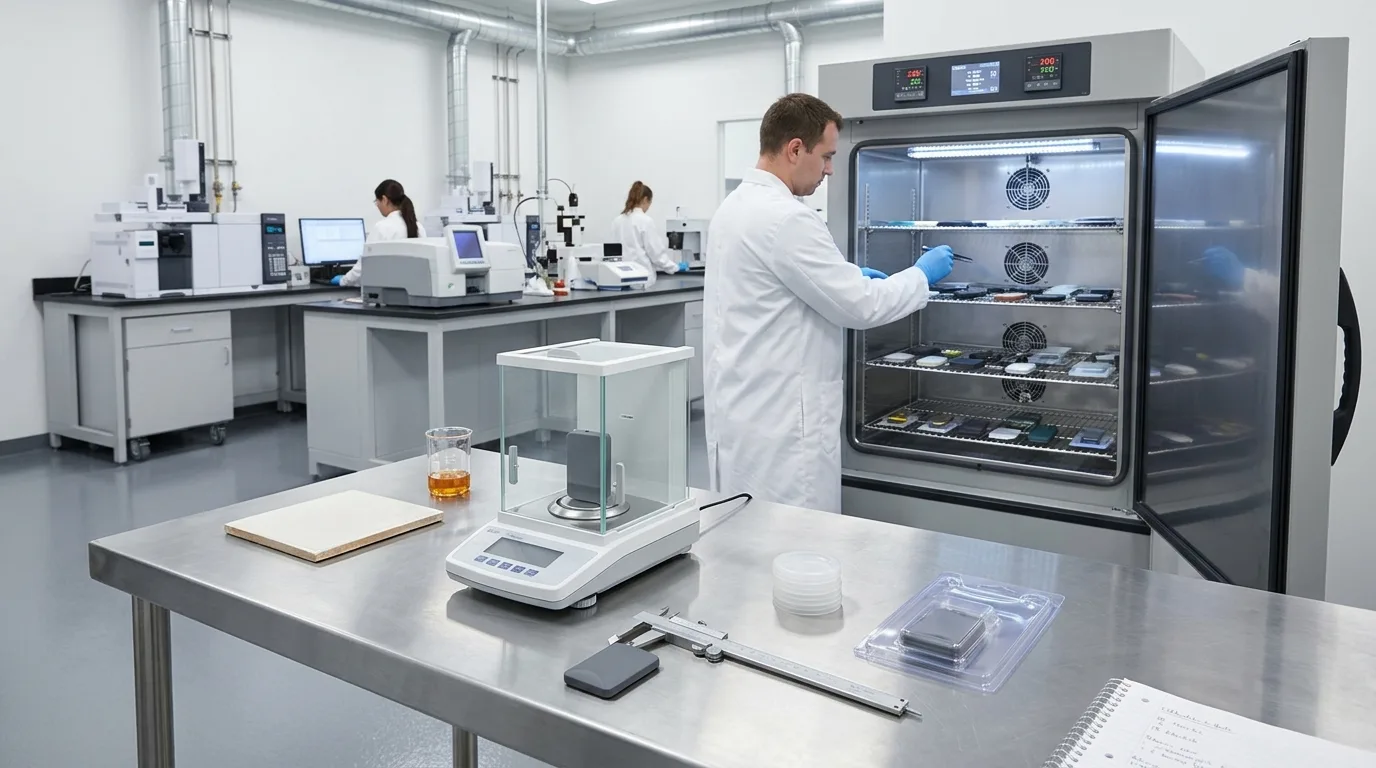
Build four engineering safeguards into your technical specification sheet:
- Prevent oil sweating and enforce free-hanging clearances: Over-dosing a paper card beyond its fiber saturation point—or under-curing an EVA blend—causes free oil droplets to sweat onto the surface under heat. If any fragranced card, polymer charm, or wet wooden cap rests directly against painted trim, coated ABS, vinyl, or leather, fragrance solvents can soften or mar the finish. Calibrate oil load to dry-touch absorption limits and print mandatory consumer hang warnings instructing users to hang items freely away from dashboards and screens.
- Account for liquid thermal expansion in hanging glass bottles: Fragrance liquids expand in heated cabins and sea containers. Filling glass vials to the neck without expansion headspace forces oil past wood threads. Always specify proper ullage (headspace), controlled cord-hole tolerances, and a snug PE/silicone inner transit plug that remains sealed until consumer activation—covered further in our car air freshener OEM quality checklist.
- Verify vent-clip grip force and louver pad cushioning: Bare metal or sharp injection-molded prongs can scratch piano-black or chrome air vents. Specify soft silicone sleeve pads on clip prongs, test retention across horizontal and vertical blade thicknesses, and ensure membrane pods pass inverted pressure checks without weeping onto below-vent infotainment buttons.
- Control syneresis (water weeping) in solid gels: Poorly balanced hydrogel formulas expel free liquid water or slump after freeze-thaw and heat cycles. As outlined in our solid gel air freshener buyer checklist, verify clean gel elasticity and zero liquid pooling after warm-chamber conditioning.
4. Specify High-Barrier Packaging to Protect Unopened Shelf Life
Volatile top notes—especially citrus terpenes, marine aldehydes, and crisp herbal esters—migrate rapidly through ordinary polyethylene bags or unlined paperboard. If barrier films are under-specified, cartons lose scent strength during ocean transit and warehouse storage, leaving sticky residue on printed outer cards.
- Multi-layer barrier pouches for paper and EVA formats: Specify heat-sealed high-barrier laminated pouches (such as KOP/CPP, PET/VMPET/PE metallized film, or aluminum-foil laminate structures) rather than standard OPP polybags when targeting 12–24+ month unopened retail shelf life. Display boxes can incorporate a small scratch-and-sniff or scented tester strip on the outer carton so shoppers never tear primary pouches.
- Solvent-resistant thermoformed blisters for vent clips: For pegboard retail cards, pair rigid APET/PETG blister cavities with tested heat-seal lacquer coatings on heavy SBS backing board. Membrane capsules inside blisters rely on an aluminum-foil barrier pull-tab that keeps liquid hermetically sealed until pulled by the driver.
- Induction or peelable foil liners on solid gel tubs: Beneath the vented decorative plastic lid, require an airtight inner aluminum-foil or composite peel seal across the container rim so zero water or fragrance evaporates prior to purchase.
5. Blank Sample Verification Sheet for Car Fragrance OEM Orders
Before signing off on golden pre-production samples, run physical evaluation across your chosen format using the verification table below. As planning references, existing stock samples take 1–3 days, custom fragrance/mold/packaging samples take 7–14 days, and bulk production runs 30–40 days after sample approval and deposit.
| Inspection item | Test setup to define | Target observation | Sample status & owner |
|---|---|---|---|
| Elevated-heat & chill conditioning | Condition sealed and opened samples across cold (0 to -10 °C) and warm/elevated cabin-simulation chambers (45–65 °C per format spec) | Zero oil sweating, polymer warping, gel liquefaction, bottle cracking, or seal ballooning | To record |
| Inverted & vibration leak check | Invert unstoppered/stoppered liquid bottles, membrane pods, and sealed gel tubs; run carton drop and vibration checks | Zero neck seepage, foil-tab delamination, or inner carton staining | To record |
| Scent throw & cabin dry-down | Install activated samples in closed test vehicles or controlled-volume booths; evaluate Day 1, Day 7, Day 15, and Day 30 | Balanced opening without harsh solvent sting; recognizable heart/base notes through target cycle | To record |
| Hardware fit & cord tensile strength | Test elastic/cotton cord knot pull force on hanging items and vent-clip insertion across thick and thin louver blades | Secure mount without slipping on rough roads; silicone pads protect vent finish | To record |
| Barrier seal & warning copy | Check pouch heat-seal seam width, peel-tab removal force, and back-card regulatory/surface-contact text | Clean, airtight seal; legible free-hanging caution and market allergen statements | To record |
Confirm regulatory and transport paperwork alongside physical testing. IFRA conformity certificates (typically Category 12 for air care products not intended for direct skin contact) verify safe fragrance ingredient usage, while EU ECHA CLP guidance and U.S. CPSC FHSA requirements govern hazard pictograms, sensitizer disclosures, and precautionary labeling. Review document handoffs in our B2B fragrance compliance documents checklist, and check SDS flash-point classifications early when shipping liquid refills versus dry solid formats.
FAQs
Which car air freshener format has the lowest custom MOQ for testing new scents?
Hanging glass car perfume diffusers offer our lowest custom MOQ planning reference starting from 500 units when using stock bottle shapes, followed by scented paper cards, car vent diffusers, and membrane diffusers from 1,000 units. Molded EVA polymer cards and solid gel canisters start around a 3,000-unit custom MOQ reference.
Which car fragrance medium is safest if we want zero free liquid during shipping and summer heat?
Scented EVA polymer cards and absorbent paper cards contain no free liquid reservoir, eliminating bottle breakage and liquid spills during parcel delivery or hot cabin parking. Solid gel canisters also immobilize aqueous fragrance inside a firm hydrocolloid matrix so overturned jars do not pour liquid, provided formulas are tested against heat syneresis.
How do we prevent car air fresheners from damaging vehicle dashboards or trim?
Formulate dry-touch oil loads that do not sweat under heat, equip vent clips with soft silicone louver pads, fit hanging bottles with leak-tight inner stoppers, and print clear consumer instructions on every retail card warning drivers to hang or clip products freely without touching painted, plastic, vinyl, or leather surfaces.
Can one signature fragrance oil be used across paper cards, EVA, vent clips, and hanging bottles?
A single scent concept—such as cedarwood leather, black ice marine, or white tea—can be coordinated across all five formats, but our perfumers adjust carrier solvents and volatility ratios for each substrate from our 3,500+ formula library so wicking wood caps, solid EVA polymers, and aqueous gels project a consistent olfactory character.
What are the standard sampling and bulk production lead times for custom car air fresheners?
As planning references, allow 1–3 days for existing stock quality samples, 7–14 days for custom scent, printed card, or molded/vessel pre-production samples, and 30–40 days for bulk mass production after final sample sign-off and deposit receipt.
6. Plan Your Multi-Format Car Fragrance RFQ & Sample Kit
Whether you are launching a low-MOQ hanging glass collection, a custom 3D EVA mascot line, or a retail pegboard program combining vent clips and promotional paper cards, comparing physical samples in real vehicles is the fastest way to finalize specs. Review our OEM fragrance sampling process or submit your target formats, scent profile, quantity, and destination market via our car fragrance OEM inquiry form.