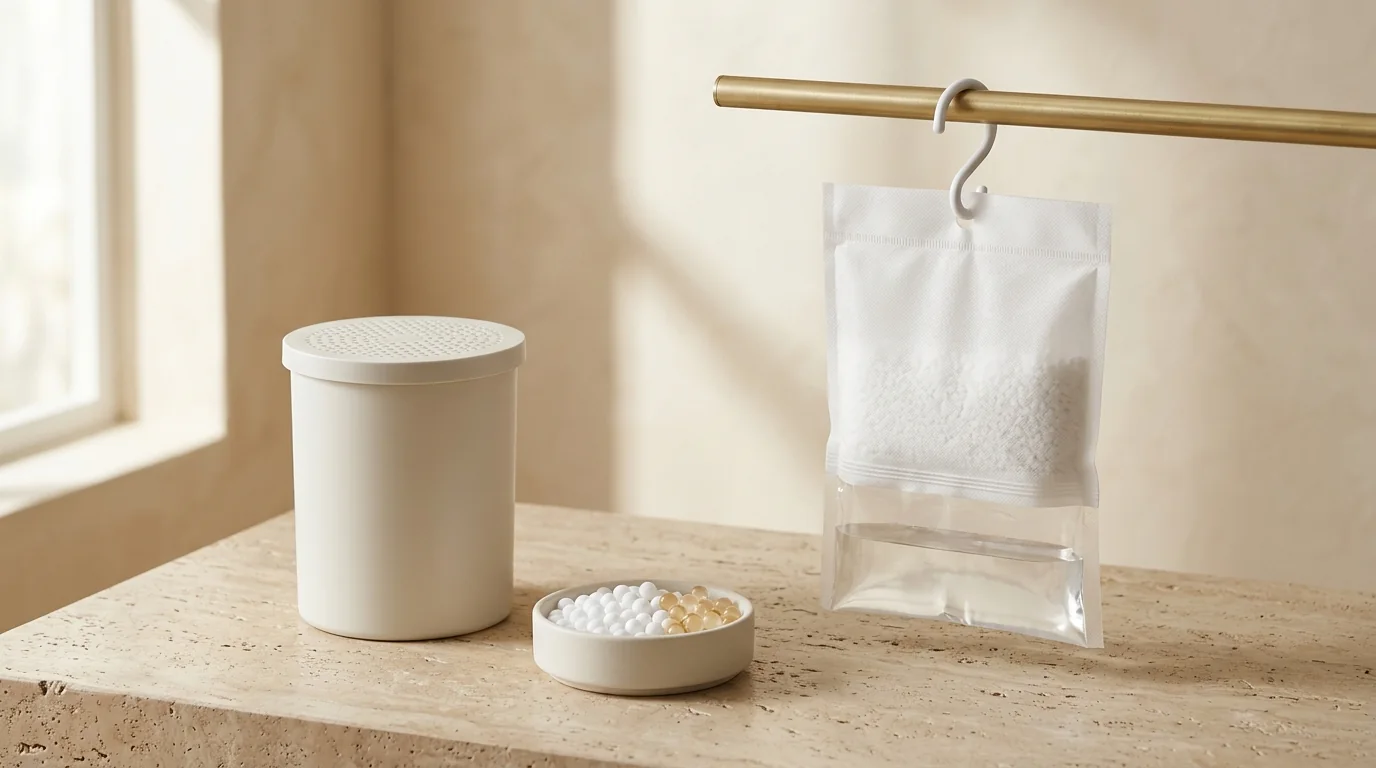
Quick answer: A private label scented moisture absorber fails or succeeds on four engineering interfaces rather than fragrance oil alone: calcium chloride physical grade (anhydrous 94% prills vs. 74% dihydrate flakes), one-way breathable membrane sealing (SMS non-woven + microporous film weld strength), fragrance bead isolation (preventing hygroscopic brine from hydrolyzing perfume notes), and high-barrier outer overwrap to stop pre-activation during ocean freight. Across LoyalCrafts' 11,000 sq m Jinhua facility, custom private label moisture absorber runs carry a 10,000-unit custom MOQ planning reference with up to 30 days reference duration, 1–3 day stock samples, and 7–14 day custom evaluation builds.
Retail buyers sourcing hanging wardrobe dehumidifier bags or countertop closet tubs for humid coastal markets—Japan, South Korea, Southeast Asia, the UK, or the U.S. Gulf and East Coast—rarely lose accounts because of a weak top note. Post-launch chargebacks almost always stem from physical containment failures: hairline heat-seal pinholes weeping corrosive calcium chloride brine onto cedar closets, rigid tubs tipping in transit without a gel-lock binder, or pouches arriving partially clumped inside a humid sea container because the outer barrier bag had an insufficient moisture vapor transmission rate (MVTR).
At our Jinhua plant—backed by fragrance manufacturing experience since 1998 and 6 automated assembly lines—our scented moisture absorber OEM team engineers the desiccant grade, membrane laminate, fragrance bead carrier, and outer barrier film as one sealed system. Use this guide to lock technical parameters inside your RFQ before paying for gravure cylinders or injection-mold tooling.
1. Choose Your Desiccant Form, Vessel Architecture, and Brine Containment
Procurement specs often ask for "a 250 g hanging closet bag" or "a 500 ml scented moisture tub" without distinguishing between calcium chloride purity or brine state after saturation. Those two choices dictate shelf density, leak risk, freight weight, and unit cost:
| Product architecture | Desiccant & binder chemistry | Brine containment & leak risk | Fragrance delivery mechanism | Tooling & print MOQ drivers | Primary retail channel fit |
|---|---|---|---|---|---|
| Dual-Chamber Hanging Bag (Liquid Reservoir) | Anhydrous CaCl2 spheres (94% grade) or 74% dihydrate flakes | Upper breathable membrane feeds liquefied brine into lower transparent PE/PA weld pocket | Separate upper scented polymer/EVA beads or sealed sachet strip | Gravure print film rolls & hanging hook injection tolerances drive 10,000-unit MOQ ref. | Wardrobes, garment racks, supermarkets, and dollar/variety chains |
| Hanging Bag with SAP Gel-Lock | CaCl2 prills blended with calibrated Superabsorbent Polymer (SAP) | Absorbed moisture converts into thick non-sloshing gel; resists burst if punctured | Isolated polymer fragrance beads suspended above gel zone | Higher raw-material BOM per gram than liquid-catch bags; same 10,000-unit film print run | E-commerce multipacks, parcel shipping, and travel/RV storage |
| Rigid PP Closet Tub (Liquid Drain Grid) | Flake or prilled CaCl2 resting on perforated inner shelf above catch basin | Top breathable film sealed over vented PP lid; brine drains visibly into lower cup | Scented beads seated in upper tray or vented cap chamber | Stock PP cup + custom sleeve/label vs. custom lid color; outer shrink/foil wrap needed | Under-sink cabinets, shoe racks, bathrooms, and home-improvement chains |
| Solid Gel-Lock Tub (Spill-Proof) | CaCl2 + SAP gel matrix inside vented rigid PP tub | Zero free-flowing liquid even when tilted; avoids carpet/wood floor damage if knocked over | Heat-resistant fragrance beads mixed in top vent compartment | Requires tight fill-weight tolerance so gel swell never pushes up breathable seal film | Pet-friendly households, boat/caravan cabins, and multi-pack club stores |
Why anhydrous 94% CaCl2 prills outperform low-purity flakes on premium SKUs: While 74% dihydrate flake lowers raw chemical cost per ton, it carries pre-bound water molecules that reduce net moisture uptake per gram of fill and compact into dense cakes during warehouse storage. Spherical anhydrous prills (typically 2–4 mm) retain higher theoretical uptake capacity, leave open interstitial air channels for vapor flow inside hanging bags, and dust far less on automated volumetric filling hoppers.
2. Engineer the One-Way Breathable Membrane and Fragrance Bead Isolation
A common assumption among first-time private label buyers is that fragrance oil can simply be sprayed directly onto calcium chloride pellets inside a single pouch. On the factory floor, direct dosing creates immediate failure modes.
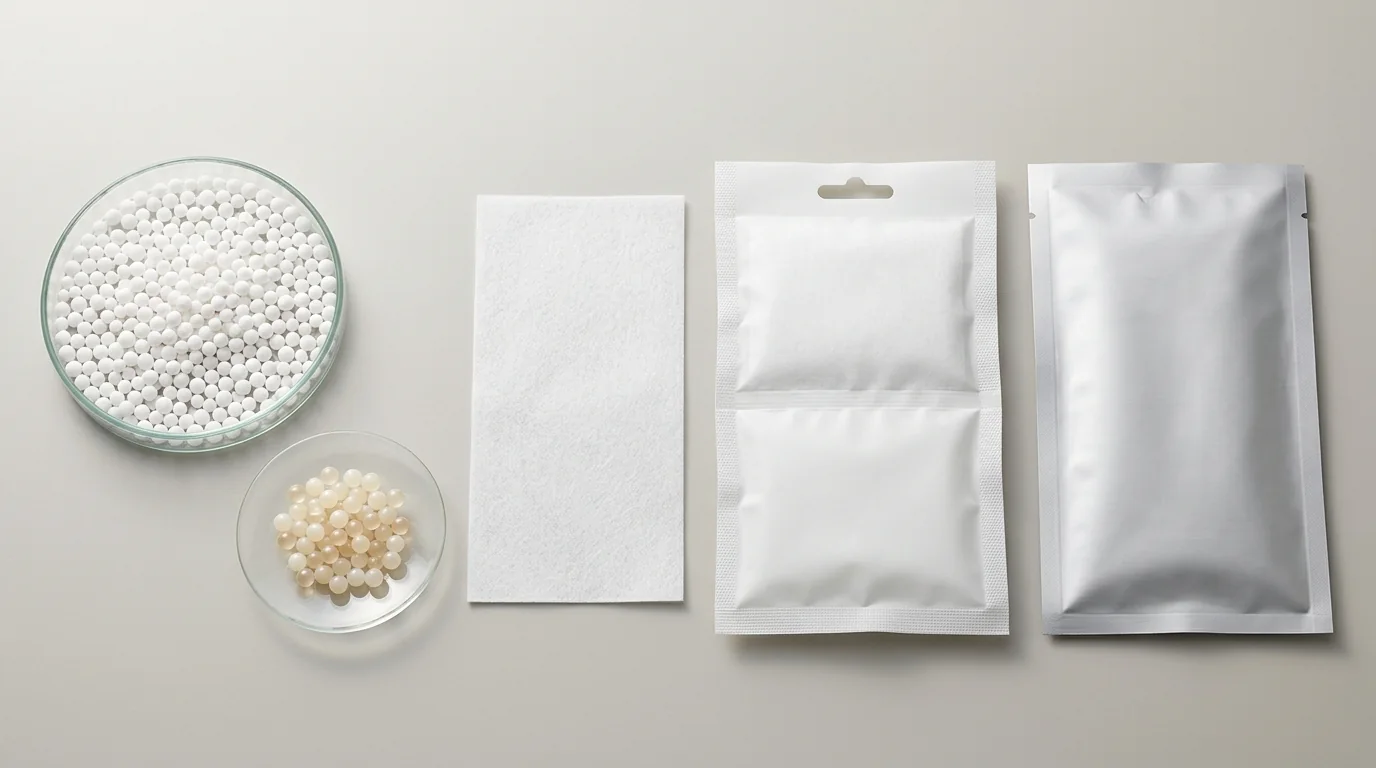
- Why fragrance must never be sprayed raw onto CaCl2: Calcium chloride is strongly hygroscopic and mildly exothermic during rapid hydration, while concentrated brine shifts local ionic strength and pH. Spraying raw liquid fragrance onto uncoated pellets accelerates ester hydrolysis, causes dark yellow discoloration, and clumps pellets against the breathable membrane—choking vapor ingress. Instead, LoyalCrafts encapsulates scent inside dry polymer, silica, or vermiculite fragrance beads housed away from direct brine immersion so the SKU maintains pleasant wardrobe freshness for up to 30 days (planning reference).
- One-way breathable laminate (SMS non-woven + microporous PE film): The active window must pass water vapor inward freely while blocking pressurized liquid brine from weeping outward if a saturated pouch is squeezed against hanging coats. Specify hydrostatic-head resistance and verify heat-seal platen temperature windows so the porous film melts cleanly into the back PE/PA sheet without scorching pinhole leaks.
- Perimeter weld width & hanging hook creep test: An empty 200 g–250 g hanging bag can absorb 400 ml–500 ml of water over its active cycle—tripling suspended mass on a single plastic hook. During Golden Sample review, verify wide perimeter heat seals (commonly 8–10 mm side/bottom seams with a reinforced center baffle weld) and run saturated load-hang testing at elevated warehouse temperatures so the punched hook slot does not stretch or tear.
3. Control Pre-Activation in Ocean Freight & Understand 10,000-Unit MOQ Economics
Unlike glass reed diffuser bottles or annealed candle jars that start around 500–1,000 units, custom scented moisture absorbers carry a 10,000-unit custom MOQ planning reference. Understanding the print-and-film bill of materials explains why splitting 10,000 bags across five different outer bag designs multiplies unit cost:
- High-barrier outer pouch (MVTR defense): Once filled on our automated line, the permeable window starts pulling ambient humidity immediately unless sealed inside a thick PE/PA or metallized PET/AL/PE barrier overwrap. During multi-week ocean transit through humid equatorial ports, thin OPP sleeves allow premature clumping before the SKU ever hits a store peg. Specify barrier film micron thickness and heat-seal integrity on every retail outer pouch or multi-pack master liner.
- Where the 10,000-unit MOQ comes from: Custom laminated roll stock—both the printed hanging bag back-film and the high-barrier outer overwrap—requires dedicated gravure printing cylinders per artwork color and minimum film-converting meterage per run. Running fewer than 10,000 units creates steep cylinder amortization and start-up film waste. If your brand needs lower entry minimums for wardrobe scenting, pair a shared stock-film or neutral-pouch test launch with lower-MOQ dry formats such as scented paper sachets (1,000 units/design ref.) or check our closet moisture absorber format overview.
- Carton stacking and crush protection: Rigid PP tubs stacked inside export master cartons require corrugated board grades (e.g., double-wall B/C flute) and internal dividers calibrated for 4-to-5-pallet-high warehouse racking so perforated top lids never crack or pop their foil freshness seals during sea freight.
4. Regulatory Boundaries: Honest Humidity Claims, EU CLP, U.S. CPSC FHSA & PPWR
Because calcium chloride is an active industrial desiccant salt rather than a simple wood-chip sachet, marketing copy and packaging hazard panels require tight legal alignment:
- Honest claim scoping (U.S. EPA Moisture Guidance): The U.S. Environmental Protection Agency emphasizes that controlling indoor moisture (ideally keeping relative humidity below 60%, and between 30%–50% where practical) is key to preventing mold growth. Position scented moisture absorbers accurately as passive localized humidity and odor-control aids for enclosed closets, lockers, and storage bins—never as structural leak repairs or mold-remediation treatments.
- U.S. CPSC FHSA & EU CLP (EC No 1272/2008) Hazard Labeling: Solid anhydrous calcium chloride and concentrated brine are typically classified as serious eye irritants (e.g., EU CLP Eye Irrit. 2 / H319, GHS07 exclamation-mark pictogram, Warning signal word) and trigger household irritant cautionary panels under the U.S. Federal Hazardous Substances Act (16 CFR Part 1500). Always lock project-specific SDS sheets, keep-out-of-reach-of-children icons, first-aid eye-flush instructions, and clear liquid disposal instructions (pour brine down drain with running water; never reuse container) before releasing print plates.
- IFRA Standards & EU PPWR Packaging Design: Request project-specific IFRA documentation (non-skin-contact Category 12 for enclosed air-care use) covering the encapsulated fragrance bead oil, and review our EU PPWR home fragrance packaging checklist and B2B fragrance compliance document guide when specifying mono-material PP tubs or recyclable outer cartons for Europe.
5. Blank Moisture Absorber Golden Sample & Pre-Production Sign-Off Sheet
Copy this acceptance template directly into your purchase specification before releasing film cylinders or carton printing. As LoyalCrafts planning references, custom moisture absorber MOQ starts at 10,000 units, stock format samples ship in 1–3 days, custom scent/artwork samples prepare in 7–14 days, and bulk production runs 30–40 days after Golden Sample sign-off and deposit.
| Inspection checkpoint | Engineering spec & verification protocol | Target acceptance criteria | Status & owner |
|---|---|---|---|
| CaCl2 grade & net fill weight | Confirm anhydrous prill vs. dihydrate flake purity, net desiccant weight (g), and optional SAP gel-lock ratio on calibrated scale | Consistent granule size; net fill within agreed +/- tolerance; free-flowing dry granules prior to activation | To record |
| Fragrance bead isolation & throw | Verify physical separation of scented polymer/mineral beads from CaCl2 bed and run enclosed-cabinet scent check | No discoloration or clumping on pellets; steady fresh scent release aligned with up to 30-day planning reference | To record |
| Breathable membrane & weld seal | Inspect perimeter weld width, baffled chamber divider, and perform inverted squeeze / hydrostatic leak test on saturated pouch | Zero brine weeping through breathable window or side seams; zero pinhole delaminations | To record |
| Hanging hook & saturated load test | Suspend fully hydrated bag (including brine mass) or test rigid tub lid lock under elevated temperature cycle | Hook neck and punched PE slot show zero tearing or creep detachment across test window | To record |
| Barrier overwrap & ocean transit | Check outer foil/PE-PA pouch heat seal, MVTR spec, and master-carton drop/stacking resistance | Zero premature caking after humidity-chamber conditioning; undamaged inner tubs/pouches post-drop | To record |
| CLP / FHSA & IFRA file alignment | Verify batch SDS, IFRA certificate for scent beads, irritant signal words, disposal guide, and retail barcodes | Approved bilingual/local warning panel matches destination customs and retail compliance audit | To record |
Ready to spec a private label hanging dehumidifier bag, gel-lock closet tub, or coordinated wardrobe-care range? Explore our home fragrance OEM/ODM factory capabilities and scented moisture absorber product specs, or send your format choice, target net fill weight, fragrance direction, and destination market via our B2B OEM inquiry form.
FAQs
Why is the custom MOQ 10,000 units for private label scented moisture absorbers?
As a planning reference, custom moisture absorber orders start at 10,000 units because custom-printed multi-layer pouch films (both the breathable inner hanging bag and the high-barrier outer overwrap) require dedicated gravure print cylinders and minimum laminate film converting runs. Brands seeking smaller multi-SKU trials can evaluate existing stock formats (1–3 days sample dispatch ref) or start with lower-MOQ wardrobe formats like scented paper sachets (1,000 units/design ref).
Should private label buyers choose liquid-reservoir hanging bags or SAP gel-lock absorbers?
Liquid-reservoir dual-chamber bags let consumers visibly watch collected water accumulate—driving strong repeat purchase in supermarkets and variety stores at a lower unit BOM. SAP gel-lock systems solidify absorbed brine into a thick non-pouring gel, making them safer for e-commerce parcel shipping, pet homes, or rigid tubs placed above hardwood floors and delicate upholstery.
Why cannot fragrance oil be sprayed directly onto calcium chloride pellets?
Calcium chloride absorbs ambient moisture rapidly and turns into high-ionic-strength alkaline brine, which hydrolyzes delicate perfume esters, yellows the salt bed, and glues pellets against the breathable membrane. Housing fragrance inside separate polymer, silica, or vermiculite scent beads keeps both moisture uptake and scent release predictable across the product's service cycle.
What compliance documents and warning labels are required for exporting moisture absorbers?
Because calcium chloride is typically classified as an eye irritant (such as EU CLP Eye Irrit. 2 / H319 and U.S. CPSC FHSA household irritant criteria), importers should request a batch Safety Data Sheet (SDS), project-specific IFRA documentation for the fragrance beads, and verified keep-out-of-children, eye-flush, and drain-disposal warning copy tailored to each destination market before printing packaging.